
Gulf UV: Pool Cover Fabric & Slat Lifespan
Plan pool-cover replacement in Gulf UV: inspect fabric and slats, compare prorated warranty terms, and budget the full replacement scope.
An unexpected fabric replacement can leave a Gulf pool owner paying for transport and site work even while a warranty is active. Plan pool-cover fabric and slat lifespan around documented condition, the exact warranty and a compatible replacement record.
There is no verified Gulf replacement interval in the sources reviewed here. A supplier's foreign-market lifespan range can inform a discussion, but the cover's condition and supplied instructions determine the next service action. Keep fabric, slats, drive components and site costs separate when comparing warranties or budgets. The checks below help a contractor prepare a replacement inquiry without promising a fixed number of years.
Updated October 2026. First published August 12, 2026. Sources and method.
How long should cover fabric last in Gulf UV?
Use a published lifespan as a product-specific reference, then inspect the actual cover. A Canadian supplier FAQ gives approximately 6–8 years for its automatic-cover material, depending on use and location. That is neither a Gulf field result nor a deadline for replacement. It also does not establish that every US or Canadian site receives less UV than every Gulf site.
The OEM inspection manual reviewed for this update connects fabric deterioration with exposure to chemicals, heat and sun. Abrasion at the track edge adds another failure path. Sun exposure, cleaning, water treatment, installation and maintenance history therefore belong in the order file alongside the installation date.
A statement such as “UV tested” needs its test report. ASTM G154-23 describes operating fluorescent UV and water exposure apparatus; the practice alone does not deliver a specific result. Ask for the exposure conditions, measured property and acceptance criterion. Test hours alone do not establish years of Gulf service.
Which signs call for a service review?
Cracking, brittle areas, exposed reinforcement and damaged edge webbing need prompt review by the cover service team. A running motor does not establish that the cover surface is sound. The Cover-Pools manual identifies these inspection locations; follow the instructions for the system actually installed.
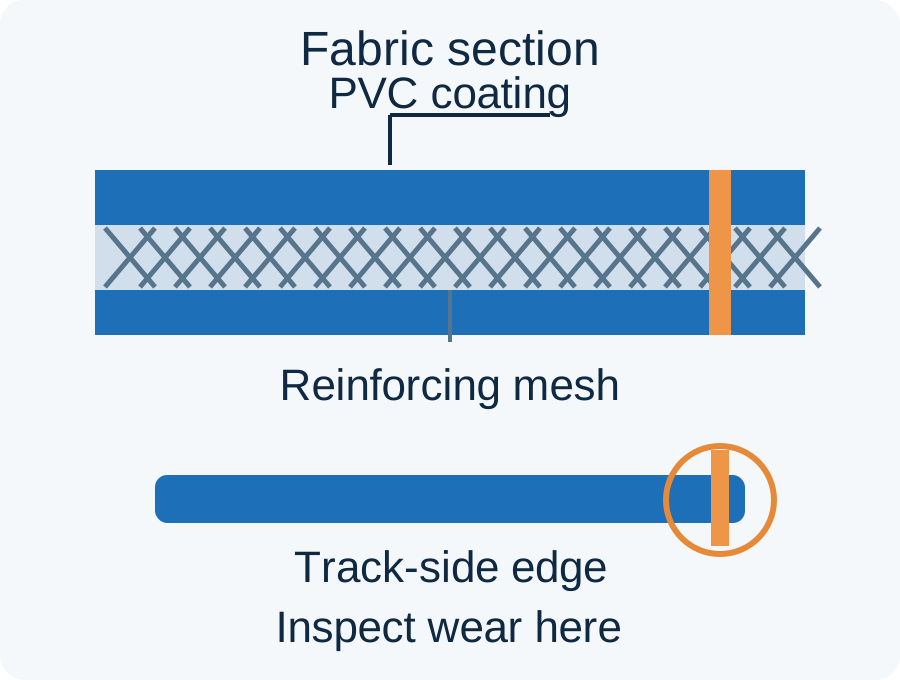
Fabric section and track-side edge, schematic only. Look for exposed reinforcement and edge damage; the drawing is not a test sample or a thickness specification.
| Observed condition | Dominant failure mode & prevention | Next action |
|---|---|---|
| Fabric feels stiff, cracks, or exposes its mesh | Loss of coating integrity; maintain the specified care and water-treatment regime | Record the extent and ask the service team whether approved repair or whole-fabric replacement is appropriate |
| Frayed webbing or damage near a track | Edge abrasion or attachment deterioration; remove debris and have alignment and track condition checked | Arrange prompt inspection of fabric, attachment and track together |
| A damaged slat joint or end cap | Loss of fit at the connected section; confirm the exact profile and approved repair method | Ask whether a matching section can be replaced and whether adjacent parts also need attention |
For a cover with suspected safety-related damage, have the site team secure pool access and obtain qualified service advice before relying on it as a barrier. Do not walk onto the cover to inspect it. Calendar age, fading alone and a photograph cannot certify its condition.
What will a prorated fabric warranty actually cover?
Compare the remedy and calculation basis before the headline number of years. The FAQ reviewed here advertises seven years, while its linked fabric certificate is an older six-year document. Obtain the dated warranty supplied with the particular order, including its regional applicability.
Record the starting event, full-coverage period, prorated period, eligible material or factory work, excluded site work and claim procedure. Manufacture, shipment and installation are different dates. Keep mechanism and motor terms separate from fabric or slat terms.
A prorated schedule may count all elapsed months, including the initial full-coverage period. It may also calculate a replacement charge rather than promise a cash refund. Use the contract's actual method.
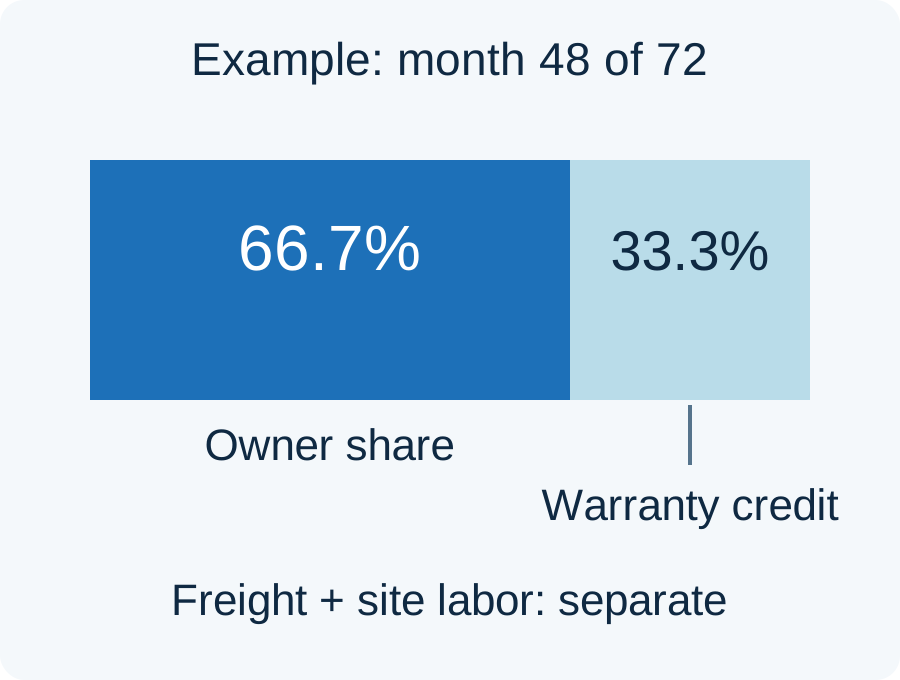
Hypothetical material-only example. The eligible claim, price basis and separate freight and site costs still need confirmation.
Assume a schedule with 30 initial full-coverage months and a total of 72 months, followed by an owner charge of elapsed months divided by 72. At month 48:
Owner's material share = 48 ÷ 72 = 66.7%; remaining material credit = (72 − 48) ÷ 72 = 33.3%.
This demonstrates the arithmetic in an older published certificate, not a current PoolProject warranty or a replacement forecast. Apply a credit only after the supplier accepts the claim. Removal, refitting and freight may remain payable even when the material remedy applies.
Do slats make replacement cheaper?
An individual-section repair can change the cost scope if the supplier approves it and compatible parts remain available. Do not assume that any PVC or polycarbonate slat can connect to the existing cover, or that a longer warranty predicts longer Gulf service.
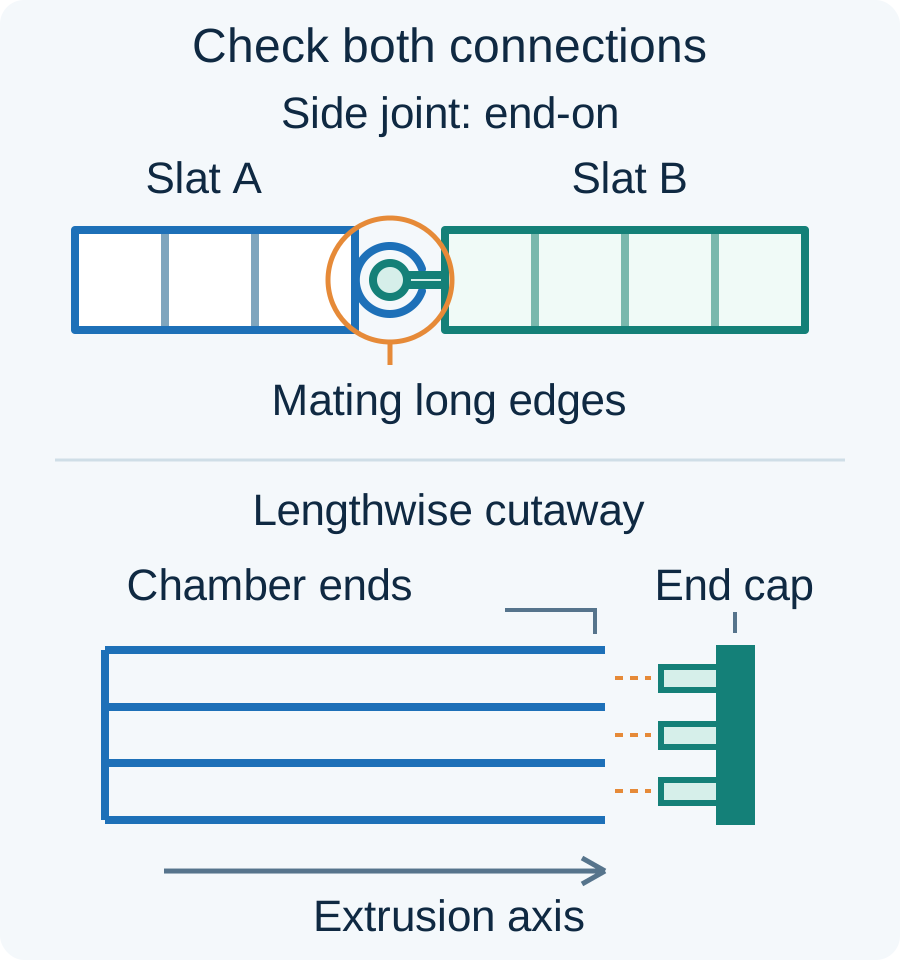
Generic profile schematic, not to scale. Joint shape, construction and end-cap details must match the approved replacement.
If the supplier cannot confirm joint and end-cap compatibility, keep the part unapproved for ordering. Compare the named profiles using the PVC and polycarbonate slat guide. Whole-fabric replacement and local slat repair have different scopes; either can require additional drive, attachment or track work after inspection.
Build a replacement budget over the same period
Compare both options over the same owner-selected planning period, using quoted costs and condition-based scenarios. An overseas fabric price omits local access, freight, duty and fitting. A fixed replacement count would hide the uncertainty this budget needs to show.
Period cost = initial installed cost + care and inspections + approved replacement events + associated freight, tax and site work + documented downtime cost − accepted warranty credits.
| Cost line | Fabric option | Slat option |
|---|---|---|
| Replacement material | Quote the complete approved fabric assembly and included edge/rope items | Quote approved individual sections and a wider replacement scenario |
| Site labor and access | Removal, fitting, track/drive inspection and recommissioning | Access to affected sections, fitting and system inspection |
| Logistics and hidden costs | Freight, packing, duty, taxes, disposal and any recorded downtime | The same cost categories, including any minimum order or matching-parts constraint |
| Warranty | Accepted remedy and its price basis, entered once | Accepted component remedy and exclusions, entered once |
For labor planning, site labor cost = quoted crew-hours × hourly crew rate. Hypothetical input: a two-person crew working three hours uses 2 × 3 = 6 person-hours; multiply by the quoted per-person hourly rate. This is an estimating example, not a job-duration promise. Use either person-hours or crew-hours consistently.
For a new system, compare this scope with the automatic pool cover supply quotation before the client signs.
Keep the order record ready for replacement
Start the replacement slats, fabric and spares inquiry with the original order reference and current condition. An archive reduces guesswork, but the supplier must still confirm fit and availability.
| What to send us | Why it matters | Example format |
|---|---|---|
| Order reference and original dimensions | Identify the supplied configuration and compare current measurements | Order number and dimensioned drawing |
| Fabric or slat reference, batch and edge/joint details | Check material and attachment compatibility | Label photo, close-ups and profile record |
| Motor model, track arrangement and installation date | Separate surface replacement from other system work | Nameplate photo and handover record |
| Warranty page, dates and maintenance history | Identify the applicable remedy and exposure history | Original PDF, dated service notes and current damage photos |
Send those records through the project quotation route. PoolProject coordinates China-side supplier configuration and documentation review; installation, maintenance and any warranty remedy remain with the site team and the supplier's terms. Ask for material, logistics and site-work exclusions as separate quotation lines.
Method, sources and update
Reviewed October 20, 2026. This update compares published product guidance and original documents; it does not assign a Gulf lifespan or a material-performance threshold. The cost formulas are planning tools using buyer inputs.
- Supplier FAQ and its linked fabric warranty: service-life reference, headline/document discrepancy and historical prorating example. The linked certificate is L9828, revised January 12, 2010. FAQ and original certificate.
- OEM owner manual 800210 REL-0003, pages 10, 12 and 15: track cleaning, fabric care and deterioration inspection. Cover-Pools owner manual.
- Public scope and significance sections only: ASTM G154-23, UV/water exposure apparatus practice. No claim that a supplied cover has passed a test.
The August 12 publication date is retained. This revision adds condition checks, warranty arithmetic, compatible-part questions and a fuller replacement budget.