
Check GCC Pool Equipment Power Before You Order
A contractor checklist for matching pumps, heat pumps, controls and lights to the project voltage, frequency, phase and nameplate data.
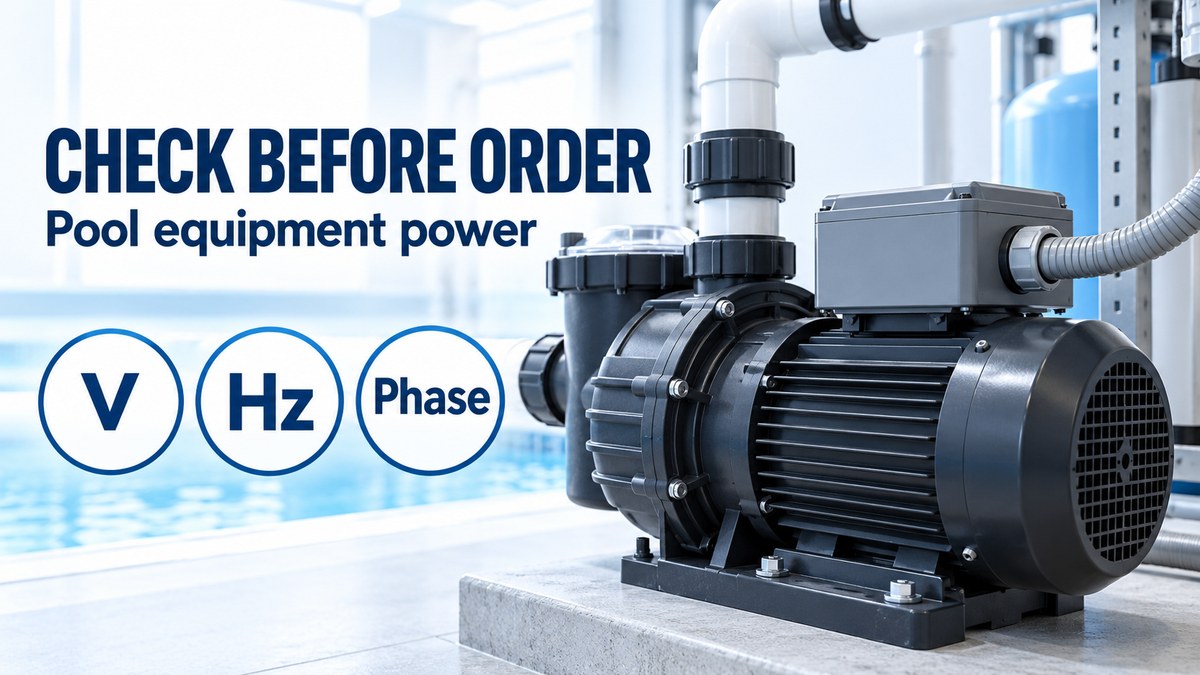
Updated October 2026
A pump can meet the hydraulic duty and still arrive in the wrong electrical version for a GCC pool project. Put voltage, frequency and phase on every powered BOM line, then match the approved model to the actual nameplate before shipment.
Approve the electrical version line by line, using the project schedule, the offered model's datasheet and the shipment evidence together. This checklist covers pumps, heat pumps, chillers, controls and pool lights. It helps contractors close procurement gaps; the appointed electrical engineer approves the design and local installation requirements.
Record the supply at each equipment connection
Start with the approved single-line diagram and equipment schedule, rather than a country label. Keep these fields beside the model reference in your pool equipment package.
Input or item | Value or source to record | Why it matters |
|---|---|---|
Equipment supply | Voltage in V, AC/DC where relevant, frequency in Hz and phase from the approved schedule | Defines the version to quote; record line-to-line or line-to-neutral voltage explicitly |
Motor or complete unit | Full model suffix, datasheet revision, rated current and electrical input; motor output separately where given | A kW figure alone does not identify the supply or running current |
Controls and lighting | Control supply, signal/interface type, driver/transformer input and output | The controller, driver and end device may have different ratings |
Site conditions | Engineer-approved ambient, enclosure/location and generator or UPS conditions | Checks the offered equipment against the actual installation |
Approval evidence | Schedule revision, supplier datasheet, confirmation owner/date, later nameplate and packing references | Keeps substitutions and unresolved values visible |
Do not use “GCC standard” as a specification
Confirm the project supply with the consultant or local utility. Do not copy it from another country or a previous job in the same city.
Saudi Electricity Company's September 2022 external circuit-breaker specification describes 230/400 V, 60 Hz LV supplies in §6.15. That is useful context, rather than proof of the connection available at your plant room. Record the approved site voltage and phase as well as frequency. For other GCC destinations, obtain the same project-specific confirmation.
Hold rule: if the required frequency is 60 Hz and the offered datasheet specifies only 50 Hz, keep the line open until the supplier identifies a suitable version and the buyer's engineer accepts it. Treat a voltage outside the offered input range or a phase mismatch the same way. A “50/60 Hz” marking closes only the frequency question; check its associated voltage, current and duty ratings too.
Why frequency changes the equipment selection
For an AC induction motor, the rotating magnetic field's synchronous speed depends on frequency and pole count. The engineering baseline is:
nₛ (rpm) = 120 × f (Hz) / p (number of poles)
Worked example with an assumed two-pole motor: 120 × 50 / 2 = 3,000 rpm; 120 × 60 / 2 = 3,600 rpm. Actual induction-motor shaft speed is lower because of slip. These field-speed calculations explain why a different-frequency datasheet needs review; they do not establish the delivered pump flow, head or input power.
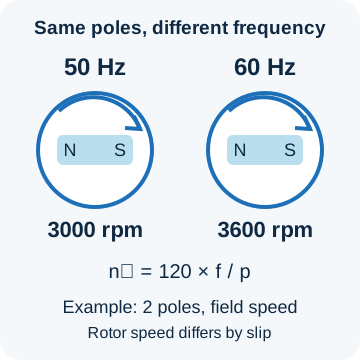
Same pole count, different field speeds. Use the exact pump curve and electrical data for the offered version, rather than converting a catalogue duty from this diagram.
The 50 Hz and 60 Hz versions of one family may have different model references and performance data. For pumps and blowers, review the required duty on the offered version's curve. Keep that curve with the electrical block in the BOM.
Check the interfaces where mismatches hide
Review the complete unit and its connected devices. A matching main supply leaves control and lighting interfaces to confirm.
Equipment | Evidence to compare | Dominant failure mode & prevention |
|---|---|---|
Pump or blower | Exact model, frequency-specific duty curve, motor rating and current | Wrong version misses the approved duty or electrical requirement; accept only the matching curve and rating |
Heat pump or chiller | Complete unit code, electrical input/current, design conditions and required protection data | Thermal output kW is mistaken for electrical input; obtain both ratings and the engineer-approved selection |
Dosing and controls | Supply, sensor type, output/signal, control voltage and BMS interface | A physically matching connector conceals an incompatible signal; confirm the interface documentation |
Underwater lighting | Driver or transformer input/output, AC/DC type, lamp rating and control system | Lamp and supply components do not match; review them as one set under the approved pool electrical design |
VFD and motor | Drive input/output, motor compatibility, current, approved speed range, enclosure and control requirements | A drive is assumed to correct any mismatch; obtain approval for the complete drive/motor arrangement |
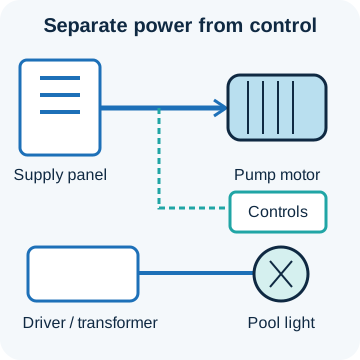
Conceptual interface map, not a wiring diagram. Record the ratings at both sides of each interface; the dashed control path is separate from motor power.
For heat pumps and chillers, confirm compressor and whole-unit data at the approved ambient design conditions. “220 V” does not define a complete unit. For lighting, separate mains supply, transformer or driver output, lamp voltage and control system.
A VFD does not automatically fix a mismatched order. The retrieved drive-maker FAQ, for example, rejects obtaining 460 V output from a 400 V input in the arrangement it describes. Request the exact drive and motor documentation rather than assuming frequency conversion also supplies the required voltage.
IEC 60364-7-702:2010 covers electrical installations associated with pool basins and surrounding zones. Its public abstract establishes that scope; it does not establish a project's local approval or an equipment certificate. Have the appointed engineer confirm the applicable requirements, protection, bonding, equipment location and installation arrangement.
Add one electrical block to the project BOM
Use this order for each powered item:
item / full model / duty / supply V / Hz / phase / electrical input and current / motor output if given / control or driver interface / status / owner / date
Mark unknown values TBC and give each an owner and confirmation date. The pool equipment BOM checklist and BOM template keep this block connected to quantities, hydraulic duties and interfaces. Note breaker/protection requirements, cable-route responsibility, generator or UPS conditions and any BMS interface at project level for the electrical engineer to resolve.
Before approval, compare the offered datasheet with the project requirement. Before packing, collect model and nameplate photographs under the agreed quality inspection scope. Link the photographed item to its BOM line and packing record, using serial or other agreed unit identification where available. A generic catalogue image cannot identify the shipped unit.
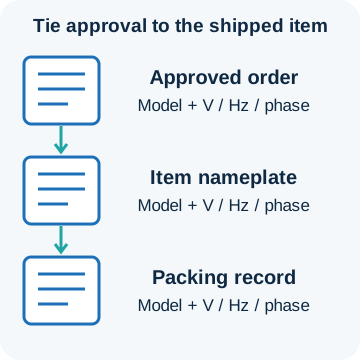
Keep model and electrical ratings consistent across the approved order, actual equipment and shipment record. Resolve differences before release.
Hold shipment review when the documents disagree. Record the discrepancy, the supplier's proposed correction and the buyer's written acceptance; update the same BOM revision before release. Saudi-bound equipment also needs consistent model and rating data across the technical file, label and shipment record. Use the SABER and SASO preparation guide early, while the equipment list can still be corrected.
Compare the cost of a usable package
Compare quotations over the same operating period and installation scope. Use this cost structure: package cost = purchase + correction/reinspection + additional freight + site rework + downtime + operating energy over the agreed period. Enter project quotations and documented assumptions in each term. Count a cost once, and compare electrical input at the same duty and operating schedule before calculating energy.
A lower equipment price can lose its advantage if the motor version requires replacement, the controls require redesign or the shipment waits for documents. Resolving those items before packing makes the comparison useful without assuming a fixed saving or inventing a payback period.
What to send us
For equipment sourced from China, we collect supplier datasheets, check model references and arrange order-specific photographs. Final design and approval belong to the project electrical engineer; installation follows local requirements.
Item | Why we need it | Example format |
|---|---|---|
BOM and duty schedule | Connect each powered item to its quantity, duty and open questions | Spreadsheet with full model or TBC |
Approved electrical information | Compare V/Hz/phase and interface requirements | Schedule or relevant single-line PDF extract with revision |
Supplier or existing equipment details | Identify the offered version or replacement | Datasheet and readable model/nameplate photos |
Destination and approval status | Identify the responsible reviewer and shipment hold points | Country/city, confirmation owner and required document list |
Send the equipment BOM for a quotation review. Choose the equipment BOM option, then attach the schedule and photographs in WhatsApp. Mark values under review as TBC so we can organize the missing supplier information against the same list.
Method and sources
Updated 20 October 2026: expanded the electrical input fields, frequency example and shipment evidence checks. First published 15 July 2026. The checklist is a procurement sequence; it supplies no cable sizes, protection settings or permission to alter equipment.
- Saudi utility LV specification, 37-SDMS-05 Rev.02, September 2022, §6.15: the stated supply context.
- Motor engineering manual, §6.3–6.4, printed page 54, retrieved 20 October 2026: frequency, synchronous speed and slip. Its model-specific submersible-motor limits are not used as pool-equipment limits.
- Drive-maker FAQ FA265119, updated 3 August 2026, retrieved 20 October 2026: the input/output voltage example.
- IEC pool-installation scope, IEC 60364-7-702:2010 public abstract, retrieved 20 October 2026: basins and surrounding zones, without presuming local adoption.