
Stainless Pool Ladders and Handrails: Anchor Socket vs Flange
Compare pool ladder and handrail fixing assemblies, check tube diameter and wall thickness, and dimension the reach across an overflow gutter before ordering.
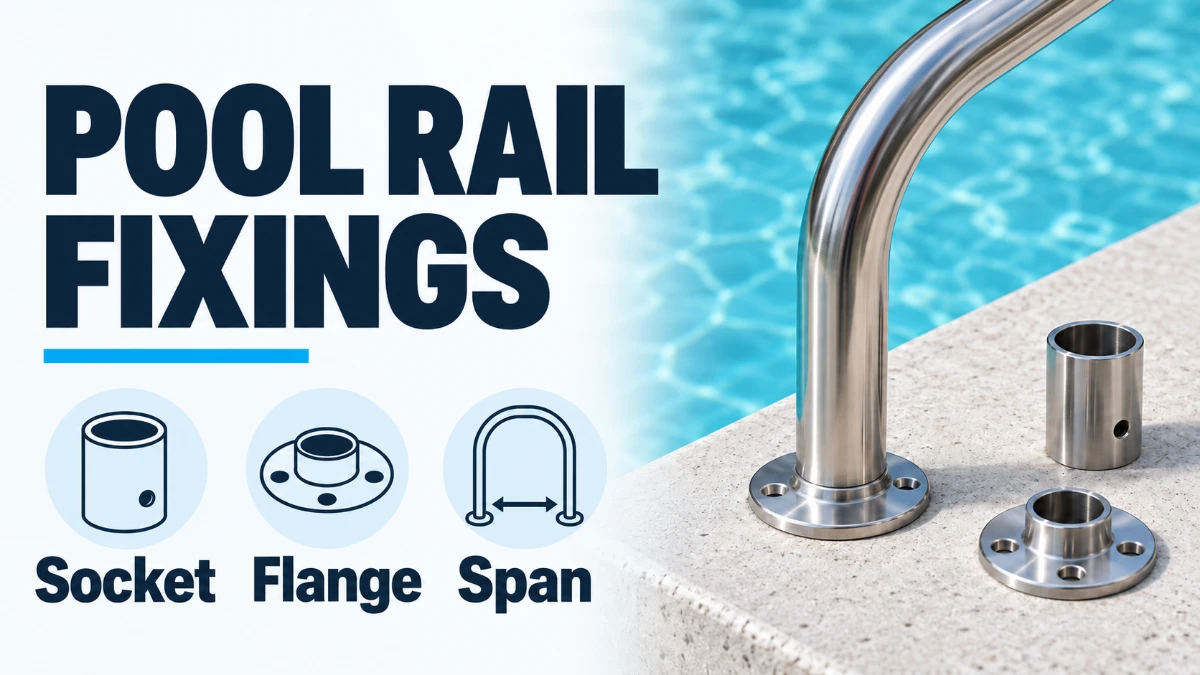
An incorrect anchor can turn a stainless-steel pool handrail or ladder order into deck rework. Choose an anchor socket or deck flange as part of the complete, intended-use assembly, then check the tube fit and gutter span against the same site drawing.
For a new deck, review embedded sockets before the concrete and bonding details are closed. For an existing deck, review both a socket retrofit and an approved surface-mounted assembly against the substrate. A flange sold for a pool ladder does not automatically suit a handrail. This guide covers the fixing and drawing handoff for swimming pool grab rails and ladders; the selected product manual and local engineer determine the installed design.
| Input | Record on the drawing | Decision it controls |
|---|---|---|
| Rail and tube | Ladder or handrail; outside diameter D; wall t; grade and finish | Mating socket, wedge or flange part |
| Site and fixing | New or existing deck; structural section; centres; exact fixing kit | Installation feasibility and approval |
| Overflow edge | Anchor centre line, both gutter edges, pool wall and rail projection | Required reach and removal access |
Anchor socket vs deck flange: what changes?
An embedded socket receives the rail below deck level; a wedge-type socket locks the tube with a matching wedge assembly. A deck flange fixes an above-deck interface to its supporting structure. Compare the actual part references and permitted application before comparing installation effort.
The primary anchor catalogue separates sockets, wedges, escutcheons and flanges. Its ladder-flange family explicitly excludes handrails. That restriction belongs to those parts, but it shows why a matching-looking base is insufficient evidence of suitability. See the assembly source note.
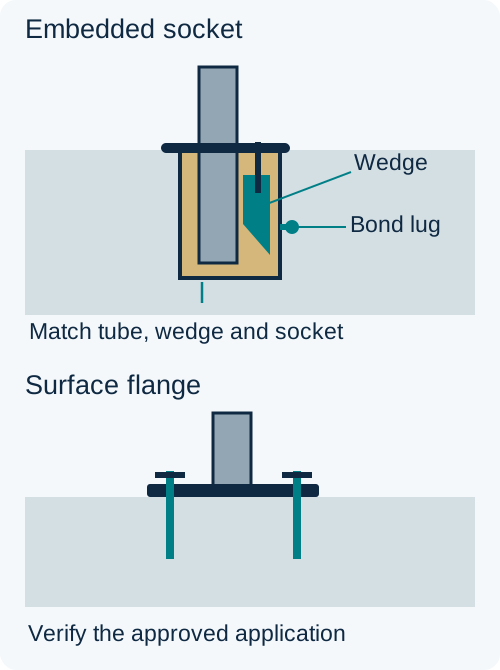
Socket and flange interfaces showing the wedge lock, bonding terminal and deck fastener positions; confirm exact dimensions, fasteners and load path on the manufacturer's assembly drawing.
| Arrangement | When to review it | Dominant Failure Mode & Prevention |
|---|---|---|
| Embedded wedge socket | New concrete work, or a retrofit with approved space and anchoring detail. Confirm insertion depth, centres, level, plumb and removal route. | Movement or inability to insert the rail from mismatched parts or misaligned sockets. Match the tube/wedge/socket set and verify centre lines before fixing. |
| Surface-mounted flange assembly | A specific ladder or handrail assembly approved for that mounting method, with a verified supporting deck and fastener design. | Movement at the base or fixing failure from an unsuitable flange or substrate. Obtain the intended-use documentation and engineered fastener/substrate detail. |
| Replacement in existing anchors | Only after identifying the installed anchor and checking condition, bore, locking system, centres and available depth. | A visually similar tube seats poorly or cannot lock. Confirm the exact mating parts and fit before releasing the replacement order. |
An escutcheon hides the opening or hardware; its appearance does not establish structural restraint. For a retrofit, have the local team check the underlying structure, waterproofing and concealed services before authorising drilling. Tile thickness alone cannot define the anchoring detail.
Selection rule: if the manufacturer does not permit the flange for the proposed handrail or commercial pool ladder, reject that combination. Neither a larger base nor a “heavy duty” description supplies the missing approval. Start with the intended use on the pool handrail specification page or the stainless-steel pool ladder page.
Check 42.4 mm or 48.3 mm outside diameter separately from wall thickness
Write the exact outside diameter and wall thickness as separate fields. If the drawing requests 42.4 mm and the offer says 48.3 mm, the diameter difference is 5.9 mm. Treat it as a design change requiring mating-part review, rather than rounding both to a nominal size. Confirm both dimensions against the mating socket or flange specification before approving a change.
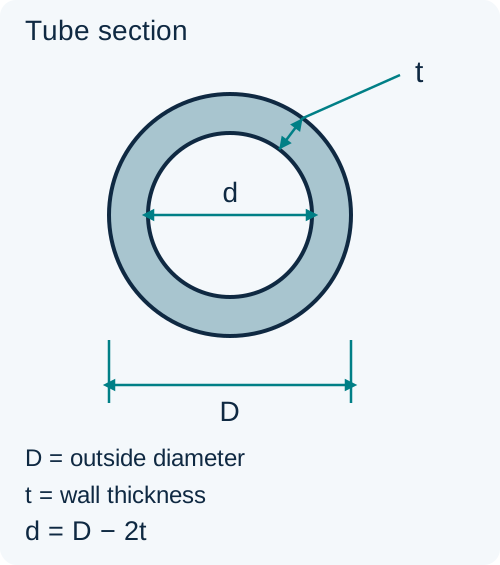
D measures the outside of the tube; t measures one wall; d is the internal diameter. Section proportions are schematic.
For a circular tube, the geometric relationship is d = D − 2t. Example calculation (assuming D = 42.4 mm and t = 2.0 mm): d = 42.4 − 2 × 2.0 = 38.4 mm internal bore. Match the outside diameter and wall thickness to the manufacturer's socket clearance, wedge kit and structural load table.
Ask the supplier to show the rail and mating anchor references on one drawing, including insertion depth and any internal spigot or locking component. Have the responsible engineer review wall thickness with the complete shape, supports and intended loading. A change to D or t can affect fit even when the overall rail outline stays the same.
For a replacement, send the old part reference, measured dimensions and clear photos of the locking mechanism. Agree dimensional acceptance and any sample fit check before production. Material grade is a separate decision; use the SS304 vs SS316 pool fittings guide with the project water and exposure conditions.
Dimension reach across an overflow gutter from named datums
Gutter width alone does not define ladder or handrail reach. Mark the anchor centre line, the dry-side edge and pool-side edge of the gutter, and the specified pool-side rail datum on one section. Define the supplier's “reach” or “span” endpoints explicitly; catalogue terms may refer to different dimensions.
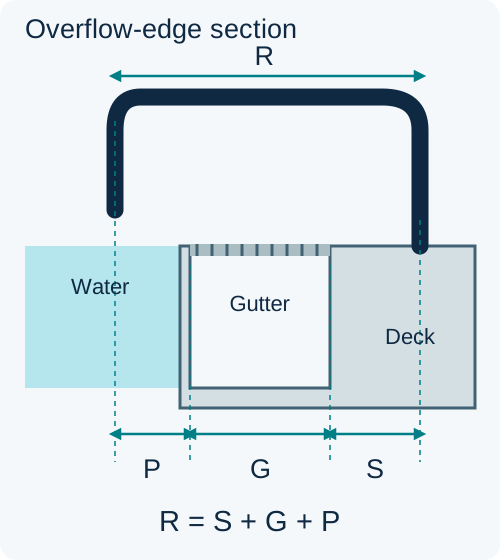
For this drawing convention, S runs from the anchor centre line to the dry-side gutter edge; G crosses the gutter; P continues to the chosen pool-side rail datum. Transfer actual site dimensions for S, G and P onto the approval section.
The horizontal drawing chain is R = S + G + P. Example calculation (assuming S = 90 mm, G = 250 mm and P = 120 mm): R = 90 + 250 + 120 = 460 mm. Replace S, G and P with measured site datums and compare R against the offered rail's centre-to-datum span.
Geometry rule: if the offered reach is less than the required drawing chain, measured between the same datums, stop the order and revise the geometry. If it equals or exceeds it, continue the checks: that inequality alone does not approve the installation. More reach changes the geometry and loading that the engineer must review.
Also dimension the rail height above finished deck, anchor-to-anchor spacing in plan, rail insertion depth, pool water level, wall contact or bumper position, and tread arrangement for a ladder. Show the complete lower ladder profile on the approval drawing even though the figure above isolates the horizontal chain. Record the gutter-grating removal envelope and rail removal route. Do not treat a removable grating as a structural support without an approved detail. Coordinate any nearby cover track or coping interface through the drawing and BOM review.
Specify bonding provisions and accessible maintenance
Include the exact bonding or equipotential-connection provision in the assembly review. Ask for the terminal location, compatible connection hardware and the manufacturer's electrical installation information. The qualified local electrical designer or installer must determine the applicable requirements and verify the completed arrangement; a terminal's presence alone does not prove electrical continuity or compliance.
The anchor catalogue identifies a bonding lug and drainage openings as separate socket features. Keep them identifiable in the submittal. A decorative cover, painted surface or ordinary fixing screw is insufficient documentation of the intended bonding path. Do not substitute a conductor size or torque from a different product or jurisdiction.
Plan access to inspect the socket, wedge and base. Manufacturer maintenance guidance calls attention to deposits, crevices and the waterline. Record water treatment, coastal exposure and cleaning access in the order, then obtain care instructions for the selected metalwork. Keep drainage provisions clear in accordance with the actual assembly instructions.
For public or commercial use, request the applicable design basis and product evidence. EN 13451-2:2015+A1:2020 addresses additional safety requirements and test methods for pool ladders, stepladders and handle bends, as identified in the current DIN catalogue. Confirm applicability and required test documentation for the exact assembly with the project consultant.
Compare the complete quotation and the same ownership period
Compare the installed scope over the same period, rather than the loose rail price. A socket quotation may omit the wedge, cover or site reinstatement; a flange quotation may omit fasteners, engineering checks or substrate work. Ask which items are included and which the site contractor supplies.
Use a buyer-entered cost worksheet: C(T) = landed assembly cost + site work + design and verification + maintenance over T + replacement/rework over T + pool closure cost over T. Use the same T, currency and operating assumptions for both options. Keep unknown costs blank for quotation; no fixed replacement interval or savings percentage follows from the fixing type.
Count visits to repair tiles or waterproofing, time to remove and reinstall the rail, access needed for inspections, and replacement-part availability. Keep the ordered part references and drawing revision with the maintenance record. Agree the order-specific inspection scope for dimensions, included parts, finish and packing; structural and electrical approval remain separate site responsibilities.
What to send us
| Item | Why we need it | Example format |
|---|---|---|
| Plan and edge section | Align fixing centres and gutter reach | Dimensioned PDF, datums S/G/P/R and revision |
| Tube and mating parts | Compare the complete assembly | D × t, grade, finish, socket/flange/wedge reference |
| Site and approval requirements | Identify review boundaries and documents | New/retrofit, substrate detail, intended use, bonding detail, water/exposure data |
| Quantity and destination | Prepare the supply quotation | Quantity per shape, city/country, required date and inspection scope |
Use the project quotation page, or open WhatsApp with the button below and manually send the drawing, existing-part photos and quantity. We coordinate China-side supply around the confirmed specification and agreed inspection scope. Ask the quotation to identify each included fixing component and any unresolved fitment input.
Method and sources
Updated 9 November 2026. The fixing comparison uses primary component documentation and geometric dimension chains; apply the selected assembly manual, current project specification and local approvals to the final installation.
Anchor assembly reference: Perma-Cast Product Guide, 2024 Rev A, printed pages 3–4 and 10. Socket anatomy and placement fields support the checks above. The handrail exclusion applies to the catalogue's listed ladder-flange family, not every surface-mounted handrail design.
- Standards scope: DIN Media, DIN EN 13451-2:2020-09, current catalogue entry for EN 13451-2:2015+A1:2020, checked 20 October 2026. Only the public catalogue scope is used here.
- Care: Fluidra stainless-steel aquatic-accessory maintenance document 00001E201-03, English guidance on deposits, crevices and water chemistry, retrieved 20 October 2026.
- Material context: IMOA, successful stainless swimming-pool design. Use exposure-specific review with the separate material guide.