
Commercial Sand Filter Backwash Rate Calculation: Bed Expansion, Water Temperature, and Media Depth
Calculate sand filter backwash flow, review water temperature and bed expansion, and prepare media-depth and drainage checks for your equipment schedule.
Updated
To calculate sand filter backwash rate for your commercial pool equipment schedule, start with the surface-loading relationship:
Backwash speed (m/h) x filter surface (m2) = Backwash flowrate (m3/h).
Different filter media need different backwash rates. Variations in media type, density, water temperature, effective size or uniformity coefficient might cause changes in the recommended backwash flow rate or bed expansion.
Work through the calculation, temperature check and commercial pool sand filter media depth review below. Keep the selected media specification beside the vessel drawing when completing the backwash section of your pool equipment package.
Calculate flow from velocity and filter area
Write the selected backwash speed and filter surface area into the formula above. Keep the media name and grade beside the speed entry; record the water temperature used for its selection.
Follow the manufacturer’s area and media-volume example
In the Dryden Aqua manufacturer example, filter surface = 0.8 m x 0.8 m x 3.14 = 2.00 m2.
Filter media volume (m3) = filter surface area (m2) x media bed depth (m).
In the same example, filter media volume = 2.00 m2 x 1.2 m = 2.4 m3.
For the first backwash, the Dryden Aqua AFM installation manual gives a velocity of 40 to 50 m/h (m3/h/m2).
Calculation example: 40 x 2.00 = 80 m3/h; 50 x 2.00 = 100 m3/h.
Keep this flow example with the AFM first-backwash instruction and the manufacturer’s example area.
Use the example as a worksheet format. Replace its dimensions with the selected filter’s documented values, then insert the backwash speed for the selected medium into the flow calculation. Record the resulting flow separately from the media loading quantity.
A flowmeter should be incorporated between the pumps and the filters to monitor the circulation rate and backwash flow rate.
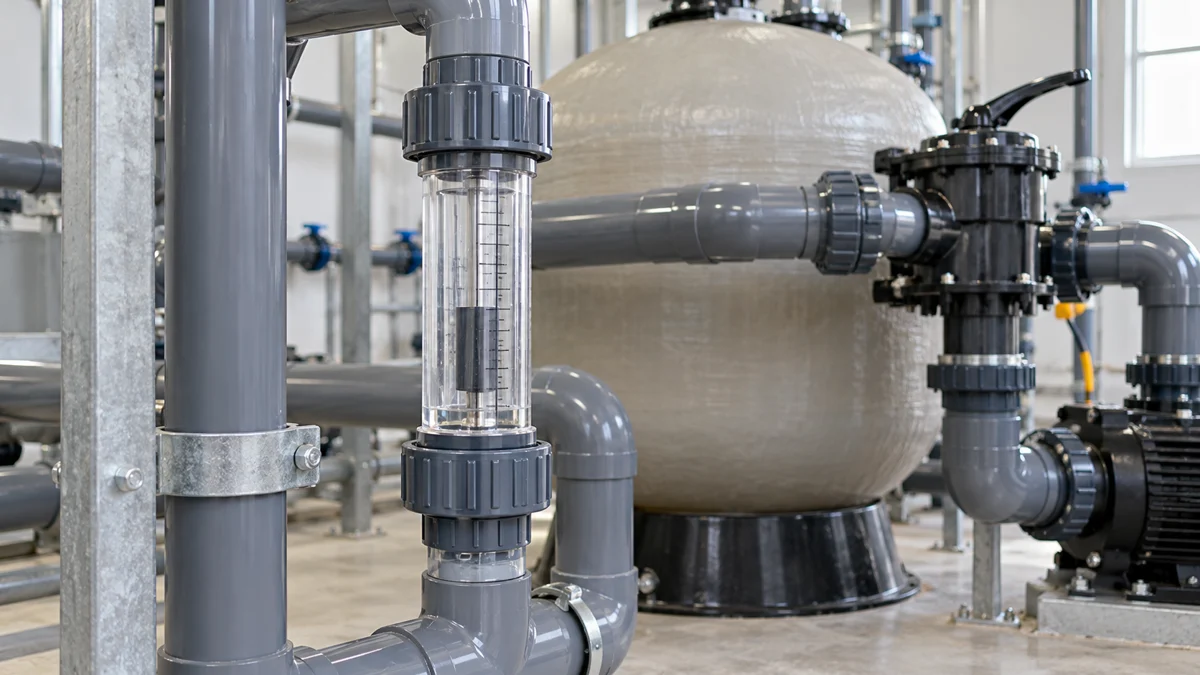
Locate the flow measurement point on the backwash drawing.
For the circulation-duty selection, continue with pump and sand filter BOM matching.
Check water temperature before choosing the backwash setting
Cold water is more viscous than warm water. Backwash rate should decrease for colder water and increase for warmer water.
For the pool-filter sand discussed in the CDC MAHC Annex, backwashing rates should increase by approximately 18% as temperature increases from 20° to 30°C.
Keep that temperature adjustment attached to the sand discussed in the Annex. For a silica sand versus glass media backwash velocity review, request the temperature basis for each proposed medium separately. Put the intended summer backwash water temperature on the submission alongside the proposed velocity.
Check bed expansion through the vessel window
The CDC MAHC Annex gives this expanded-bed recommendation:
The depth of the expanded bed during backwashing should be at least 20% greater than the depth of the fixed bed after backwashing.
Bed expansion can be measured in the field using filter viewing windows.
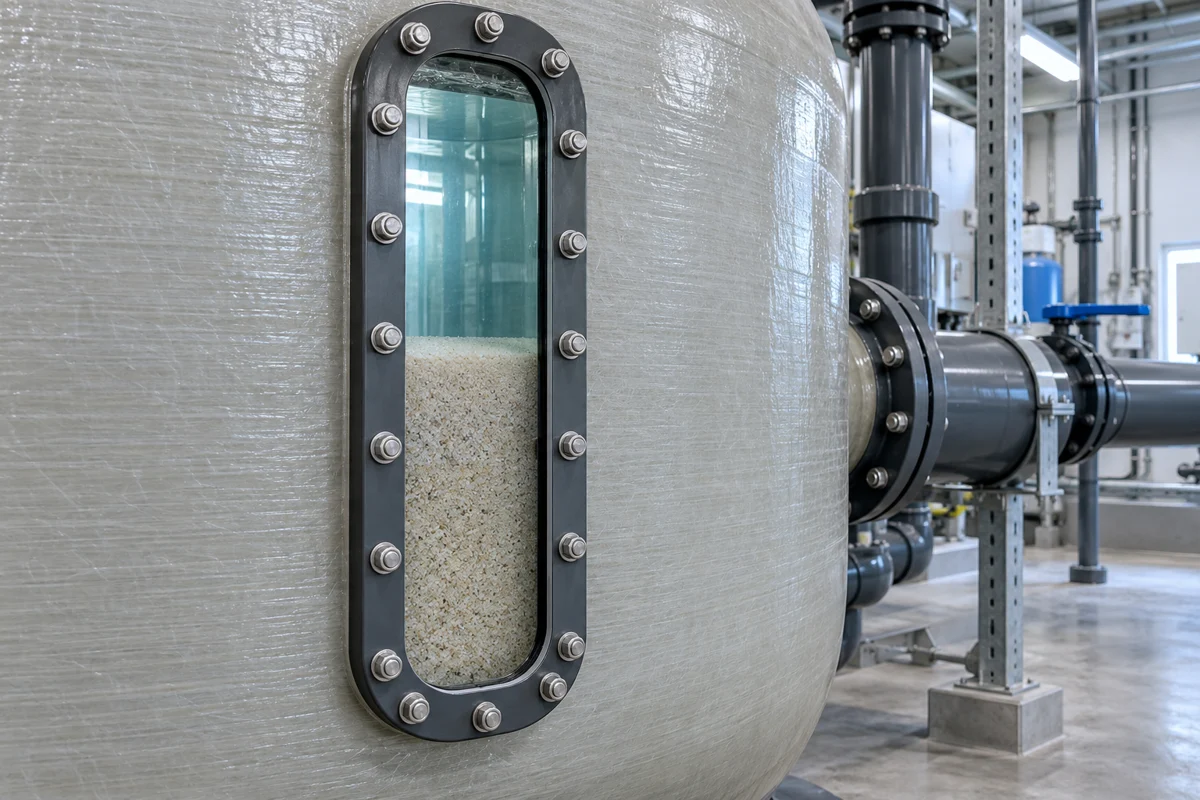
Identify the settled-bed reference and the viewing position before recording expansion.
Record the settled bed, expanded bed, water temperature and measured backwash flow together. Keep the expansion observation beside the media specification used for the calculation.
Confirm media depth and freeboard on the selected vessel
The CDC MAHC Code states that the minimum depth of filter media cannot be less than the depth specified by the manufacturer.
The height of a filter needs to be sufficient to accommodate bed expansion, without losing media.
For Pentair Triton Side Mount filters, the distance between the top of the filter tank and sand bed is known as “Free Board” and should be maintained.
For these Triton filters, sand density varies and the listed media amounts are reference values.
Use the vessel loading drawing to record the media depth and freeboard. Request the support-media arrangement as a separate drawing detail; list the specified materials and quantities against that drawing.
Compare silica sand and glass by the exact media specification
The choice of medium must match the filter so that the medium does not expand above the overflow level.
Waterco EcoPure Glass Media is available in a 0.5-1.0mm grade.
Waterco EcoPure Glass Media is also available in a 0.8-1.5mm grade.
The Dryden Aqua AFM installation manual specifies a routine backwash velocity of >40m/h.
When PoolProject Supply prepares a commercial sand or activated glass media package for your filter vessels, we specify the filtrating grade (such as 0.5–1.0 mm) and support-layer grade (0.8–1.5 mm or coarse pea gravel), design backwash velocity, GCC summer water-temperature factor, settled bed depth and freeboard clearance directly against the vessel section drawing.
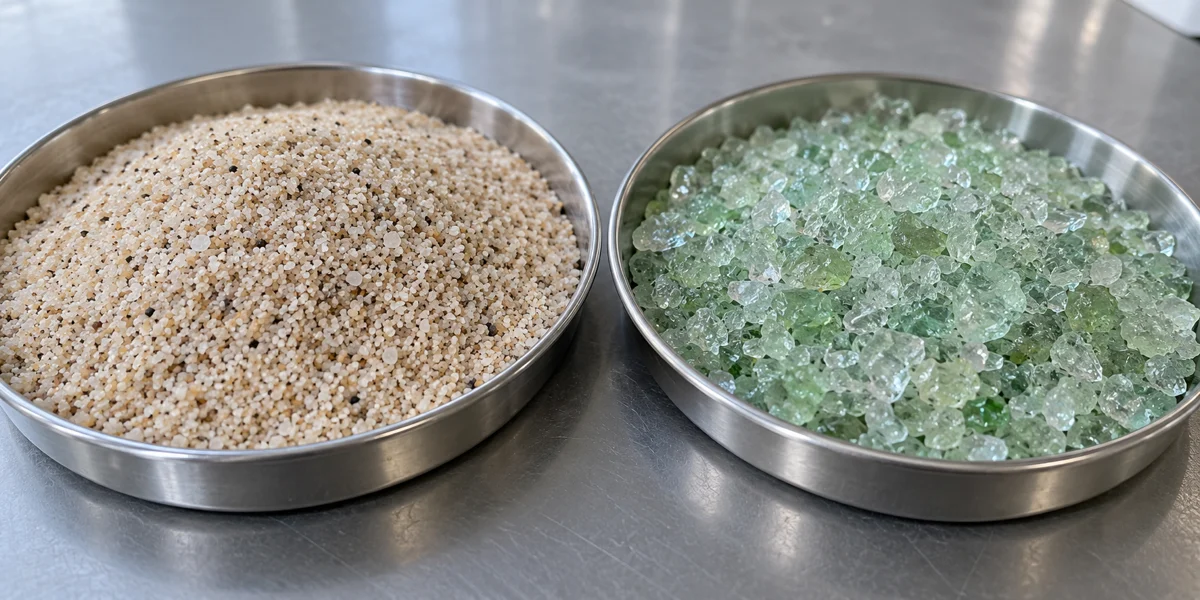
Keep the media identity and grade with the backwash-rate submission.
Carry the calculated flow through the waste-line review
The backwash water pipework should be large enough to discharge the water without a build-up of pressure inside the filter tank.
The drainage system needs to accommodate both the backwash flow and the volume of backwash water discharged.
For AFM, adjust flowrate (speed n°3) on the variable speed pump using a flowmeter.
On the backwash drawing, mark the flowmeter, selected filter, waste route and discharge destination. Attach the proposed pump setting and the flow record to the same submission.
Prepare the backwash portion of your equipment request
Send the following with your equipment BOM template:
- Filter model, vessel drawing and documented filter surface area.
- Selected media name, grade, loading depth and support-media arrangement.
- Highest intended backwash water temperature and the rate-selection basis.
- Backwash-flow calculation and proposed measurement point.
- Settled-bed and expanded-bed observations, plus the freeboard detail.
- Waste-pipe size, route and discharge destination.
Request a quote with your drawing and media schedule.
Sources
- US EPA — SWTR Turbidity Guidance Manual
- CDC — MAHC Annex
- CDC — MAHC Code
- PWTAG — Swimming pool filter specification
- PWTAG — Code of Practice
- Dryden Aqua — AFM installation manual
- Pentair — Triton installation and user guide
- Waterco — EcoPure Glass Media brochure