
Sandstorms and Pool Covers: What to Expect
What one dust storm does to an uncovered pool, what a tracked or slatted cover actually prevents, and how GCC contractors should specify dust protection.
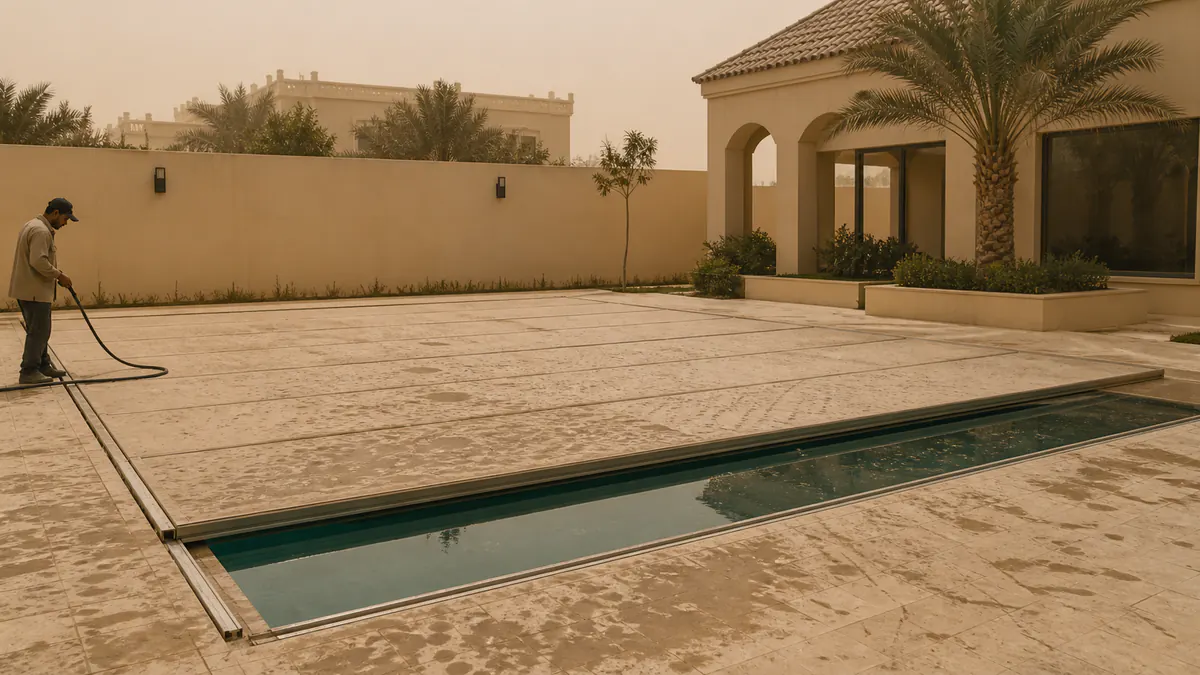
A dust storm passes over the site on a Thursday afternoon. On Friday morning the client sends a photo of the pool — a grey film across the floor, dust lines on the steps — and asks the question you have heard before: would a cover have stopped this?
The useful answer is more precise than yes. A cover changes where the dust ends up. It does not make dust disappear, and it does not take the pool off the maintenance schedule. A client who hears the precise version before buying stays satisfied after the first storm instead of surprised.

What one storm does to an uncovered pool
The visible part is sediment: a layer on the floor, on steps and benches, and a line at the waterline. The invisible part is the load on the system. The skimmer and filter take a spike of fine dust, chlorine demand rises for several days afterwards, and the algae risk climbs while the water carries that extra load.
Recovery is a known protocol: skim the surface, brush the walls, vacuum the floor, backwash the filter, rebalance the chemistry and, if the readings call for it, shock the water. Heavy work, but routine — a competent service crew closes it out the same day. One storm does not wreck a pool, and it is worth saying that to clients plainly.
The cost is the season, not the storm
The problem is repetition. In central Saudi Arabia the dust season runs roughly from late February to mid July, and peer-reviewed climate records put events at a few times a month while the season lasts. Every event restarts the same protocol.
That turns dust into a maintenance tax: service hours, filter wear and chemical consumption, spread across four or five months, every year. For a villa owner it is an irritation. For a compound with several pools on one service contract, it is a cost line worth engineering against.
What a cover actually changes
A cover that closes the water surface — automatic on tracks, slatted, or a properly tensioned manual cover — keeps most of the dust out of the water and off the filter.
That changes what the morning after looks like. Instead of a full water-column reset, the job becomes deck cleanup plus a rinse of the cover surface. The chemistry stays close to where it was, the filter has not swallowed the storm, and the pool is back in use the same morning. Across a season, that is the difference the client is actually buying.
What a cover does not do
Three limits belong in the same conversation, because the client will discover them anyway.
The deck still needs cleaning. Dust settles on the cover, the surrounds and the furniture exactly as before. The cover protects the water, not the property.
A loose tarp is a different product. An unsecured sheet in high wind is hard to handle, and when it is dragged off it can shed the debris it collected straight into the pool it was protecting. Fixing method, tension and roller handling are therefore part of the specification, not accessories. An automatic cover removes the handling problem entirely — it retracts on a motor, with nobody wrestling fabric in the wind.
The pool still runs as a pool. Filtration and water treatment continue on their normal cycle. A cover reduces the load; it does not replace the system.
Dust protection is a specification conversation
A dust-proof claim on a datasheet settles nothing. The questions that produce a workable quotation are concrete:
- Which cover type suits the pool and the budget — automatic on tracks, slatted, or a tensioned manual cover?
- How is the cover fixed at the edges, and what does the pool edge detail require?
- Who closes the cover when a storm is forecast, and can they do it in rising wind?
- Who cleans the cover surface afterwards, and with what?
The answers differ between a shielded courtyard pool and a compound pool facing open ground. That is why the inquiry should carry site information, not just dimensions.
What to put in the inquiry
- City, and how exposed the site is — open desert edge, suburban plot, or enclosed courtyard.
- Cover type preference, or a request for two priced alternatives.
- The pool edge and fixing conditions — a clear photo of the edge detail is enough to start.
- Who will operate the cover day to day, and who maintains it.
Our China-side review covers cover selection, fixing detail and supplier configuration; site measurement, installation and the maintenance routine stay with the contractor and the service team.
Drop the city and a photo of the pool edge into the WhatsApp chat below. We will come back with the cover types that suit the exposure, so the dust conversation with your client is a specification rather than a slogan.