
Pool covers for sandstorms and dust season
Choose a cover that limits debris entering the water and gives your crew access to clean what collects on top. Edge detail, material and daily handling decide whether it suits your pool.
Plan for the dust on the cover
Review the barrier, the cleanout route and the person who will operate it.
Send the city, pool dimensions and edge photos. Include who operates and cleans the cover.
Decide where the dust will land
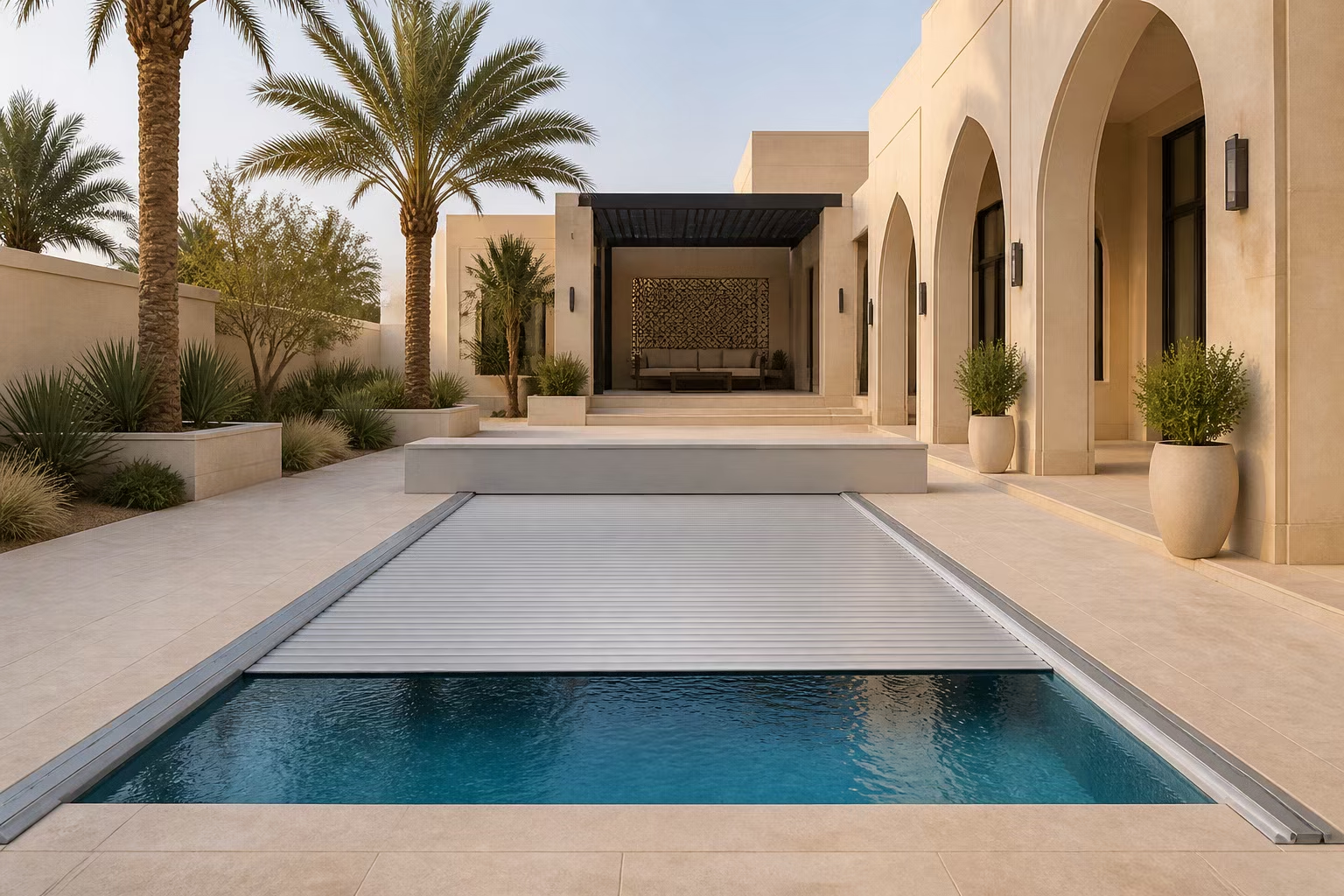
A solid cover separates falling debris from the water below while it is closed. The exposed surface still needs cleaning, and dust can enter during swimming or through uncovered areas. Specify the closure and the cleaning routine together.
Material matters. EPA WaterSense distinguishes solid covers, which block debris, from mesh covers, which let some debris and precipitation through. A mesh sheet and a solid automatic cover do not provide the same barrier.
Open water
Debris reaches the water and pool floor.
Solid cover closed
Collected debris needs a cleanout route before retraction.
Compare the cover and its care requirements
“Automatic” describes operation; “solid” describes the barrier. A tracked fabric cover and a slatted cover have different edges and moving parts. Review the actual section and manual before selecting either. For an exposed site, ask for the selected configuration’s written limits for both operation and the closed position.
| Cover option | Decision condition | Dominant failure mode and prevention |
|---|---|---|
| Cover optionTracked solid fabric | Decision conditionCheck the edge section, housing drainage and access along both tracks. | Dominant failure mode and preventionGrit in the travel path can affect movement and accelerate wear. Include track cleaning and service access in the handover. |
| Cover optionFixed manual solid cover | Decision conditionConfirm fixing detail, roller storage and that a trained person can close and clean it. | Dominant failure mode and preventionPoorly secured fabric or debris tipped into the water during removal. Agree fixing and removal instructions before ordering. |
| Cover optionSlatted cover | Decision conditionConfirm slat profile, edge gaps, retention details and cleaning instructions for that configuration. | Dominant failure mode and preventionAssuming joints and edges seal like solid fabric. Request the section drawing and an explanation of debris and water passage. |

Use the drawing and the manual to set the limits
An unsecured sheet is not a specified storm solution. Check fixings and handling before it becomes a purchasing option.
A general “wind resistant” label cannot set an operating limit. Request the supplier’s configuration-specific instructions; do not choose a wind speed from a different model.
A debris cover does not establish a safety-cover rating. Keep access controls and supervision in place, and never treat the cover as a walking surface.
Agree the post-dust routine before handover
For a fabric-cover maintenance baseline, the Cover-Pools T4 Versa manual calls for removing damaging debris before uncovering, keeping tracks clear and checking housing drains. It calls for more frequent track cleaning in sandy or windy areas. Apply the supplied cover’s own manual to the final procedure.
If the cover hesitates, runs unevenly or meets abnormal resistance, stop operation and ask the service technician to investigate. Do not force it across grit or adjust the drive to overcome a blockage. Isolate power before servicing an electric mechanism, following its instructions.
1. Inspect
Check surface, travel path and drainage.
2. Clean
Remove debris and collected water as instructed.
3. Check water
Test water and check filtration before use.
4. Record
Log crew time, rinse water and service needs.
Keep the deck and surrounds in the cleanup plan. Fine dust already in the water still needs pool care. Follow the filter’s own cleaning criteria and test the water; a storm alone does not specify a backwash or chemical dose. Agree who signs off the pool for use instead of promising recovery by a fixed hour.
Count the seasonal work, including cover care
Use the service log to compare total work before and after installation. Separate pool recovery from cover cleaning, routine visits and repairs. A cover still needs someone to operate it and remove the debris it collects.
Seasonal recovery labour = dust events × pools × crew-hours per pool per event
Planning example only: assume 6 events, 4 pools and 1.5 crew-hours per pool per event. Then 6 × 4 × 1.5 = 36 crew-hours. These are hypothetical inputs, not a Gulf storm forecast or a cover-savings estimate. A two-person crew working for one hour records two crew-hours.
- Recovery: actual skimming, vacuuming and water-treatment labour, plus filter servicing when required.
- Cover care: inspection, surface and track cleaning, rinse water, drainage checks and operator time.
- Ownership: installed scope, access for service, compatible wear parts, documented warranty terms and replacement logistics.
Ask for the cover price and its service scope separately. To estimate a labour difference, subtract measured total crew-hours with the cover from the comparable uncovered routine. Keep exposure and pool count comparable, and include cover care in the covered total.
Send a site brief for the cover review
PoolProject coordinates China-side cover supply and configuration review. Your contractor confirms measurements, local installation and site operation. Send the details below so the discussion can address the pool edge and maintenance access as well as the cover price.
| Send | What it resolves |
|---|---|
| SendCity and site exposure; photos facing the open side | What it resolvesExposure context for the supplier’s written operating limits. |
| SendPool dimensions, plan and photos of edges, steps and features | What it resolvesCover arrangement, fixing conditions and areas left exposed. |
| SendHousing, drain route and service-access photos | What it resolvesHow collected water and debris will be removed and components reached. |
| SendCurrent recovery log and named operator or service team | What it resolvesHandling feasibility, care responsibilities and the cost comparison. |
| SendPreferred cover type and any existing system identifiers | What it resolvesConfiguration documents, compatible parts and quotation scope. |
Send the city, pool dimensions and edge photos. Include who operates and cleans the cover.
Method and sources
Reviewed 18 October 2026. Material distinctions follow EPA guidance; track and fabric care use the OEM manual below as a maintenance baseline. The comparison and service-log calculation are project-planning tools. Confirm wind limits, cleaning details and warranty scope against the documents for the selected configuration.
- US EPA WaterSense, Jump Into Pool Water Efficiency (September 2022), page 4: solid and mesh cover materials.
- Cover-Pools T4 Versa owner’s manual, 800235 REL-0001 (2020), pages 7–12: debris removal, tracks, mechanism care and drainage.