
Pool cover safety starts with a documented configuration
An undocumented cover can leave a safety requirement unmet. A safety cover can add a barrier over the water when the specified system is correctly installed, fully closed and secured. Confirm those conditions before ordering; adult supervision and the other protective layers still matter.
An opening still exposes water
Review the complete system before ordering.

A pool cover contributes to safety only as part of a documented system used as instructed. Automatic operation, solid-looking slats or a locked switch alone do not establish a safety classification. For a project with a child-safety requirement, identify the proposed model, its installation arrangement and the supporting test documents before accepting safety wording in the quotation. Keep the destination’s barrier requirements in the project brief, and arrange an operator handover as well as delivery.
Define the safety requirement before comparing covers
State that safety is a requirement at the first enquiry. Ask for the exact configuration and the documents that support its proposed use, rather than selecting a cover for water or dust control and adding a safety label later.
| Project situation | Decision before ordering | Core failure mode and prevention |
|---|---|---|
| Project situationChild access is a design concern | Decision before orderingRequest a documented safety-cover configuration matched to the pool drawing. | Core failure mode and preventionAn unsupported safety claim leaves the requirement unresolved. Match the model and installation documents before approval. |
| Project situationA loose floating blanket is proposed | Decision before orderingTreat it as a different product category; ask separately about a documented safety cover. | Core failure mode and preventionA child can slip beneath a floating cover. Keep the access barriers and supervision arrangements in place. |
| Project situationAn existing automatic cover has no records | Decision before orderingIdentify the installed system and ask for its manual and condition review. | Core failure mode and preventionUnknown condition or missing securing parts can defeat the intended protection. Resolve those points before relying on it. |
Keep protection around the pool as well as over it
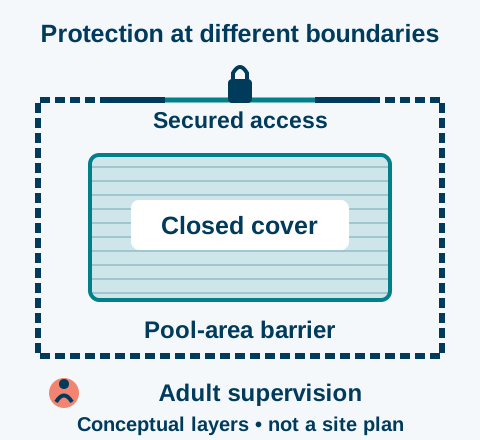
A cover is one layer. Fences and secured access points control entry to the pool area; a suitable closed cover addresses access to the water. Supervision remains essential. Ask the project’s local contractor to confirm the destination’s barrier requirements before changing an existing fence or gate.
Match every safety claim to the quoted configuration
Match the cover, control and installation documents to the same quoted configuration.
ASTM F1346-23 is a performance specification for safety covers and cover labeling. Its public scope describes reducing child access when a cover is correctly installed and used according to its manufacturer’s instructions. Naming the standard on a brochure does not identify which offered system has supporting evidence. ASTM F1346-23
- Request the manufacturer and exact model identification, together with the cited test report and standard edition.
- Check that the report’s scope and the proposed drawing refer to the supplied cover arrangement; record any difference for the supplier to resolve.
- Put the control, securing method, drainage provision and installation responsibilities in the quotation. Request selected-configuration data where it is not yet available.
Include visibility, securing and drainage in handover
The public Cover-Pools owner manual illustrates why operation belongs in the specification: it calls for full operator visibility and protection against unauthorized operation. Use the selected system’s own manual to agree the actual controls and securing procedure.
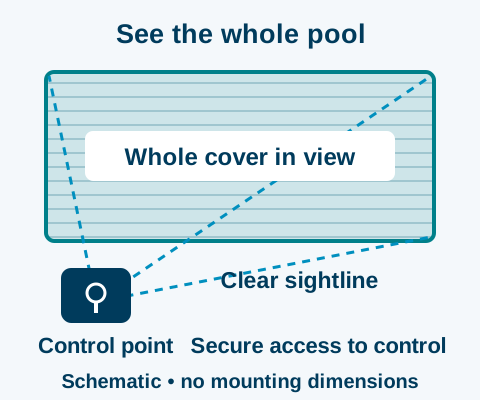
- Have the installer demonstrate complete opening before swimming and complete closure and securing after use. Never swim beneath a partly closed cover.
- Arrange standing-water removal according to the selected manual. Water on top of a cover is a drowning hazard; confirm the specified drainage equipment and who checks it.
- Identify who keeps keys or access codes and who may operate the cover. Keep children from operating it.
- Record how to report damage or abnormal movement and arrange inspection. Keep people off the cover; it is not usable pool deck.
Compare the supplied scope and the upkeep
Ask which installation work, drainage equipment, operator instruction and maintenance items are included in each offer. Record the responsible party for each. Also ask how replacement fabric or slats and control parts will be identified later; a low initial price is difficult to compare when these items are missing from the scope.
What to send for a configuration review
Send the safety expectation with the site information. PoolProject coordinates project supply and drawing review; the quotation should identify the proposed configuration, available documents and open items before an order is confirmed.
| Item | Why we need it | Example format |
|---|---|---|
| ItemPool drawing and dimensions | Why we need itReview the pool outline and cover arrangement. | Example formatDimensioned plan, including steps or raised edges. |
| ItemProject stage and site photos | Why we need itSeparate new-build provisions from retrofit constraints. | Example formatNew build or retrofit, with views of each pool edge. |
| ItemAccess and control location | Why we need itReview the intended sightline and who can operate the cover. | Example formatMarked plan or photos; note children or staff access. |
| ItemDestination and safety requirement | Why we need itIdentify the documents and local approvals to check. | Example formatCountry, project type and any consultant requirement. |
| ItemExisting system, if any | Why we need itIdentify the correct records and components. | Example formatModel label, manual and clear condition photos. |
Request a documented safety-cover review
Send the dimensions, project stage, site photos and safety requirement on WhatsApp. We can review the supply brief and identify configuration documents to request before quotation approval.
Keep drawings, document references and unresolved items together with the quotation.
Method and sources
Updated October 2026. This guide combines the public ASTM scope with the operational topics in an OEM owner manual, then turns them into a buyer checklist. The OEM instructions illustrate review questions; the supplied configuration’s own manual and supporting documents govern its operation. No model-specific load, certification or local barrier approval is asserted here.
- ASTM F1346-23: public scope, sections 1.1–1.2
- Cover-Pools owner manual 800235 (2020): safety pp. 4–5, operation pp. 7–8, drainage p. 9 and inspection p. 14