
Pool cover water savings in Gulf projects
An uncovered pool loses water to evaporation between swims, increasing replenishment costs. A well-fitting solid cover reduces that loss while it stays closed; your project’s saving depends on local conditions and the closing routine. For a Gulf pool, compare the cover’s fit and ease of use with your summer temperature target before using a published percentage in a budget.
Plan the water saving
Match the cover to the water surface and the people who will close it.
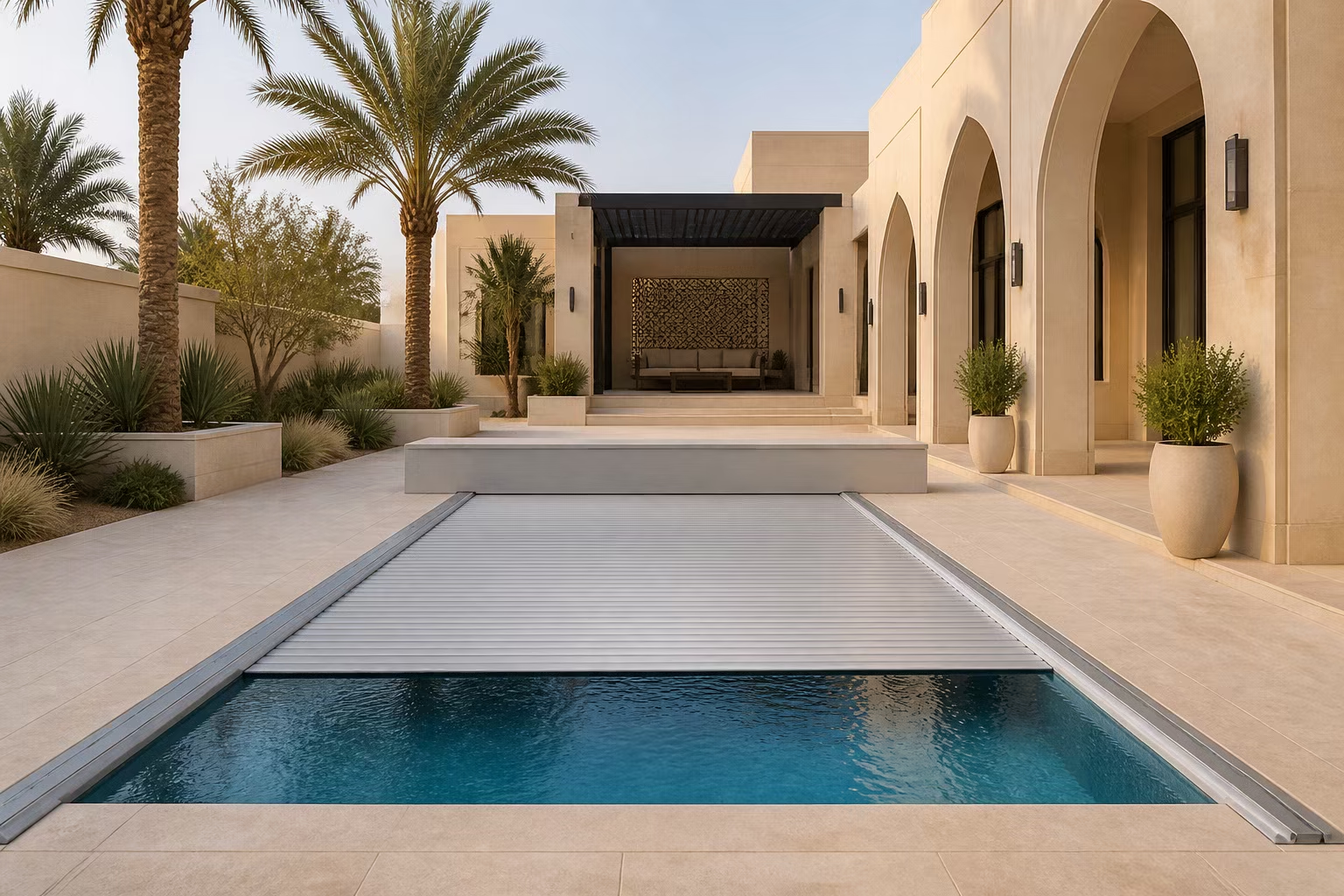
- Cal Poly’s 2016 report measured a 93.9% evaporation reduction for the solid-track cover tested with near-continuous coverage. This is a covered-state result.
- DOE’s 2004 school-facility guidance gives 30–50% potential make-up-water savings. Its scope is different from a Gulf annual forecast.
- Use pool surface area, a stated evaporation-depth assumption and an operating log to develop your project estimate.
Read the saving percentage with its conditions
Cal Poly’s January 2016 report compared pool covers at its California research facility during 2015. The tested solid-track cover reduced evaporation by 93.9% against an uncovered control. Covers stayed in place through the test, apart from track-cover cleaning and measurements.
The report treats these solid-cover results as maximum possible efficiencies. Swimming and other uncovered periods change the outcome. The figure describes evaporation under the test conditions; it is not a rating for every cover material or a promise of annual water savings.
Tested solid-track cover: evaporation balance
93.9%
Evaporation prevented
6.1%
Evaporation remaining
The full bar represents 100% of the uncovered control’s evaporation, not the pool’s total water demand.
The US Department of Energy’s 2004 school operations guide lists potential make-up-water savings of 30–50% from pool covers (printed page 67). This is older school-facility guidance, rather than a model for annual Gulf pool use. Use a local water baseline and the intended cover schedule for a project budget.
| Published figure | What it describes | Misuse to prevent |
|---|---|---|
| Published figure93.9% evaporation reduction | What it describesThe tested solid-track cover under Cal Poly’s near-continuous covered conditions; January 2016 report | Misuse to preventApplying it to a full year or every quoted cover. Confirm the configuration and account for uncovered periods. |
| Published figure30–50% potential make-up-water saving | What it describesDOE school-facility guidance, 2004; a different operating context | Misuse to preventTreating it as a guaranteed annual GCC saving. Compare against a local replenishment record. |
Calculate litres from surface area and depth loss
Multiply the exposed water-surface area in square metres by the evaporation depth in millimetres over the same period. One millimetre over one square metre equals one litre. Pool depth is not an input to this conversion.
Select the evaporation-depth input from a suitable site assessment. A water-level drop can also include leaks, splash-out, backwashing or deliberate draining; separate those losses before treating it as evaporation.
Top: water-surface area. Bottom: enlarged water-level change.
Worked example with assumed inputs
V (L) = A (m²) × d (mm)
8 × 4 × 5 = 160 L
160 × 30 = 4,800 L = 4.8 m³
Assume an 8 m × 4 m pool and evaporation of 5 mm per day for a hypothetical 30-day period. The result is 160 litres per day, or 4.8 m³ over that period, for the uncovered scenario. Substitute a site-supported depth input before using the calculation commercially.
This volume is the starting evaporation loss. Estimating the cover’s saving also requires its performance and the periods when it will actually be closed. Avoid multiplying a test maximum into a full-year promise.
For an existing pool, record make-up-meter readings, cover open/closed periods, rainfall, backwashing and unusual water use. Ask the maintenance team to investigate leakage separately. Keep the pool treatment and water-testing routine in place when a cover is installed.
Choose a cover you can close between swims
Both manual and automatic systems need to cover the intended water surface to control evaporation. If daily manual handling will leave the pool uncovered, review an automatic route; if an operator can manage the manual cover and roller reliably, include that option in the comparison. Ask for a drawing-based fit check rather than choosing from a headline saving alone.
| Cover route | Decision condition | Dominant failure mode and prevention |
|---|---|---|
| Cover routeManual cover and roller | Decision conditionA responsible operator can deploy and store the cover around pool use. | Dominant failure mode and preventionCover stays rolled away because handling or access is awkward. Check roller position, clear working space and the closing routine. |
| Cover routeAutomatic cover | Decision conditionThe project needs simpler routine deployment and the layout can accommodate the proposed system. | Dominant failure mode and preventionA poor layout or unresolved obstruction prevents full closure. Submit pool-edge details, steps, features and storage-space information for review. |
Compare water cost with handling and upkeep
Use the actual water invoice or tanker-delivery record to value a cubic metre. With tanker supply, check whether reduced replenishment would change delivery frequency; a smaller calculated volume does not automatically remove a delivery charge. Evaluate the cover with its operating costs before claiming payback.
- Separate pool replenishment from household water use and confirm which tariff or delivery charges would change.
- Include the operator’s time for deployment, cleaning the cover and keeping the roller or track area clear.
- Request the proposed cover’s servicing, spare-parts and warranty terms. Plan replacement from condition and documentation rather than a fixed Gulf lifespan.
- Value cleaning or heating benefits only where the site has a relevant baseline. Keep leak repairs, filtration and water-quality management in the maintenance budget.

Send the pool layout and closing routine for review
Send PoolProject the information below to discuss a cover route and prepare a project enquiry. The selected configuration, dimensions, operating method and exclusions belong in the written quotation.
| What to send | Why it matters | Example format |
|---|---|---|
| What to sendPool plan and edge photos | Why it mattersCheck coverage, obstructions, storage and roller or track space. | Example formatDimensioned plan plus photos of all pool edges. |
| What to sendCity, pool type and water source | Why it mattersSet the climate context and identify the replenishment cost record. | Example formatCity; skimmer or overflow; municipal or tanker supply. |
| What to sendUse pattern and closure responsibility | Why it mattersAssess whether the cover can be deployed between swims. | Example formatOpening hours; who closes it; any existing cover routine. |
| What to sendTemperature target and equipment | Why it mattersReview summer heat concerns and winter heating needs. | Example formatSummer target; chiller or heater details if installed. |
| What to sendAvailable water-use records | Why it mattersSeparate a scenario from the project’s measured baseline. | Example formatMake-up readings with rainfall, cleaning and leak-repair notes. |
WhatsApp opens with this page’s reference. Add the layout, location and intended closing routine before sending.
Method and sources
Reviewed 18 October 2026. Published research establishes the covered-state mechanism and reference ranges; the worked example uses stated assumptions and a unit conversion. Annual Gulf savings require site-specific weather, water-use and deployment information. The diagrams explain the calculation and source conditions without assigning performance to an unverified product configuration.
- Misgana Muleta, Cal Poly/NPC, January 2016: cover test methods and evaporation-reduction results, executive summary Table 1.
- US DOE, School Operations and Maintenance: Best Practices for Controlling Energy Costs, August 2004, printed page 67: potential make-up-water savings.
- US EPA WaterSense, Jump Into Pool Water Efficiency, September 2022: surface area, cover use, heat retention and other water-loss pathways.