
Mesh vs Solid Pool Cover: Drainage, Weight & Safety Spec
Compare mesh, solid vinyl, and hybrid anchored safety pool covers on rainwater drainage, dust and UV blocking, fabric weight, ASTM F1346 loads, and spring tension.
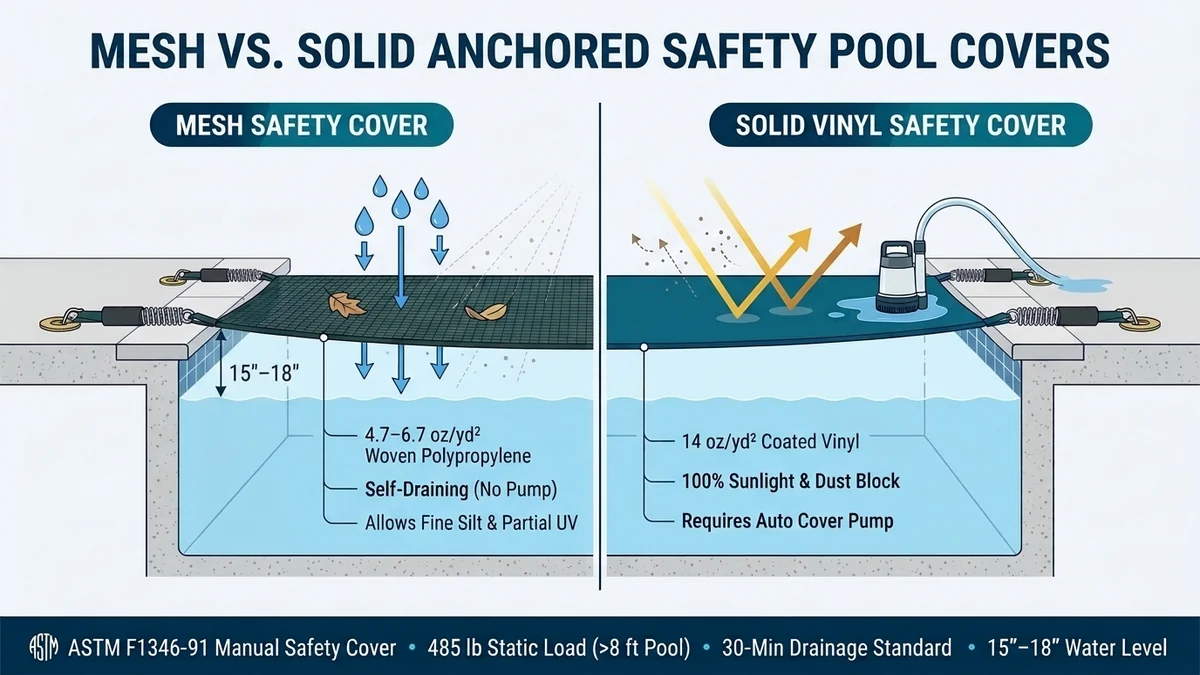
Choose a mesh pool cover when unattended rainwater self-drainage, lighter single-operator handling, and simpler weave longevity matter most. Choose a solid vinyl pool cover with an automatic cover pump—or a hybrid solid cover with a center mesh drain panel—when blocking 100% of sunlight, algae growth, and windborne fine dust outweighs higher sheet weight.
Both anchored configurations qualify as manual safety covers under ASTM F1346-91 when paired with deck anchors and tensioned springs, unlike floating blankets on a manual pool cover roller. According to U.S. EPA WaterSense at Work Section 5.3, solid, mesh, and hybrid pool covers reduce evaporation by up to 95% when in use and can serve as certified safety barriers, whereas floating solar bubble covers reduce evaporation by 50% to 95% and cannot serve as a safety cover.
What Are the Pros and Cons of a Mesh vs Solid Pool Cover?
Mesh pool covers let rainwater drain straight through woven polypropylene into the pool, weigh roughly half to one-third as much as coated vinyl, and handle easily with one person, but they allow fine dust and partial sunlight through. Solid vinyl covers block 100% of sunlight, debris, and water, yet they weigh far more and require standing-water removal.
Fabric basis weight explains the day-to-day handling split between anchored safety cover families. In LOOP-LOC product specifications, standard Super Dense Mesh uses polypropylene-extruded monofilament yarn (525 denier warp, 595 denier fill, 41 by 20 weave, 80% black yarn and 20% green yarn for ultraviolet stability) weighing 4.7 ounces per square yard. Tighter double-layer virtually solid mesh (Aqua-Xtreme, 86% black yarn and 14% colored yarn) weighs 6.7 ounces per square yard—still 50% lighter than solid vinyl—while draining up to 80 gallons per minute without clogging. By contrast, high-adhesion coated solid vinyl with a woven rip-stop scrim (ULTRA-LOC III) weighs 14 ounces per square yard.
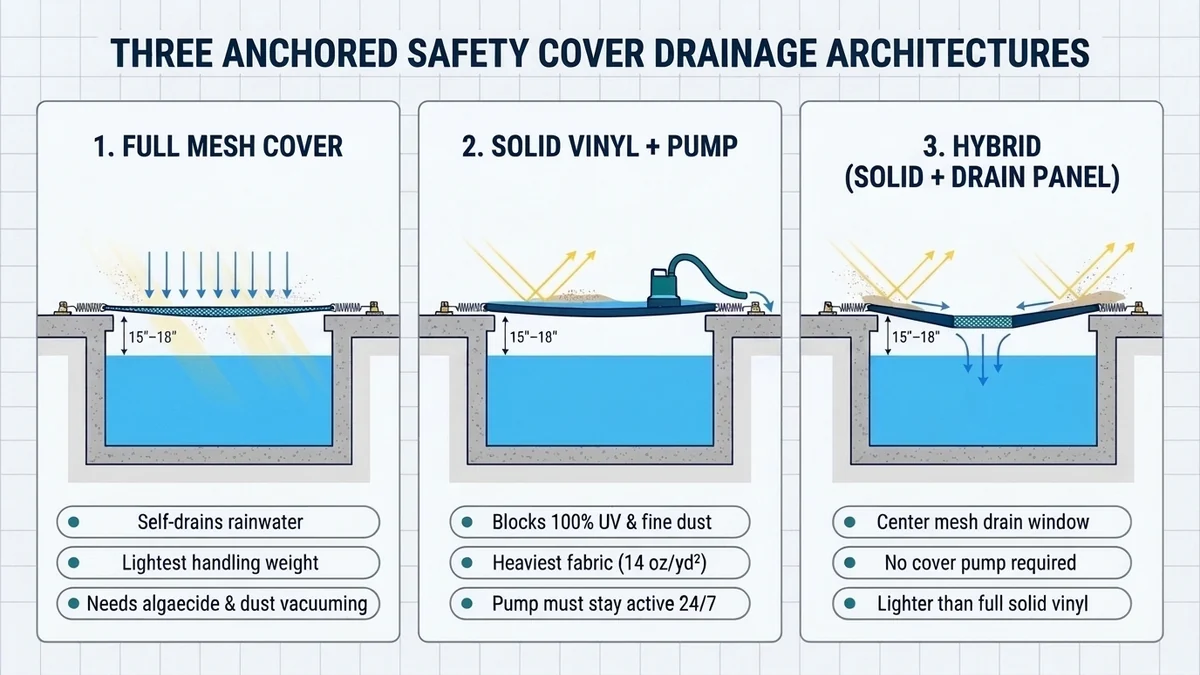
Drainage and barrier trade-offs across the three anchored safety cover architectures: full mesh filters rain everywhere, solid vinyl relies on an active automatic cover pump, and hybrid designs route rainwater to a central mesh drain window.
Water-quality impact separates these materials sharply in dusty or high-sun climates. Robelle Industries installation guidance and Carlton Pools technical comparisons confirm that porous mesh screens out leaves and large debris while allowing fine dust, silt, and small dirt particles to pass into the basin. Sunlight penetrating standard mesh also reduces chlorine levels and promotes algae growth unless sanitizer and winterizing algaecide are maintained. Solid coated vinyl blocks all debris, rainwater, and 100% of sunlight, preserving sanitizer balance and keeping pool water cleaner between seasons—making solid or hybrid architectures especially relevant alongside sand and dust protection planning.
Water conservation also varies slightly across anchored cover types. U.S. EPA WaterSense at Work Section 5.3 reports CUWCC estimates showing evaporation accounts for 56% of pool water use (ahead of filter backwashing at 23% and mineral buildup control at 21%), and notes that while solid, mesh, and hybrid covers cut evaporation by up to 95%, porous mesh covers allow more evaporation than impermeable solid vinyl.
| Specification Criterion | Standard / Dense Mesh Cover | Solid Vinyl Cover (With Pump) | Hybrid Solid Cover (With Drain Panel) |
|---|---|---|---|
| Fabric construction & basis weight | Woven polypropylene: 4.7 ounces per sq. yard (standard dense) or 6.7 ounces per sq. yard (double-layer dense mesh, 50% lighter than solid) | Coated vinyl with woven rip-stop scrim at 14 ounces per sq. yard | Solid coated vinyl outer body with central mesh drain window; lighter than full solid cover |
| Rainwater & melt drainage | Self-draining across full span (dense double-layer weaves rated up to 80 gal/min without clogging); no cover pump | Impermeable; rainwater collects on top and requires a continuously active automatic cover pump | Rainwater pitches inward across solid outer fabric and filters through the center mesh window without a pump |
| Sunlight & algae suppression | Partial light passes through standard mesh, reducing chlorine and requiring algaecide dosing; double-layer mesh blocks far more light | Blocks 100% of sunlight to preserve chlorine balance and suppress algae growth | Solid outer perimeter blocks sunlight over most of the basin while limiting light entry to the center drain window |
| Fine dust & silt exclusion | Screens leaves and large debris, but fine dust and dirt filter through porous weave into the basin | Blocks all windborne dust, silt, leaves, and surface water from entering the pool | Blocks most debris across solid perimeter; small silt can enter only through the center mesh panel |
| Evaporation reduction | Up to 95% category rating, but allows more evaporation than solid covers | Up to 95% evaporation reduction when installed | Up to 95% category rating with reduced open evaporation surface compared with full mesh |
| Crew handling & deployment | Lightweight enough for straightforward one-person handling and folding | Heavy and bulky; typically requires extra hands for installation and removal | Lighter than an all-solid vinyl sheet, though heavier than standard woven mesh |
How Does a Hybrid Pool Cover With Drain Panels Compare?
A hybrid pool cover pairs solid outer vinyl panels with a porous mesh drain window down the center, blocking most sunlight and perimeter debris while draining rainwater into the pool without an electric cover pump. It weighs less than a full solid vinyl cover but requires correct strap pitching to avoid edge ponding.
U.S. EPA WaterSense at Work Section 5.3 classifies hybrid covers alongside solid and mesh as primary anchored cover architectures, noting that placing mesh in the middle of a solid sheet allows water passage while trimming total sheet mass compared with full solid vinyl. Robelle Industries and LOOP-LOC manuals similarly note that solid safety covers fitted with mesh drainage panels keep most debris out of the pool without requiring a permanently wired automatic cover pump on deck.
However, a hybrid cover only drains cleanly when strap tension creates a slight inward slope toward the mesh window. If rainwater ponds on the solid outer surface instead of reaching the drain panel, Dover Pool Products specifies a four-step pitching adjustment:
- Loosen the four straps bordering the mesh drain window so the center panel sits slightly lower than the outer vinyl perimeter.
- Tighten the outer straps surrounding the pooled water to pull the outer vinyl flat and pitch standing water inward toward the mesh window.
- Wait 2 to 3 days for the solid coated vinyl to settle under the revised strap tension.
- Flood-test the solid surface with a garden hose and repeat adjustments until water runs directly into the mesh drain panel without puddling.
For sites experiencing seasonal windstorms without reliable deck power outlets for an automatic cover pump, a hybrid drain-panel cover avoids the electrical pump failure risk of an all-solid cover while keeping far more fine silt out than a full-width standard mesh weave.
Should a Tensioned Mesh Safety Pool Cover Touch the Water?
No—under normal dry tension, an anchored mesh or solid safety cover should stay stretched tightly above the pool like a trampoline rather than floating on the water surface. However, pool water must remain 15 to 18 inches below the top of an in-ground pool so the cover can settle onto the water for support under heavy snow or ice loads.
Both LOOP-LOC care instructions and Robelle Industries installation manuals emphasize this dual requirement. When dry, keeping the cover taut prevents flapping wear against coping edges and stops leaves from collecting in sag pockets. During heavy snow or ice accumulation, the cover is engineered to deflect downward until it rests on the underlying pool water, using buoyancy to share the load. Allowing water level to drop below 18 inches on an in-ground pool—or below 14 inches on an on-ground pool per LOOP-LOC guidance—removes that water cushion, over-stretches the webbing and springs, and voids manufacturer warranty coverage.
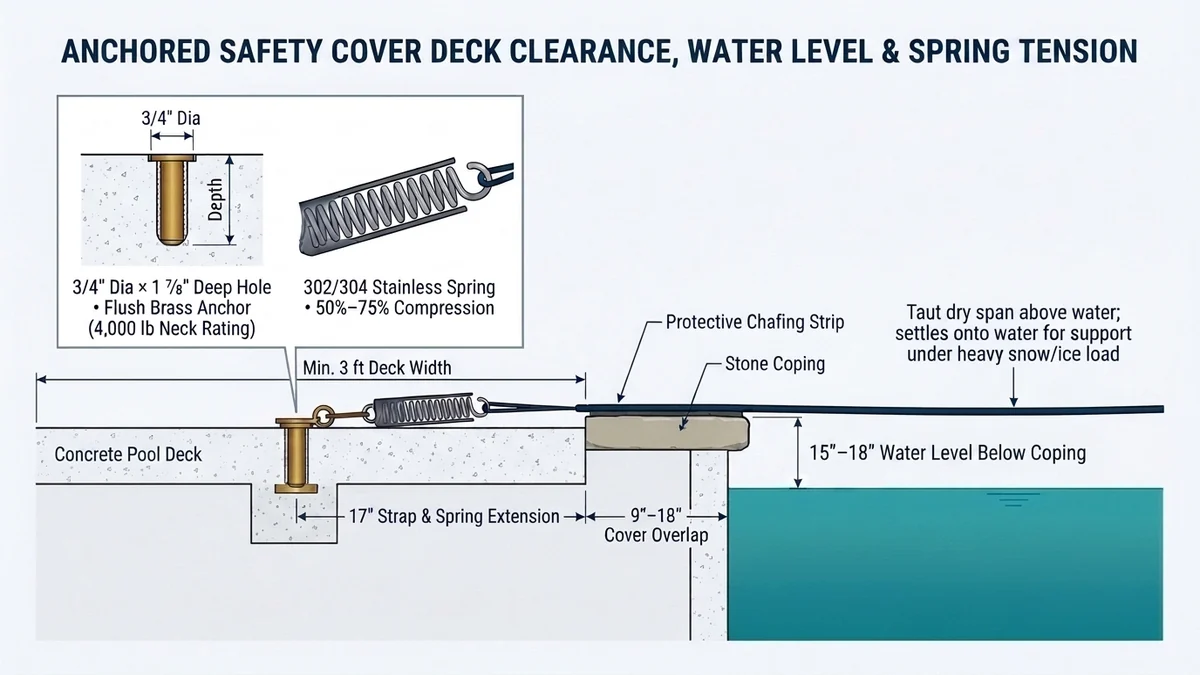
Perimeter clearance, deck-anchor embedment, stainless spring tension, and the 15 to 18 inch off-season water-level buffer that lets a taut safety cover settle onto pool water under heavy loads.
What Spring Compression, Deck Clearance, and Anchor Drilling Specs Apply?
Pool safety cover installation depends as heavily on perimeter deck width, substrate anchor depth, and pool cover springs tension as on fabric choice. Before ordering, confirm basin geometry using our pool cover measurement guide and verify deck clearance against standard installation tolerances.
Robelle Industries installation specifications require at least 3 feet of solid deck perimeter around the pool: the cover fabric overlaps the water edge by 9 to 18 inches (18 inches on freeform pools), and the straps plus stainless steel springs extend another 17 inches beyond the cover edge. On concrete slabs, installers drill perpendicular 3/4-inch holes to a depth of 1 and 7/8 inches so brass anchors recess completely flush with the deck when closed during swim season. On brick, stone, pavers, or lawn surrounds, Robelle requires drilling a 7/8-inch hole 18 inches deep and driving each brass anchor inside a stabilizing anchor tube flush with the surface.
Structural hardware ratings carry the full perimeter tension load. LOOP-LOC technical specifications call for 1-inch-wide polypropylene/polyester webbing with a 2,100-pound single minimum break strength, sewn double-thick for a 4,200-pound minimum strap break strength (minimum 90% black yarn) across roughly 3-foot by 3-foot grid sections (or 5-foot by 5-foot sections on residential rectangular pools only). Straps attach to 302/304 stainless steel compression springs sleeved in thick vinyl deck-protective tubes—stepping up draw-bar and coil wire diameter for commercial covers larger than 2,500 square feet—hooked onto flush brass anchors rated to a 4,000-pound break strength at the neck.
Spring compression targets depend on cover fabric weight and manufacturer engineering: Dover Pool Products specifies tightening straps to maintain 50% spring compression on mesh safety covers and 60% to 75% compression on heavier solid safety covers, whereas LOOP-LOC specifies approximately 90% compression at initial in-ground installation and maintaining 75% compression over time (50% for on-ground installations).
| Installation Parameter | Published Specification / Threshold | Field Engineering Purpose |
|---|---|---|
| Minimum deck width & overlap | At least 3 feet deck width; 9 to 18 inches fabric overlap (18 inches freeform); 17 inches extra for straps and springs | Provides safe anchorage setback from coping edge and prevents perimeter gap intrusion |
| Concrete vs paver anchor holes | Concrete: 3/4-inch diameter by 1 and 7/8 inches deep; brick, stone, or pavers: 7/8-inch hole 18 inches deep with anchor tubes | Seats brass anchors flush with the deck surface while preventing pull-out in segmented pavers |
| Webbing, grid & anchor strength | 1-inch double-thick webbing (4,200 lb break strength; 2,100 lb single); 3 ft by 3 ft grid (5 ft by 5 ft residential rectangular); 4,000 lb brass anchor neck | Transfers static rescue loads and wind uplift evenly into the concrete perimeter |
| Spring alloy & compression | 302/304 stainless springs (heavy commercial gauge over 2,500 sq ft); Dover 50% mesh / 60% to 75% solid; LOOP-LOC 90% initial / 75% maintained in-ground | Keeps cover drum-tight while absorbing seasonal stretch and dynamic storm loads |
| Off-season water level | 15 to 18 inches below top of in-ground pool (14 inches on-ground); never lower than 18 inches | Allows loaded cover to settle onto water for support without over-stressing straps or voiding warranty |
How Do ASTM F1346 Safety Standards and Off-Season Closure Rules Apply?
Both mesh and solid anchored covers satisfy the exact same ASTM F1346-91 performance tests to qualify as a Manual Safety Cover (MSC)—including a 485-pound static rescue load on pools wider than 8 feet, 30-minute surface water drainage, and strict perimeter deflection and opening limits.
According to CDC data cited in U.S. CPSC Safety Barrier Guidelines for Residential Pools, drowning is the leading cause of unintentional death for 1- to 4-year-old children, with nearly 300 children under age 5 drowning in swimming pools each year. CPSC guidance emphasizes that barriers—fences, alarms, and compliant safety covers—are not childproof and provide layers of protection during a lapse in adult supervision rather than replacing supervision.
ASTM F1346-91 (Reapproved 2010) draws a bright technical line between a Manual Safety Cover (MSC, Section 4.2), which provides a high level of safety for children under age five by inhibiting water access, and Other Covers (OC, Section 4.3), which are not intended as child safety barriers. Floating bubble blankets or foam sheets wound onto a manual pool cover roller and reel fall under Other Covers and never substitute for an anchored MSC. Qualifying ASTM F1346-91 manual safety covers satisfy four core test regimes:
- Static Load (Sections 7.1 and 7.1.1): Pools with a width or diameter greater than 8 feet (2.4 meters) shall hold 485 pounds (220.0 kilograms)—representing 2 adults and 1 child—to permit a rescue operation; pools 8 feet (2.4 meters) or less shall withstand 275 pounds (125 kilograms).
- Surface Drainage (Sections 7.3, 9.3.1, and 9.3.2): After spraying water evenly at 10 gallons per minute per 1,000 square feet (9.29 square meters) for 30 minutes, the cover or its auxiliary pump system shall drain substantially all standing water within 30 minutes after normal rainfall stops. Three minutes after placing a 32-inch by 9-inch by 5-inch, 36.6-pound torso-shaped test object faceup 2 to 3 feet from the pool edge, accumulated water shall not completely cover the torso.
- Perimeter Deflection (Section 9.2): With 50 pounds (22.7 kilograms) placed 4 to 6 feet from the pool side, the cover shall not deflect enough to let a 3.7-inch (0.09-meter) by 5.7-inch (0.14-meter) by minimum 12-inch length, 36.6-pound ellipsoidal test object pass between the cover and the pool wall.
- Openings Test (Section 9.4): A 4.5-inch maximum breadth solid-faced sphere pushed steadily with 40 pounds (plus or minus 1 pound) of force cannot pass through any opening in the cover or along the deck edge.
Are Mesh Pool Covers Good for Off-Season and Winter Closure?
Yes—anchored mesh safety covers are widely used for seasonal and winter closure because concrete-anchored perimeter hardware resists wind uplift and passes rain and snowmelt without manual pumping. U.S. EPA WaterSense at Work Section 5.3 notes that winter covers held via concrete anchors are harder to remove daily during swim season, so they are built primarily for seasonal closure rather than daily rolling.
Public health codes also enforce ASTM safety covers during extended shutdowns. Under Washington Administrative Code 246-260-141, any pool facility out of operation for more than twelve months must either be covered with a safety cover meeting ASTM standard F1346-91 or backfilled; a closed pool that develops an ice layer must also install an ASTM F1346-91 safety cover or close the entire enclosure. Crucially, the regulation requires that all pool covers be completely removed during periods when the pool is open for use.
When closing a pool under a mesh cover, chemical and dust planning prevents spring surprises. Because mesh admits rainwater, sunlight, and fine silt, LOOP-LOC recommends dosing a winterizing algaecide at closing and adding additional algaecide one month before opening—or whenever temperatures remain at 60 degrees or higher—alongside periodic sanitizer checks. On dusty, unattended sites where spring silt cleanup is undesirable, switching to a dense double-layer mesh, a hybrid drain-panel cover, or a solid vinyl cover with a monitored automatic pump cuts re-opening vacuum labor substantially.
How Do Mesh vs Solid Pool Cover Lifespan, Cost Drivers, and Cover-Pump Needs Compare?
Mesh safety covers generally deliver longer service life and lower upfront material cost than solid vinyl covers because simpler woven polypropylene uses less material mass and eliminates standing-water pump failure risks. Solid vinyl covers without drain panels cost more in raw fabric and handling labor and require a continuously powered automatic cover pump to stay ASTM-compliant and under warranty.
Looking strictly at physical engineering cost drivers rather than vendor pricing, three operational factors separate lifetime ownership between mesh and solid anchored covers:
- Fabric mass and manufacturing complexity: Carlton Pools notes that mesh covers require less material in a simpler weave, translating into lower initial material cost and longer expected service life compared with heavier coated vinyl sheets (14 ounces per square yard versus 4.7 to 6.7 ounces per square yard in LOOP-LOC specifications). Premium woven polypropylene safety covers carry long manufacturer backing—such as LOOP-LOC's 15-year prorated warranty across its safety cover line.
- Installation and seasonal handling crew size: Because woven mesh is 50% lighter or more than solid coated vinyl, a single operator can typically fold, unfold, and anchor a residential mesh cover, whereas heavy, bulky solid vinyl covers normally require extra hands during closing and spring removal.
- Mandatory continuous cover-pump duty on solid covers: LOOP-LOC, Robelle Industries, and Dover Pool Products all state unambiguously that solid safety covers without mesh drainage panels must keep an automatic electric cover pump running on top of the cover at all times while installed. Without an active pump, rainwater pools into a drowning hazard that violates ASTM F1346-91 surface drainage rules, overloads straps and springs, accelerates coated vinyl damage, and voids warranty coverage.
Before issuing an inquiry or requesting a project quote for a manual safety pool cover, assemble five submittal details alongside dimensions from our pool cover measurement guide:
- Basin dimensions and perimeter features: Waterline length, width, step bays, raised walls, and diagonal measurements plus confirmation of at least 3 feet of clear deck perimeter.
- Deck substrate material: Specify poured concrete (3/4-inch drill bit to 1 7/8 inches deep for flush brass anchors) versus brick, stone, or pavers (7/8-inch hole 18 inches deep with anchor tubes).
- Site exposure and power availability: Note windborne dust intensity, sun exposure, off-season duration, and whether a dedicated deck power outlet exists for an automatic cover pump.
- Preferred cover architecture: Full standard mesh, high-shade double-layer dense mesh, hybrid solid with center mesh drain window, or full solid coated vinyl with automatic cover pump.
- Commercial vs residential scale: Identify total cover square footage so covers above 2,500 square feet specify heavy-gauge 302/304 stainless steel commercial springs and 3-foot by 3-foot webbing grids.
Frequently Asked Questions
What is the main difference between a mesh and a solid safety pool cover?
A mesh safety cover uses porous woven polypropylene (4.7 to 6.7 ounces per square yard) that lets rainwater filter into the pool without a pump while keeping leaves out, whereas a solid safety cover uses heavier coated vinyl (14 ounces per square yard) that blocks 100% of sunlight, water, and fine dust but requires an automatic cover pump or a center mesh drain window.
Should a mesh safety pool cover touch the water?
No—when dry, a tensioned mesh safety cover should stretch tightly above the water like a trampoline. However, pool water must stay 15 to 18 inches below the top of an in-ground pool (and never lower than 18 inches) so the cover can deflect onto the water surface for support under heavy snow or ice loads without over-stretching the straps.
Are mesh pool covers as safe as solid pool covers?
Yes, when certified to ASTM F1346-91 as a Manual Safety Cover and properly anchored and maintained. Both mesh and solid safety covers satisfy identical static load tests (485 pounds on pools wider than 8 feet; 275 pounds on pools 8 feet or less), 30-minute surface drainage rules, perimeter deflection checks, and 4.5-inch opening limits.
Do solid safety pool covers require a cover pump?
Solid safety covers without built-in mesh drainage panels require an automatic cover pump operated at all times when installed to satisfy ASTM F1346-91 surface drainage standards and preserve warranty coverage. Hybrid solid covers equipped with a center mesh drain panel drain rainwater through the window without a pump when straps are pitched properly.
How do mesh and solid pool covers compare for off-season algae and dust?
Solid vinyl covers block 100% of sunlight and windborne silt, preserving sanitizer balance and minimizing spring cleanup. Standard mesh covers pass fine dust and some sunlight, which lowers chlorine and encourages algae unless winterizing algaecide is applied at closing and replenished one month before opening or whenever temperatures reach 60 degrees or higher.
Sources
- U.S. Environmental Protection Agency — WaterSense at Work, Section 5.3: Commercial Pool and Spa Equipment (November 2023)
- Washington Administrative Code § 246-260-141 — Water Recreation Facility Pools Not in Operation (Cornell LII)
- U.S. Consumer Product Safety Commission — Safety Barrier Guidelines for Residential Pools
- ASTM International — ASTM F1346-91 (Reapproved 2010), Standard Performance Specification for Safety Covers and Labeling Requirements for All Covers for Swimming Pools, Spas and Hot Tubs
- LOOP-LOC — Pool Safety Covers Product Brochure, Technical Specifications, and Mesh Care and Maintenance Guide
- Robelle Industries — Mesh and Solid Safety Cover Installation Guide
- Dover Pool Products — Homeowner Safety Cover Care and Use Guide
- Carlton Pools — Solid vs Mesh Pool Covers Comparison