
Manual Pool Cover Rollers & Reels: GCC Sizing Guide
Engineering guide to manual pool cover rollers, commercial pool cover reels, span tube sizing, GCC dust-season cover fabrics, and manual safety pool cover hardware.
Specifying a manual pool cover roller or a commercial pool cover reel for a villa compound, hotel deck, or lap pool in the Gulf requires separating the nominal water surface from the structural span of the reel tube, the coping overhang, and the storage footprint at the reel end of the deck.
For a rectangular pool, reference water area equals length multiplied by width (for example, 8 m by 4 m equals 32 m²), which describes the water surface only and does not set the cover cut size, roller span, or fixing allowance.
Before ordering a fixed-length or telescopic reel tube, project teams verify shell squareness using the pool cover measurement guide.
For a rectangular pool with inside dimensions L = 8 m and W = 4 m, the diagonal cross-check formula d = √(L² + W²) yields √(8² + 4²) = √80 ≈ 8.944 m.
Wait-and-see procurement that treats cover hardware as an aftermarket accessory overlooks how strongly evaporation and windborne dust drive operating budgets across GCC facilities.
According to US EPA WaterSense at Work Section 5.3 (EPA 832-F-23-003, November 2023), CUWCC estimated that water evaporation, filter backwashing, and mineral buildup control account for 56, 23, and 21 percent of pool water use respectively across pools in California.
In Gulf summer conditions analyzed in our guide on whether pool covers make water hotter in GCC summers, daily water loss scales directly with exposed surface area.
One millimetre of evaporation depth over one square metre equals one litre, so an assumed 8 m by 4 m rectangular pool with an assumed 5 mm evaporation loss loses 8 × 4 × 5 = 160 litres.
Airborne silt and Shamal dust events also impose recurring housekeeping loads, as detailed in our analysis of how pool covers handle sandstorms in the GCC.
In an assumed seasonal dust-recovery example of 12 events, 1.5 crew-hours per event for uncovered recovery equals 18 crew-hours whereas 0.75 crew-hours per event for combined cover care and residual pool cleaning equals 9 crew-hours, a difference of 9 crew-hours.
How Do Stationary, Mobile, and Multi-Reel Manual Frames Compare by Pool Geometry?
Selecting the right frame architecture on our pool covers overview depends on deck clearance behind the storage end, whether the cover must be wheeled clear of swimmer traffic, and the total wet weight of the blanket during winding.
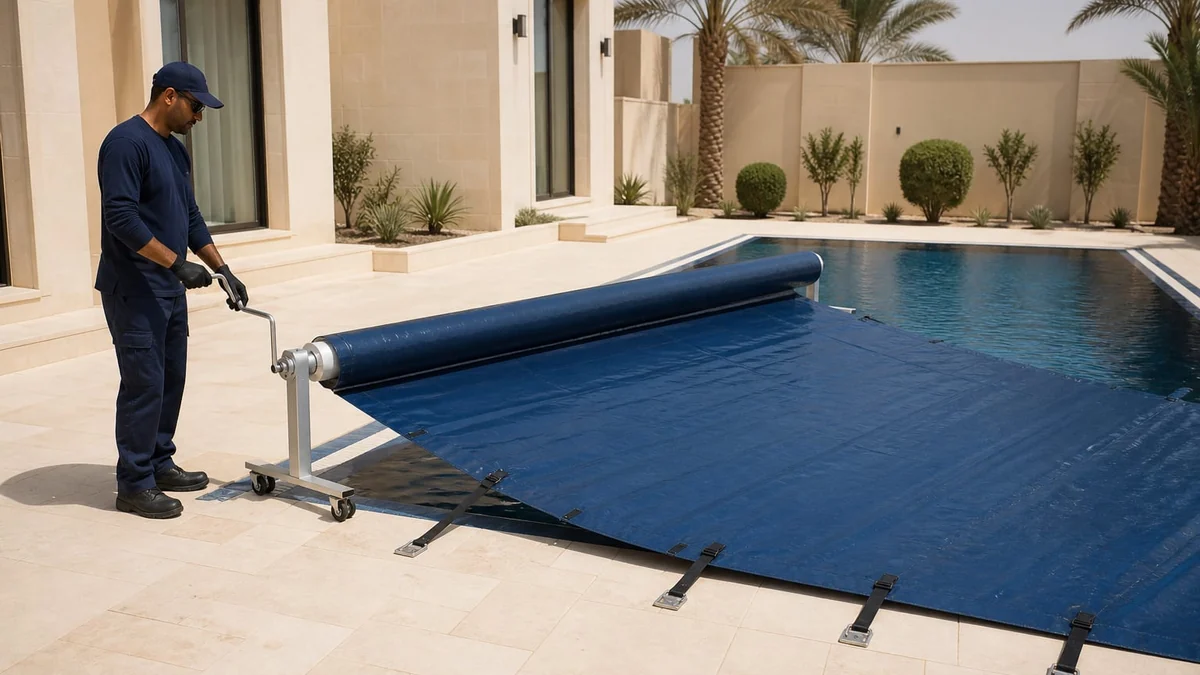
Mobile manual pool cover roller on a travertine deck with locking castor stands, hand crank, anodized span tube, and webbing tether straps.
For residential villas and compact hospitality plunge pools, a domestic manual pool cover reel can be supplied with castor wheels, bolted floor flanges, or wall brackets where perimeter paving is narrow.
The Certikin Eco-Reel domestic roller is available in mobile, fixed-floor, and fixed-wall styles for pools from 2.6m to 5.7m wide and bubble covers up to 12m in length, with optimum operational capacity surpassed when a cover exceeds 50m2.
When pool width and blanket length move into mid-size hotel or school basins, selecting a commercial pool cover reel prevents frame racking and excessive winding torque.
The Certikin Eco-Reel Plus commercial pool roller is designed for bubble covers 6-8m wide, with a maximum cover size of 130m2 and a maximum cover length of 16m.
Where single-operator winding effort and accidental unwinding in gusty courtyard winds are key concerns, geared domestic reels incorporate mechanical reduction and positive tube locks.
The Monaco Premier Geared Domestic Reel features an integral tube locking device, an anti-reel locking device, and a 3:1 ratio Smartgear handwheel system suitable for pools up to 21’ (6.4m) wide.
In manufacturer series that pair anodized aluminum tubes with powder-coated aluminum or stainless steel end frames, tube diameter and wall thickness step up systematically with pool width and length.
The Daisy 5 Star A75 roller uses a 75mm x 1.4mm anodised aluminium tube for pools up to 4.3m x 12.0m, and the 5 Star A100 uses a 100mm x 1.6mm tube (including 95mm x 1.6mm or 79mm x 1.4mm for telescopic) for pools up to 5.5m x 12.0m, with a 260mm height to tube centre, 447.5mm total height, 420mm depth, and 10 year pro-rata warranty.
On salt-chlorinated or coastal Gulf decks where chloride aerosols attack painted frames, stainless steel end frames and larger tube cross-sections extend span capacity.
The Daisy 5 Star 316ST roller pairs a 316 stainless steel frame and handwheel (395mm height to tube centre, 582.5mm total height, 570mm depth, 10 year pro-rata warranty) with a 100mm x 1.6mm anodised aluminium tube (95mm x 1.6mm for telescopic) for pools up to 4.3m width (4.3 x 18m) or up to 6.1m width (6.1 x 14m).
For wider residential or compound lap pools where a single-piece barrel eliminates telescopic joint play, a heavy-wall fixed tube is used.
The Daisy 5 Star 125ST roller (395mm height to tube centre, 582mm total height, 485mm depth, 10 year pro-rata warranty) uses a single-length pre-manufactured 125mm x 2mm anodised aluminium tube for pools up to 4.3m width (4.3 x 20m) or up to 6.7m width (6.7 x 18m).
For full-scale commercial and resort pools, single-length commercial barrels transition to heavy-wall tubes supported on tall stainless steel stands.
For commercial pools, Daisy specifies three single-length pre-manufactured anodised aluminium tube rollers with stainless steel frames and handwheels and a 10 year pro-rata warranty: U125 (125mm x 2mm tube, 1010mm total height, 605mm depth, max pool 4.9m x 25.0m or 6.7m x 20.0m), U150 (150mm x 2mm tube, 1010mm total height, max pool 4.9m x 50.0m or 6.7m x 25.0m), and U203 (203mm x 3mm tube, 1050mm total height, max pool 4.9m x 50.0m or 6.7m x 50.0m).
Ergonomic winding torque on those tall commercial frames is controlled by matching the handwheel diameter to the pool length.
Daisy commercial 6-spoke stainless steel handwheels (10 year pro-rata warranty) are sized by maximum pool size: 500mm diameter for 20m pools, 700mm diameter for 25m pools, and 900mm diameter for 50m pools, compared with 375mm diameter residential handwheels.
Heavy-duty commercial mobile units combine locking swivel castors, low-friction axle bearings, and corrosion-resistant frame finishes.
Daisy Commercial roller systems use four stainless steel 360º full-swivel castors with secure brakes (or stationary mounting), heavy-wall anodised aluminium tubes (203mm x 3mm, 152mm x 2mm, or 125mm x 2mm), stainless steel axles in cast aluminium end-caps with Delrin bearings, and frames of marine-grade (316) stainless steel or white powder coated aluminium.
When a commercial basin is wider than a single blanket bay, engineers either specify a double-barrel reel frame or divide the pool into parallel blanket lanes across the length of the basin.
Rocky's Senior Commercial System (Part#321) uses die-cast aluminum construction with 4" locking castors, a positive anchoring system, saltwater pool grounding capability, approximately 14" ground clearance to the underside of the tubing (approximate shipping weight 22 lbs), and 12-sided 4" anodized Commercial Tubing (16' to 33' lengths) for pools up to 33' wide and 100' long of 12mil cover.
For wide multi-lane competition or resort pools, transverse multi-roller banks keep each blanket width manageable for deck staff.
For wide commercial pools where each blanket unit is approximately 5m wide, Daisy's commercial production plan divides a 25200mm pool length into 4 x 500UM blankets (each 4250mm wide, fully edge bound with wind skirts and attached over-covers) paired with 4 x ST152D52 rollers, each 4.6m wide.
Cut profile and step-bay geometry must also be coordinated with the stationary or mobile roller position before fabrication.
Daisy's standard Upturn Cut makes the pool cover oversize for an upturn of around 20mm against the pool coping to catch and hold debris and allow for up to 1% natural shrinkage, whereas the Waterline Cut leaves no allowance for the up to 1% natural shrinkage; when folding a step area onto the cover, the roller should be placed at the non-step end.
On public-use hotel and club decks, metallic frame and fastener selection should align with our stainless steel grade selection guide for GCC pool fittings.
For public-use swimming pools, PoolProject Supply notes that BSI identifies BS EN 13451-1:2020+A1:2024 as addressing general safety requirements and test methods for equipment installed in pools for public use, while SS316 contains molybdenum to improve resistance to chloride-related pitting and crevice corrosion over SS304.
| Roller Configuration | Mounting & Mobility | Tube Construction | Primary GCC Deck Application |
|---|---|---|---|
| Domestic Mobile or Fixed-Floor Reel | Wheeled T-stands or bolted deck flanges | Telescopic anodized aluminum sections | Private villa pools with open stone paving behind one end |
| Domestic Fixed-Wall Reel | Wall-mounted brackets above coping | Telescopic anodized aluminum sections | Courtyard plunge pools with boundary walls at the storage end |
| Single-Tube Commercial Mobile Reel | Braked swivel castors on tall stainless frames | Single-length heavy-wall anodized aluminum barrel | Hotel, school, and compound lap pools with wide deck aprons |
| Multi-Roller Transverse Commercial Bank | Parallel mobile or stationary commercial frames | Multiple single-length heavy-wall barrels | Wide resort and competition basins split into manageable blanket bays |
What Span Tube Diameters, Wall Thicknesses, and Telescopic Overlaps Prevent Mid-Span Sag?
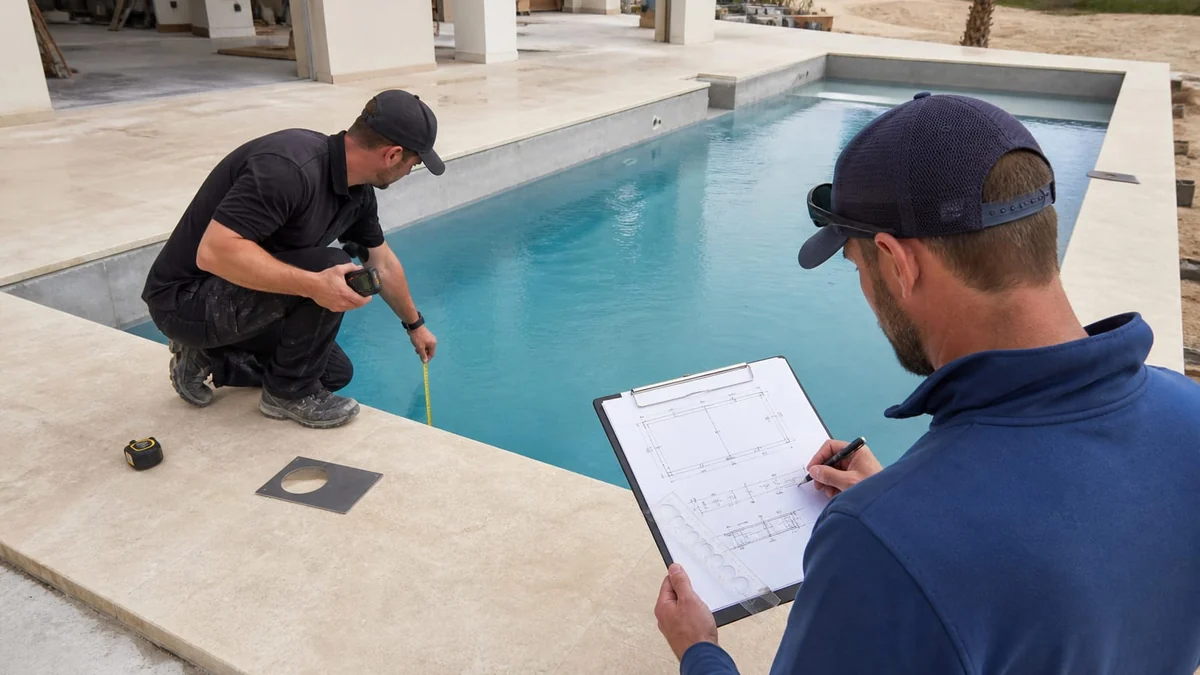
Field verification of inside water-line width, coping overhang, and deck clearance before ordering a fixed or telescopic roller tube.
A Daisy roller tube is best used with a pool cover when the tube is approximately 300mm wider than the main pool cover area.
Across modular residential and light-commercial product lines, tube outer diameter and multi-piece telescoping geometry are matched to target span brackets.
Daisy DIY tube models include DIY LARGE 100mm (a 3-piece tube up to 6.4m long), DIY SMALL 75mm and DIY SMALL 100mm (2-piece tubes up to 4.6m long), 50mm Buddy (3-piece 50mm tube), and 125mm fixed-length pre-made tubes for longer, wider pools.
The Slidelock Telescopic Reel system uses an anodised aluminium tube of approximately 99mm (3 7/8”) diameter in two sizes: a small tube telescoping from 3.05m to 4.57m (10’ to 15’) pool size and a large tube extending from 4.88m to 6.4m (16’ to 21’) pool size.
On the Slidelock Telescopic Reel system, installers should allow a maximum 1’ overlap each side (minimum 6”), and the maximum recommended area of cover material on either size reel is 75 sq m (800 sq ft), with extra care to be taken when quoting or installing reels for covers over 19’ wide.
Multi-sided extruded aluminum profiles increase torsional and bending stiffness across wide residential spans without relying on welded seams.
Rocky's 3-inch Residential Tubing uses a 12-sided extruded aluminum design with an anodized finish and 1/8th of an inch wall thickness (for a maximum 12mil cover): AT1 fits covers up to 20' wide (extending to 21') and AT2 fits covers up to 24' wide (extending to 25').
Fastening a multi-sided telescopic joint requires strict adherence to overlap length, bolt orientation, and manual torque control.
On Rocky's AT-1 adjustable tube (maximum length 21'), a minimum 9" overlap is required on each side, and each overlap join is secured with 1/4" x 3 3/4" bolts (4 in total) placed an inch from the tube edges and rotated 180 degrees / perpendicular to the first bolt, hand-tightened only without an impact driver so the tube does not bend and puncture the solar cover.
Smooth-wall expandable tubes use alignment plugs and grouped self-drilling screws at each splice and end slug.
During Daisy expandable tube assembly, white feather plugs hold the aligned tubes in place (using a supplied 6.5mm drill bit for custom lengths), and 6 self-drilling screws are installed in two groups of three red-marked holes at each tube join, plus 6 self-drilling screws (3 per side) to secure the end slugs.
How the cover blanket attaches to the roller tube also governs whether the sheet winds squarely without tearing at the trailing edge.
When attaching a cut-to-shape cover to a Daisy roller, eyelets are punched through the pool cover in line with the white feather plug and approximately 100mm from the end of the pool cover.
On systems that use webbing tether straps and brass or polymer grommets, doubling the cover edge and maintaining proper edge setback distances prevents pull-out under tension.
When attaching strapping and grommets on Rocky's AT-1 system, the hole in the strapping must be at least 1" from the end of the strap and the hole in the cover at least 2" from the end of the cover (fold the edge for two layers if possible), while Tek screws securing the strap to the tube are placed about an inch into the strap to prevent tearing.
For large commercial covers where individual webbing straps can allow a wide blanket to drift off-center during winding, continuous rod-and-sheet connections keep the trailing edge aligned.
On the Certikin Aquatronic commercial roller, straps should be avoided because they can allow larger covers to float off-centre; instead, covers are connected via a 6mm nylon rod fed through the back edge of the cover or a PVC (indoor) or mesh (outdoor) connection sheet with fixing toggles.
How Do Cover Fabrics, Wind Skirts, and Over-Covers Perform in GCC Heat and Shamal Dust?
When pairing a blanket with a manual pool cover roller or evaluating replacement pool cover fabrics, GCC specifiers must distinguish between translucent solar bubble blankets that add solar heat to the water and opaque (e.g. Daisy Titanium Cool) or closed-cell foam blankets that block solar gain while suppressing evaporation.
Daisy 525 Blue polyethylene bubble cover (525um, total material height 6mm, 485 g/m², R rating 0.1 m2K/W, 8 - 10 years residential / 5 years commercial pro-rata warranty) is translucent, warms water by up to 8C, can shrink up to 1% in length only, and saves 99% on evaporation.
Where summer chiller load reduction or unheated water temperature control is required in Riyadh, Dubai, or Doha, an opaque non-heating bubble formulation (e.g. Daisy 525 TC Titanium Cool) prevents solar warming while preserving evaporation control.
Daisy 525 TC Titanium Cool (Titanium Silver, 525um, total material height 6mm, 485 g/m², R rating 0.1 m2K/W, 8 - 10 years residential warranty) is opaque and non-heating while saving 99% on evaporation and shrinking up to 1% in length only.
Lighter bubble gauges reduce roll weight on smaller domestic reels but carry lower thermal resistance and shorter service horizons.
Daisy 400 Blue bubble material (400um, 6mm height, 5 years residential warranty) weighs 390 g/m² with an R rating of 0.08 m2K/W, while 250 Blue (250um, 6mm height, 3 years warranty) weighs 250 g/m² with an R rating of 0.067 m2K/W; both save 99% on evaporation and can shrink up to 1% in length only.
For commercial basins and dust-season debris exclusion, closed-cell cross-linked foam blankets eliminate longitudinal shrinkage, while woven polypropylene mesh sheets prioritize leaf and silt screening.
Daisy TT Foam 4.5mm (535 g/m², R rating 0.13 m2K/W, 8 years warranty) and TT Foam 3.0mm (500 g/m², R rating 0.1 m2K/W, 8 years warranty) are opaque, non-heating woven polyethylene covers with closed-cell cross-linked foam internals that do not shrink and save 99% on evaporation, whereas WinterKleen/WinterKap 400um woven non-stretch polypropylene mesh (150 g/m², 90% shading) saves 80% on evaporation.
In commercial specification submittals, thermal conductivity and basis weight differentiate heavy-duty foam blankets from commercial bubble sheets.
In Daisy's Commercial Pool Cover Specification, Thermotech Foam (4.5mm thickness, 4.5mm total height, reversible, 5 year pro rata warranty) has a nominal weight of 585gsm and thermal resistance (R-value) of 0.13 m2/K w, whereas UltraDome bubble cover (525 micron PE, 5 year pro rata warranty) has a nominal weight of 460gsm, R-value of 0.10m2/K w, and thermal conductivity of 0.08 W/mK.
| Blanket Family | Optical & Thermal Behavior | Dimensional Stability | GCC Operational Fit |
|---|---|---|---|
| Translucent Polyethylene Bubble | Transmits solar radiation to warm pool water while blocking evaporation | Subject to longitudinal shrinkage allowance requiring upturn cut margin | Cool-season heating support on outdoor villa and club pools |
| Opaque Non-Heating Polyethylene Bubble | Blocks solar heat gain while maintaining high evaporation suppression (e.g. Daisy 525 TC Titanium Cool manufacturer-rated 99%) | Subject to longitudinal shrinkage allowance requiring upturn cut margin | GCC summer evaporation control on chilled or unheated residential pools |
| Closed-Cell Cross-Linked Foam Blanket | Opaque non-heating insulation with woven PE skins (reversible on Thermotech commercial foam) | Zero longitudinal shrinkage | Commercial hotel, school, and lap pools with daily haul-cord deployment |
| Woven Polypropylene Debris Mesh | High solar shading with breathable drainage weave | Non-stretch woven structure tensioned across the deck | Seasonal Shamal dust, leaf, and windborne debris exclusion |
Once a cover is wound onto a manual pool cover roller on an exposed Gulf deck, Daisy's white protective over-cover should be fitted immediately whenever the cover is stored on the roller.
Daisy requires the white protective over-cover to be used every time a pool cover is stored on the roller, even if the swim is only for 10 minutes, as this is enough time to damage a pool cover.
On outdoor commercial decks exposed to Shamal gusts, perimeter wind uplift and roll-storage UV protection are addressed directly in the blanket fabrication spec.
For outdoor commercial pools, Daisy recommends attaching weighted rope wind skirts to both sides of pool covers to keep cover edges in contact with the pool water at all times and prevent wind from getting under the cover, plus a permanently attached heavy-duty reinforced PVC protective overcover.
When a resort or villa pool features an infinity weir or perimeter overflow gutter, a submerged lead-core wind skirt stabilizes the floating blanket edge without blocking water flow into the channel.
Daisy's commercial wind skirt uses a black woven edge with an encased lead core rope to pull the edge of the pool cover just under water, stopping wind from lifting the cover and holding the cover in place on infinity or overflow edges where water flows through the woven webbing.
To deploy a wide commercial blanket from the roller without folding the leading edge under the water, the nose of the cover is stiffened and towed via a floating harness.
Daisy Commercial pool covers have 300mm deep reinforced PVC end binding with a stitched pocket for a 40mm flotation rod, a full-width non-tangle harness to distribute towing load evenly, and a fully buoyant 8mm ski-rope haul cord with a stainless steel snap hook clip.
How Do Safety Classifications Separate Floating Reel Blankets from Anchored Manual Safety Pool Covers?
A critical specification error in project tenders is confusing a floating solar or thermal blanket on a manual pool cover reel with a perimeter-anchored manual safety pool cover, or assuming that only automatic slatted or track pool covers act as a child-safety barrier.

Submittal verification layout combining pool shell plan drawings, stainless deck anchor hardware, coping stone samples, and cover fabric swatches.
Public water-efficiency and safety guidance draws a strict boundary between unanchored floating blankets and anchored safety covers.
In US EPA WaterSense at Work Section 5.3 Table 3, Solid/Mesh/Hybrid pool covers reduce evaporation by up to 95 percent when in use and can serve as a safety cover (certified under ASTM F1346), whereas Solar/Bubble covers reduce evaporation by 50 to 95 percent, are designed to heat the pool with the sun's energy, and cannot serve as a safety cover.
The governing specification defines each cover category by how it is secured and whether it forms a load-bearing barrier.
ASTM F1346 classifies pool covers into Power Safety Cover (PSC), Manual Safety Cover (MSC, Section 3.1.14), and Other Covers (OC, Section 3.1.15); solar energy blankets (Section 3.1.18, floating translucent bubble sheets) and energy conservation blankets (Section 3.1.19, floating cellular foam sheets) are not affixed to the pool structure and fall under Other Covers (OC), which are not intended to serve as a barrier for children under the age of five.
To qualify as a Manual Safety Cover, the installed cover and its perimeter deck hardware must pass both static weight support and surface water drainage verification.
Under ASTM F1346 Section 7.1 (Static Load), a safety cover for a pool with a width or diameter greater than 8 ft (2.4 m) shall hold a weight of 485 lb (220.0 kg) (2 adults and 1 child), while under Section 7.1.1 a pool with a width or diameter not greater than 8 ft (2.4 m) shall withstand 275 lb (125 kg); Section 7.3 requires draining substantially all standing water within 30 min after cessation of normal rainfall.
Any floating bubble or foam blanket that is not anchored and cannot support static load must carry explicit hazard warnings.
Under ASTM F1346 Fig. 1 (Hazard/Warning Statement Chart), covers that will not support weight and do not meet all requirements for PSC or MSC must carry the warning statements "Stay off cover—will not support weight.", "Non-secured or improperly secured covers are a hazard.", and "This is not a Safety Cover."
Where a project requires a true manual safety pool cover for off-season closure or compound villa handover, the cover relies on tensioned webbing, compression springs, and flush deck anchors rather than a floating reel tube.
Loop-Loc safety pool covers (tested and certified by Underwriters Laboratories, U.L., to ASTM F1346) use UV-resistant bonded polyester thread that is 30% stronger in thread size than many competitive options, combined with double-perimeter webbing, double-thick straps, stainless steel springs, and brass anchors that recess flush with the deck.
On commercial facilities specifying an anchored mesh manual safety pool cover, spring compression and basin water level must be maintained within defined installation limits.
For commercial mesh safety covers, Loop-Loc specifies 302/304 stainless steel commercial springs compressed approximately 90 percent at initial installation and maintained at approximately 75 percent compression over time, with pool water maintained approximately 15 to 18 inches below the top of the pool (and states that solid safety covers are not recommended for commercial applications due to weight restrictions and non-draining fabrics).
What Should a GCC Manual Cover and Roller Submittal Include Before Ordering?
Before issuing a purchase order or requesting a project quote for a manual pool cover and roller package, engineering and procurement teams should lock the following submittal fields:
- Dimensioned Pool Shell Plan and Diagonal Check: Record inside water-line length, inside width, step-bay projections, and diagonal measurements verified per the pool cover measurement guide.
- Edge Overflow and Coping Profile: Identify whether the basin has bullnose coping, cantilevered stone paving, a raised beam wall, or a wet infinity/overflow edge requiring a submerged lead-core wind skirt.
- Roller Frame Topology and Storage Zone: Specify mobile castor stands, fixed-floor flanges, fixed-wall brackets, or multi-reel commercial banks, and confirm unobstructed deck depth behind the non-step end of the pool.
- Span Tube Outer Diameter, Wall Thickness, and Join Method: Select fixed-length heavy-wall commercial barrels or telescopic residential tubes sized wider than the main cover sheet, together with the required cover-to-roller connection kit.
- Blanket Material vs Anchored Safety Cover Classification: Specify whether the deliverable is an unanchored floating bubble or closed-cell foam blanket with a white protective storage over-cover, or a perimeter-anchored manual safety pool cover with recessed deck anchors and tension springs.
Sources
- PoolProject Supply — Manual Pool Covers and Rollers for GCC Projects
- PoolProject Supply — Pool Cover Measurement Guide
- PoolProject Supply — Do Pool Covers Make Water Hotter in GCC Summers
- PoolProject Supply — How Pool Covers Handle Sandstorms in the GCC
- PoolProject Supply — Stainless Steel Grade Selection for Pool Fittings in GCC Projects
- Fluidra and Certikin — Domestic and Commercial Pool Cover Rollers Technical Brochure
- Daisy Pool Covers — Pool Roller Installation Brochure and Tube Sizing Guide
- Daisy Pool Covers — Pool Cover Material and Roller Technical Data Sheet
- Daisy Commercial Pool Covers — Commercial Engineering Submission and Specification Document
- Daisy Commercial Pool Covers — Wind Skirts, Edge Binding, and Towing Harness Technical Flyer
- Daisy Commercial Pool Covers — Commercial Cover and Roller Technical Specifications
- Daisy Pool Covers — Stationary Deck-Mounted Pool Rollers Guide
- Rocky's Reel Systems — Extruded Aluminum Residential and Commercial Reel Tubing Specifications
- Rocky's Reel Systems — Adjustable Tube Assembly and Overlap Instructions
- US Environmental Protection Agency WaterSense at Work — Commercial Pools and Spas Best Management Practices
- Coverstar Central — Performance Specification for Pool Safety Covers
- Loop-Loc — Safety Pool Cover Hardware and Commercial Mesh Spring Specification Guides