
Pool Chiller & Heat-Cool Heat Pump BOM Guide for GCC
Check cooling duty, tropical ambient limits, titanium exchangers, bypass flow and electrical supply before approving a GCC pool equipment BOM.
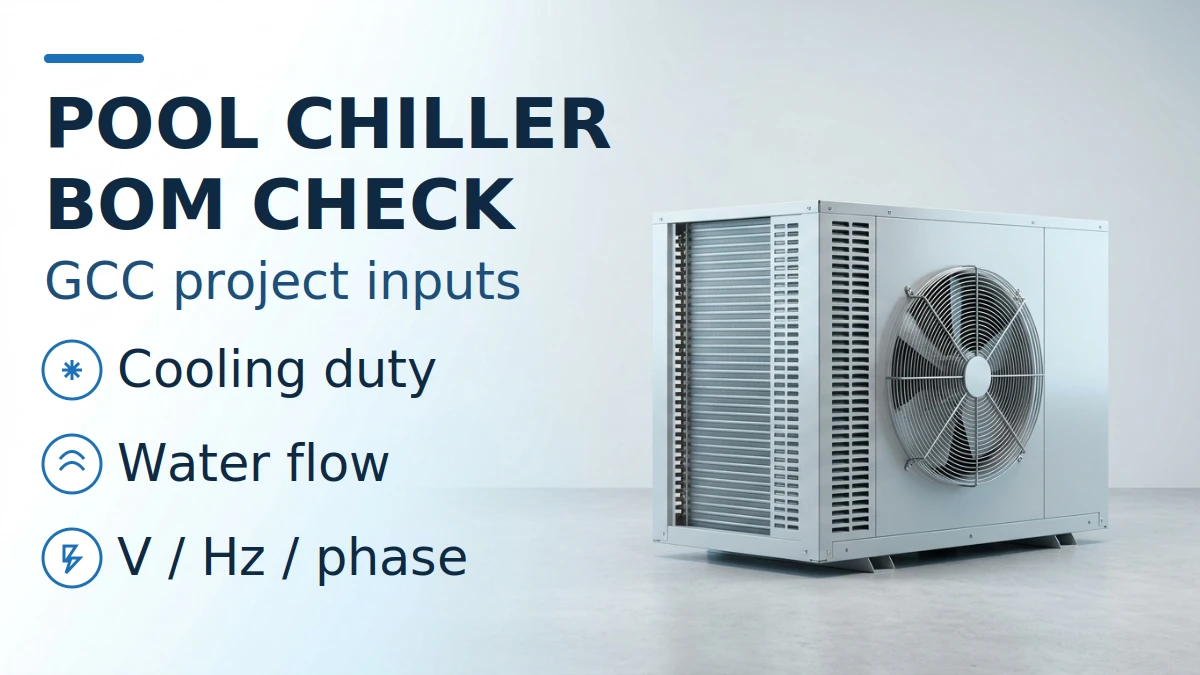
A pool chiller selected from its heating rating can leave a GCC project short of cooling capacity. Specify the pool chiller or heat-cool heat pump against the approved cooling duty, condenser-inlet air conditions and water temperature, then match its hydraulic and electrical interfaces to the equipment BOM.
A quote-ready swimming pool chiller line carries cooling output and electrical input separately. For a pool heater and chiller combo, require heating and cooling selections at their own design conditions. The checklist below turns those selections into comparable package offers; final thermal design and site approval stay with the project engineer.
Record the duty before comparing equipment
Use the same input sheet for every supplier in the pool equipment package. A pool-volume recommendation alone leaves the heat load and available operating hours unresolved.
Input or item | Value or source to record | Why it matters |
|---|---|---|
Pool geometry | Water volume in m³ and surface area in m² from drawings | Stored heat and surface heat exchange are different loads |
Water duty | Starting/target °C, recovery hours, operating schedule | Defines pull-down and holding requirements |
Summer and winter air | Engineer's design conditions at the unit air inlet | Defines the selection point and operating-envelope check |
Cover and exposure | Cover type/hours, shade, wind and humidity basis | Defines separate covered/open heat balances |
Water treatment | Salt/chloride, pH and disinfectant data | Checks wetted materials and warranty conditions |
Hydraulic/electrical interfaces | Available flow/head and approved V/Hz/phase | Prevents a capacity match with incompatible services |
Choose cooling-only or reversible equipment by duty
Choose cooling-only equipment when the approved scope needs cooling and winter heating is absent or separately provided. Choose a reversible heat-cool heat pump when both duties belong in the package and the offered unit meets each seasonal selection. Reversibility does not mean equal heating and cooling output.
Configuration | Selection evidence | Dominant Failure Mode & Prevention |
|---|---|---|
Cooling-only pool chiller | Cooling kW and input kW at specified air/water conditions | Insufficient pull-down capacity: check net load plus recovery requirement |
Reversible heat-cool unit | Separate summer cooling and winter heating selections | Heating headline reused as cooling duty: require both performance schedules |
Multiple units | Duty/standby arrangement, simultaneous output and control sequence | Summed nameplates conceal unavailable capacity: check the approved operating combination |
Calculate recovery separately from the holding load
Cooling selection must account for stored water heat and the net heat entering during operation. For an indicative fresh-water calculation, use density approximately 1,000 kg/m³ and specific heat approximately 4.184 kJ/(kg·K), giving a rounded factor of 1.16 kWh/(m³·K).
Recovery duty (kW) ≈ 1.16 × volume (m³) × temperature reduction (K) ÷ recovery time (h)
Example calculation (assuming 100 m³ water volume, 4 K temperature reduction and 12 h recovery): 1.16 × 100 m³ × 4 K ÷ 12 h = 38.7 kW for the stored-water term. With an assumed 8 kW net heat gain over that same period, the cooling requirement is approximately 38.7 + 8 = 46.7 kW, before the engineer's design allowance. Replace these inputs with the project water properties, hourly heat-gain schedule and the unit's capacity across the operating temperature range.
For unit comparison, Btu/h ≈ kW × 3,412; the example's 46.7 kW is approximately 159,300 Btu/h. Btu is energy; Btu/h and kW are rates. Electrical input kW is a separate field.
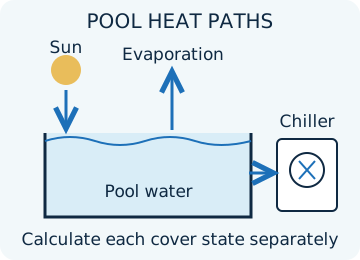
Heat paths in covered and uncovered operation; calculate each load term from the project schedule and site conditions.
For each time block, record solar gain, air exchange, radiation, make-up water, equipment heat and evaporation. Air exchange can add or remove heat depending on conditions. Evaporation removes heat; suppressing it also removes a cooling path. A cover changes several terms, so covered and open cooling loads need separate calculations. Apply the actual cover optical properties and schedule rather than deducting a fixed percentage from the chiller size. The cover energy and heating guide explains the seasonal trade-off.
Selection rule: if available cooling at the design point is less than the calculated load plus recovery duty, the selection cannot meet that recovery requirement. At holding temperature, compare capacity with the holding load separately. More running hours cannot correct a holding-load deficit while the net heat gain continues.
Verify the whole-unit tropical operating envelope
A “T3 compressor” description leaves the complete unit's cooling performance unresolved. Ask for the quoted model's cooling selection at the design condenser-inlet air temperature and water temperatures, together with its permitted ambient range and the test/rating reference behind the tropical claim. A compressor label alone is insufficient evidence for the complete assembly.
Use two acceptance checks: the design inlet-air condition must be within the model's documented operating range, and cooling output at that condition must meet the required duty. Maximum permitted ambient temperature is an operating boundary, not a guarantee of nominal capacity there.
The air inlet is the relevant location. Exhaust recirculation or an enclosed plant area can expose the coil to conditions different from the weather-file temperature. Include the location drawing, manufacturer clearances, maintenance access, dust-cleaning access and coastal-exposure requirements in the submittal. Keep these dimensions model-specific.
Specify titanium with chemistry limits and a hydraulic schedule
For a salt-chlorinated pool, request a titanium water-side exchanger and written compatibility for the actual water chemistry. Check the full wetted assembly, seals and connections as well as the tube material. Titanium does not waive the manufacturer's pH, salinity/chloride or disinfectant limits. Salt-chlorinated and seawater pools require their own chemistry data.
Record minimum/design/maximum branch flow, exchanger pressure drop, allowable pressure, inlet/outlet connection standard and bypass pipe/valve sizes. A connection diameter does not define the required branch flow or the whole filtration flow. Ask the supplier to identify which unions, isolation valves, flow indication and control interlocks are included.
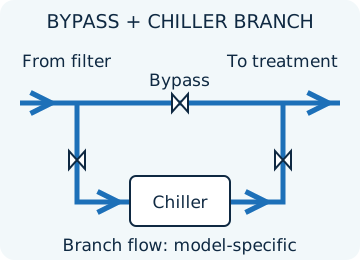
Split-flow bypass arrangement. Valve settings, pipe sizes and treatment protection require the selected manufacturer's approved layout.
For indicative fresh-water branch flow, flow (m³/h) ≈ cooling duty (kW) ÷ [1.16 × water temperature difference (K)]. Example calculation (assuming 24 kW cooling duty and a 2 K water temperature difference): 24 ÷ (1.16 × 2) = 10.3 m³/h. Verify that the resulting flow lies within the selected model's published minimum/maximum flow range and check the corresponding exchanger pressure drop.
If that flow falls outside the offered model's limits, revise the selection or hydraulic design. Check pump head with the added exchanger and branch losses. Retain filtration requirements independently. Confirm chemical-injection position and backflow protection against the manufacturer's drawing so concentrated treatment chemicals cannot return through the exchanger. Add these interfaces to the equipment BOM template.
Match voltage, frequency, phase and controls exactly
A schedule saying “380 V” leaves frequency and phase open. If the project specifies 380 V, three-phase, 60 Hz, a 380 V, three-phase, 50 Hz nameplate requires written manufacturer confirmation of suitability for that exact model and supply before approval. Matching voltage alone does not establish compatibility.
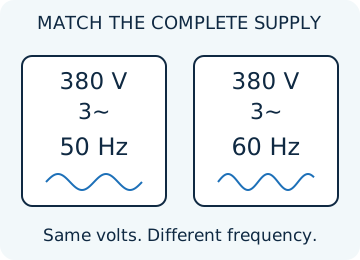
Identical voltage can conceal a frequency mismatch. Compare the complete approved electrical block.
Request the model suffix, permitted supply range, input/current schedule and wiring diagram. The project electrical designer must approve cable, protection, isolation, earthing and any neutral requirement using the manufacturer's documents and applicable local requirements. The GCC electrical checklist covers the wider package.
For controls, specify the required enable signal, pump/flow permissive, heating/cooling changeover, alarm output and any BMS interface. Confirm the actual protocol or contacts; “smart control” does not define an integration. Record who supplies each interface and who tests it at commissioning.
Compare total cost over the same operating period
Compare purchase and installation scope alongside whole-system electricity, service and downtime exposure. Use the same weather, setpoints, cover schedule, delivered thermal duty and comparison period for every offer.
Period electricity (kWh) = sum of [unit input kW × hours] + incremental circulation/control electricity
Example calculation (assuming a constant 6 kW electrical input over 8 h/day for 30 days): 6 kW × 8 h/day × 30 days = 1,440 kWh for the chiller alone. Multiply by the project's applicable tariff and add incremental pump consumption. Do not divide cooling load by a heating COP. For variable operation, use the cooling input map across the operating hours.
Cost item | Boundary to keep equal |
|---|---|
Equipment and site interfaces | Same duty/standby basis, bypass, valves, controls and electrical scope |
Electricity | Same period and thermal service, including additional pumping |
Service and spares | Coil cleaning access, approved service scope and offered spare-part terms |
Delivery and downtime | Packing, freight, site access, commissioning responsibilities and recovery arrangements |
State the period cost as equipment plus installation plus that period's energy, maintenance and other agreed costs. Use discounted cash flows if the project requires a multi-year present-value comparison. Align the shipping boundary with the consolidation and delivery scope.
Attach this acceptance checklist to the BOM
Keep each requirement beside the offered model, supporting document and approval status. Mark unresolved fields TBC with an owner before releasing the order.
- Cooling kW, electrical input and design air/water conditions are on the same selection sheet.
- Covered/open load basis, recovery time and seasonal duties match the design brief.
- Whole-unit ambient envelope and the tropical claim have model-specific evidence.
- Titanium exchanger, full wetted-material list and water-chemistry limits match the treatment data.
- Branch flow, pressure drop, bypass sizes, connection standards and included fittings are recorded.
- Voltage, frequency, phase, model suffix and controls match approved project documents.
- Quantity, duty/standby arrangement, service access, delivery boundary and commissioning evidence are agreed.
What to send us
Item | Why we need it | Example format |
|---|---|---|
Pool and plant drawings | Coordinate geometry, equipment access and interfaces | Dimensioned PDF with volume/surface area |
Thermal design brief | Compare cooling/heating selections on one basis | Air/water conditions, loads, recovery hours and cover schedule |
Treatment and services | Identify material, hydraulic and electrical gaps | Chemistry sheet, flow/head schedule and V/Hz/phase |
Current BOM and offers | Track quantities, model evidence and exclusions | Excel/PDF with destination and required-on-site date |
Start the drawing and BOM review with those files, or request a package quotation. We review the available drawings and BOM, identify open questions and coordinate supplier configurations and quotations. Your contractor and project engineer retain final design, installation and technical approval.
Method and sources
Updated 9 November 2026. The checklist combines public OEM documentation with heat-balance arithmetic and project procurement checks. The HP2300/2800 SPLIT installation manual, version 02/2019, sections 1.1, 3.1–3.2 and 4.1–4.3, supports the model-specific operating-envelope, chemistry and bypass checks. The SCP heat-pump catalogue, archived October 2024, separates heating/cooling ratings and hydraulic/electrical fields. Obtain the current documents for the exact model offered and verify operating limits against its published datasheet.
The EPA WaterSense outdoor-pool guide, September 2022 supports evaporation and cover-use principles. USGS specific heat guidance supplies the water heat-capacity basis; the NIST Btu definition supports the rounded unit conversion. Worked examples above apply the stated heat-balance formulas; replace the example inputs with the project's approved GCC design conditions and utility tariff.