
Pool Pump Cavitation: Causes, Sound & Suction-Side Fixes
Pool pump cavitation forms imploding vapor bubbles when inlet pressure drops below vapor pressure. Diagnose gravel noise vs air leaks or bearings and fix suction NPSH.
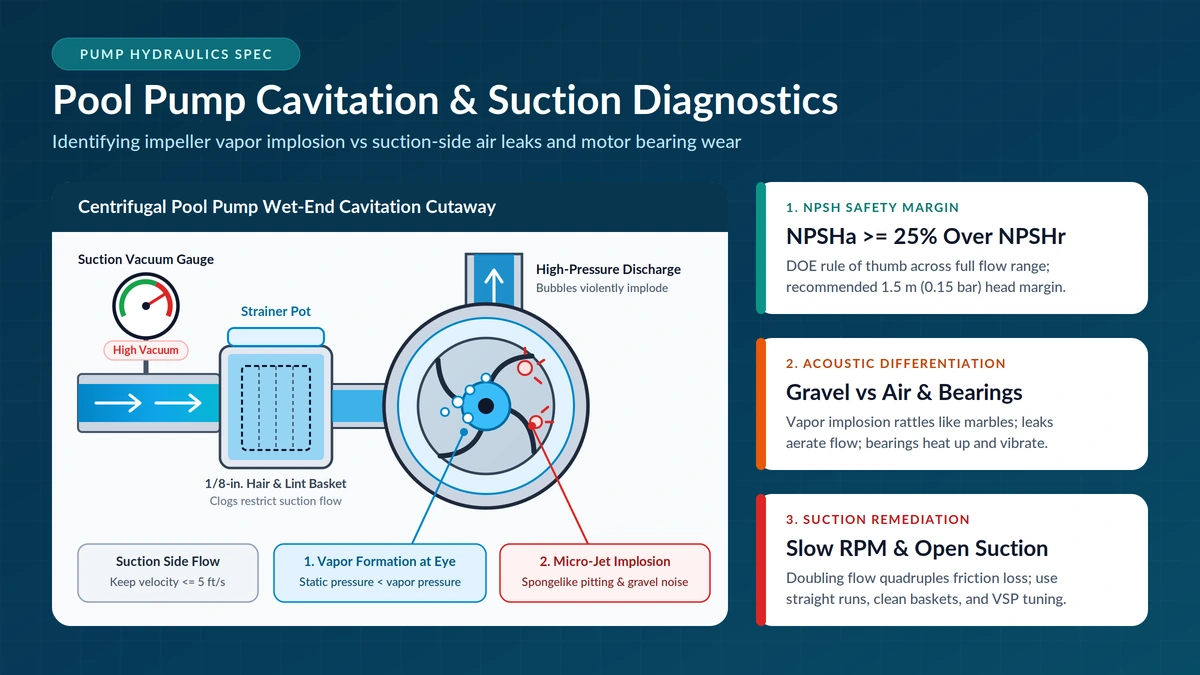
Pool pump cavitation occurs when static pressure at the impeller eye drops below the pool water's vapor pressure, causing liquid to flash into vapor bubbles that violently implode inside the high-pressure discharge zone. The resulting shock waves sound like gravel or marbles rattling inside the pump casing, pit the impeller face, and accelerate mechanical seal and bearing failure.
According to the U.S. Department of Energy pumping sourcebook, centrifugal pumps require sufficient inlet fluid pressure so that available suction head exceeds required suction head by at least 25% across the expected flow range. When planning a complete pool equipment package, pair this troubleshooting workflow with swimming pool filtration pump and sand filter BOM matching and VGB main drain cover flow rating and sump depth.
What Causes Cavitation in Pool Pumps?
Cavitation in pool pumps happens whenever suction pressure falls below the water's vapor pressure at flowing temperature—most commonly from clogged hair and lint strainers, blocked or undersized suction piping, close-coupled inlet elbows, excessive vertical suction lift, warm water, or operating far off the pump's best efficiency point (BEP).
In centrifugal pool circulation systems, cavitation takes two distinct operating forms depending on where the pump runs on its performance curve:
- Suction cavitation: A low-pressure, high-vacuum condition at the pump inlet vaporizes water at the impeller eye. When those vapor pockets reach the discharge side, higher pressure violently compresses them back into liquid, attacking the impeller face until chunks or tiny pits leave a spongelike surface. Common suction triggers include clogged filters or baskets, suction-side pipe blockages, overly long piping runs, collapsed vacuum hoses, poor suction layout, insufficient net positive suction head (NPSH), or running too far right on the pump curve.
- Discharge cavitation: Extremely high discharge pressure—normally when a pump runs below 10% of its BEP—forces most of the water to recirculate internally through narrow housing clearances at extreme velocity. The resulting local vacuum vaporizes water along the housing wall, wearing impeller vane tips, the pump casing, mechanical seals, and bearings.
Once cavitation pitting begins on an impeller surface, erosion accelerates. Each pit increases local flow turbulence and creates crevices that act as nucleation sites for additional vapor bubbles.
How Do NPSHa, NPSHr, and Water Temperature Control Cavitation Margin?
Available Net Positive Suction Head (NPSHa) measures how far the absolute pressure head at the pump inlet sits above the liquid's vapor pressure head, while Required NPSH (NPSHr) is the manufacturer-specified suction head needed to avoid cavitation—often determined experimentally as NPSH3, the point where pump head output drops by 3% at a given flow rate.
Water temperature directly narrows that safety margin. Because a fluid's vapor pressure is the force per unit area it exerts trying to change phase from liquid to vapor—and Tameson technical notes highlight that vapor pressure rises exponentially with temperature—warm pool or spa water lowers NPSHa and makes centrifugal pumps significantly more vulnerable to cavitation. General NPSH design practice calls for a minimum of 600 mm (0.06 bar) and a recommended 1.5 m (0.15 bar) of head pressure above manufacturer NPSHr, aligning with the U.S. Department of Energy rule of thumb keeping NPSHa at least 25% above NPSHr over the full operating flow range.
What Does Pool Pump Cavitation Sound Like, and How Do You Separate It from Air Leaks or Bearing Noise?
Suction cavitation produces a distinct rattling, crackling noise inside the wet-end pump casing commonly described as pumping gravel or marbles. Technicians separate hydraulic cavitation from suction-side air leaks and worn motor bearings by matching acoustic character, bubble behavior, bearing temperature, and vibration location across the pump assembly.
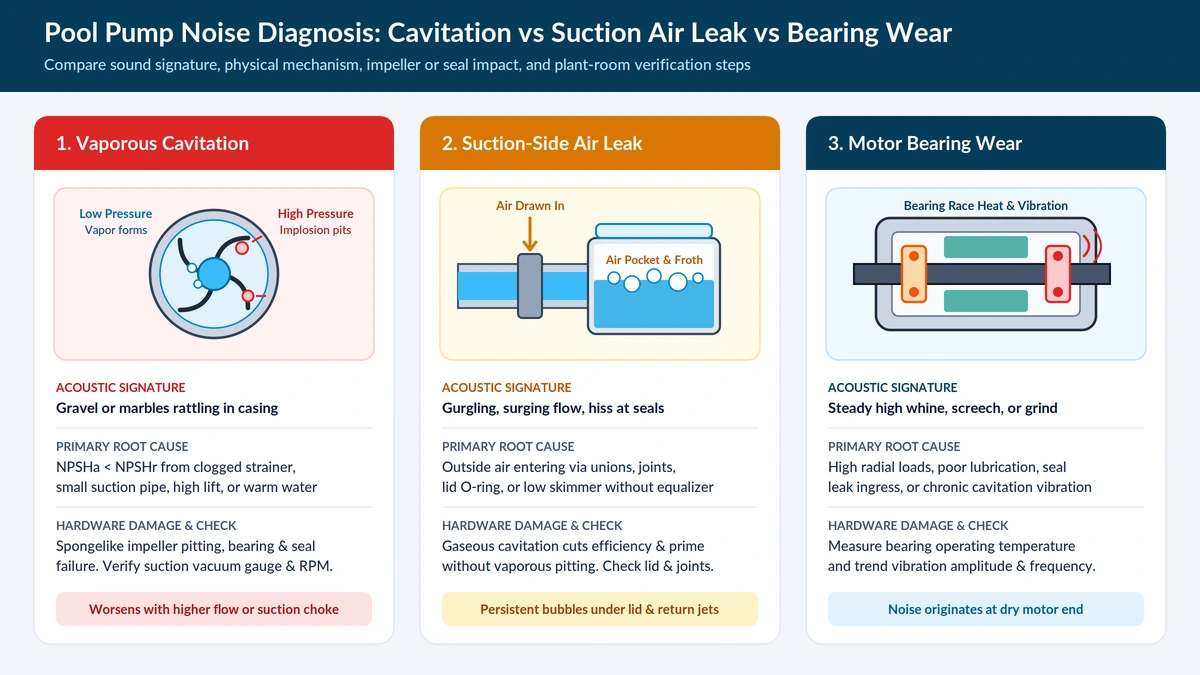
Comparing the three primary pool pump noise sources: vaporous cavitation rattles inside the wet end and pits the impeller, suction air leaks aerate the strainer basket and drop prime without pitting, and motor bearings run hot with rising vibration at the dry end.
Tameson technical guidance distinguishes vaporous cavitation from unwanted aeration: when outside air enters a suction line through loose unions, joints, or holes, it creates gaseous cavitation that significantly lowers hydraulic operating efficiency without causing the pitting erosion produced by vaporous bubble implosion. Meanwhile, the U.S. Department of Energy pumping sourcebook recommends assessing bearing condition by listening for excessive wear noises, measuring bearing operating temperature, and trending vibration amplitude and frequency over time—noting that impeller erosion from chronic cavitation can also introduce mechanical imbalance and vibration that shortens bearing and seal life.
| Failure Mode | Acoustic Signature | Primary Root Cause | Hardware Impact | Field Verification Check |
|---|---|---|---|---|
| Suction cavitation (vaporous) | Crackling rattle sounding like gravel or marbles inside the wet-end pump casing | NPSHa drops below NPSHr from clogged strainers, blocked or undersized suction piping, high lift, close-coupled elbows, or warm water | Spongelike pitting across the impeller face, sharp vane drag increase, mechanical imbalance, and premature bearing and seal failure | Check suction compound vacuum-pressure gauge, clean 1/8-inch basket, and test whether noise drops at lower motor RPM |
| Discharge cavitation | Harsh hydraulic noise and vibration under excessive discharge pressure | Pump running at less than 10% of BEP against severe downstream restriction, forcing internal fluid recirculation | Premature wear on impeller vane tips and pump housing, plus rapid mechanical seal and bearing failure | Read discharge pressure gauge adjacent to pump and verify downstream valves, filter media, and operating point against BEP |
| Suction-side air leak (aeration) | Gurgling, surging hydraulic flow, and intermittent prime-loss chatter | Outside air entering through loose unions, joints, holes, or a low skimmer lacking a properly sized equalizer line | Gaseous cavitation that cuts pumping efficiency and triggers air lock or loss of prime without vaporous metal pitting | Inspect suction unions, joints, and strainer seals; verify pool water level and skimmer equalizer float valve assembly |
| Motor or pump bearing wear | Continuous wear noise centered at the motor frame or shaft end rather than hydraulic rattling | Excessive radial load, poor lubrication, misalignment, or prolonged vibration caused by cavitation erosion | Progressive bearing degradation, rising motor housing heat, and eventual shaft or seal failure | Measure bearing operating temperature, inspect mechanical seal leakage, and trend vibration amplitude and frequency over time |
Why Is the Pool Pump Surging and Showing Bubbles Under Load?
A pool pump surges and discharges bubbles under load for two different hydraulic reasons: either external air is being pulled into the suction stream and breaking prime, or severe vaporous cavitation is raising impeller vane drag sharply enough to stall and recover flow cyclically.
Start by separating gaseous aeration from vapor starvation. Under Kentucky public pool regulations, a skimmer equalizer line connects the skimmer housing below the weir box to the pool and is sized specifically to satisfy pump demand and prevent air lock or loss of prime using a float valve and pop-up valve assembly. If pool water drops below the skimmer mouth without an active equalizer path—or if outside air enters through leaking suction unions and joints—aeration drops pump efficiency and sends visible air bubbles through the system.
Elevation above the waterline compounds loss-of-prime symptoms. Kentucky pool standards require any pump installed above the facility water line to be self-priming, and under U.S. federal pool pump regulations (10 CFR 431.462), a self-priming pool filter pump is certified under NSF/ANSI 50-2015 or capable of re-priming to a vertical lift of at least 5.0 feet in 10.0 minutes or less. When vertical suction lift, dirty strainer baskets, or collapsed vacuum hoses starve a pump beyond its available suction head, impeller vane drag increases drastically—potentially stopping flow altogether—producing repeated surging cycles until suction restriction is removed.
How Do You Reduce Cavitation in a Centrifugal Pool Pump?
Reduce cavitation in a centrifugal pool pump by increasing available suction head and lowering required NPSH simultaneously: dial down variable-speed motor RPM, clear and enlarge suction piping to keep suction velocity at or below 5 feet per second, eliminate close-coupled inlet elbows, lower pump elevation where feasible, and keep operation within 20% of BEP.
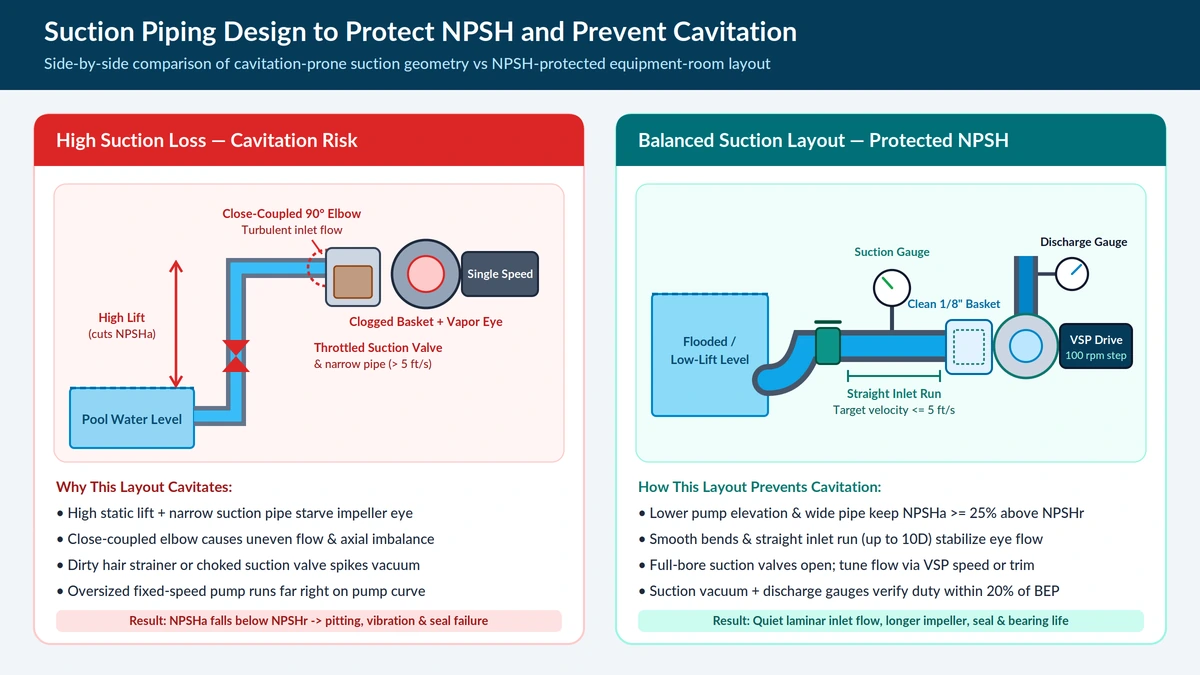
Eliminating close-coupled suction elbows, maintaining suction velocities at or below 5 feet per second, lowering pump elevation, and dialing flow with a variable-speed drive protect available NPSH margin across the operating curve.
Apply five engineering levers in order from fastest plant-room adjustment to permanent piping upgrades:
- Lower motor speed with a variable-speed drive: Tameson notes that reducing motor speed slows how fast water enters the pump and reduces inlet pressure drop, while NPSH pump-curve behavior confirms that lower flow reduces NPSHr directly. Because the U.S. Department of Energy shows dynamic head losses scale roughly with the square of flow velocity—doubling flow increases dynamic losses fourfold—stepping down pump speed yields a disproportionate gain in NPSHa margin. Under 10 CFR 431.462, a variable-speed dedicated-purpose pool pump adjusts across user-determined speeds in increments of at most 100 rpm down to one-third or less of maximum speed, and DOE guidance favors adjustable speed drives or multiple pump arrangements over throttling or bypassing excess flow.
- Enlarge, shorten, and smooth suction piping: Kentucky public pool construction rules cap suction piping velocity at 5 feet per second (compared with 10 feet per second in pressure piping). Upgrading to smooth plastic or epoxy-coated piping cuts friction factor by more than 40% per DOE guidance, and Tameson notes that sweeping pipe bends create less friction loss than abrupt elbows while reducing joints limits air-leak entry points.
- Remove close-coupled suction elbows: Poorly developed inlet flow from an elbow mounted directly against the pump inlet flange strikes the impeller vanes unevenly, causing cavitation, vibration, poor impeller filling, and premature seal, bearing, and impeller failure. Pump manufacturer manuals commonly recommend about 10 pipe diameters of straight pipe run upstream of the pump inlet flange where equipment-room space allows.
- Match impeller output to the system curve: When an oversized pump runs too far right on its curve, DOE guidance recommends selecting or adjusting operation so the system curve intersects the pump curve within 20% of BEP, or trimming the impeller to match actual system head. As a short-term hydraulic diagnostic, cavitation remediation guidance allows throttling back the discharge valve slightly to decrease flow rate and venting trapped gases off the pump casing—never throttle the suction-side isolation valve, which deepens inlet vacuum.
- Increase static submergence and manage water temperature: Raising the liquid level relative to the pump centerline or lowering pump elevation increases absolute suction pressure directly, which is especially critical in heated pools and warm-climate plant rooms where higher water temperatures raise vapor pressure exponentially.
What Suction-Side Checks Fix Pool Pump Cavitation in the Plant Room?
A plant-room suction audit fixes most pool pump cavitation cases by verifying pool water level and equalizer flow, cleaning the 1/8-inch hair and lint strainer basket, comparing suction vacuum and discharge pressure gauges, sealing leaking suction unions, verifying suction piping velocity and straight run, and checking mechanical seals and bearings for secondary wear.
Use the field checklist below during commissioning or fault investigation, and keep pump duty curves, strainer sizing, and piping diameters aligned on one shared submittal schedule when ordering a pool equipment package.
| Inspection Step | Component Checked | Target / Engineering Threshold | Corrective Action |
|---|---|---|---|
| 1. Basin water level & skimmer | Skimmer mouth, weir, and equalizer line float valve | Continuous flooded draw with equalizer line preventing air lock or loss of prime | Restore basin water level, clear skimmer baskets, and verify equalizer float and pop-up valve movement |
| 2. Hair & lint strainer | Pre-pump strainer basket and suction isolation valves | Clean basket with openings no larger than 1/8 inch (except vacuum filter systems) and full-open suction valves | Close isolation valves, clean or swap the strainer basket, inspect the lid seal, and reopen suction valves fully |
| 3. Suction & discharge gauges | Suction compound vacuum-pressure gauge and adjacent discharge pressure gauge | NPSHa at least 25% above NPSHr (recommended 1.5 m / 0.15 bar); vacuum filter limit switch at most 18 inches of mercury | Clear upstream suction restrictions if vacuum spikes; inspect downstream filter or closed valves if discharge pressure spikes |
| 4. Suction joints & unions | Suction pipe unions, threaded joints, vacuum hoses, and valve stems | Airtight suction envelope with zero external air ingress or collapsed vacuum hoses | Tighten or re-seal leaking unions and O-rings, vent trapped gas from casing, and replace restricted or collapsed hoses |
| 5. Suction geometry & speed | Suction header diameter, inlet elbow spacing, and motor RPM / impeller trim | Suction velocity at most 5 feet per second, up to 10 pipe diameters straight inlet run, duty within 20% of BEP | Reduce VSP speed in 100 rpm increments, trim an oversized impeller, or repipe close-coupled elbows with smooth bends and larger plastic pipe |
| 6. Seals & bearings follow-up | Mechanical shaft seal, impeller face, and motor bearings | Zero out-of-spec mechanical seal leakage; stable bearing temperature and vibration trend | Replace leaking mechanical seals, inspect pitted impellers for imbalance, and lubricate or replace worn bearings |
For new equipment-room pump and filter sizing, review swimming pool filtration pump and sand filter BOM matching; for suction outlet cover flow ratings and sump geometry, see VGB main drain cover flow rating and sump depth; and download our equipment BOM template to record suction line velocity, gauges, and pump operating points consistently across submittals.
Frequently Asked Questions
What does pool pump cavitation sound like compared with bad motor bearings?
Suction cavitation sounds like gravel or marbles rattling inside the wet-end pump casing and shifts noticeably when suction restriction or pump speed changes. Failing motor bearings produce a steady mechanical wear noise at the motor end, accompanied by elevated bearing operating temperature and rising vibration amplitude and frequency over time.
How much NPSH safety margin should a centrifugal pool pump have?
The U.S. Department of Energy rule of thumb is to keep available net positive suction head (NPSHa) at least 25% higher than the pump's required NPSH (NPSHr) across the full expected flow range. General NPSH design guidance similarly calls for a minimum of 600 mm (0.06 bar) and a recommended 1.5 m (0.15 bar) margin above manufacturer NPSHr.
Can closing a suction-side valve stop pool pump cavitation?
No. Restricting or partially closing a suction-side valve increases suction head loss and deepens the inlet vacuum, making vaporous cavitation worse. If an oversized pump runs too far right on its curve, lower variable-speed motor RPM, trim the impeller, or throttle slightly on the discharge valve rather than the suction side.
Does a suction air leak pit the pump impeller like vaporous cavitation?
No. Tameson technical guidance notes that unwanted air drawn through leaking unions or joints causes gaseous cavitation, which significantly reduces operating efficiency and causes surging or loss of prime, but it does not produce the violent micro-jet pitting erosion caused by vaporous cavitation bubbles imploding on the impeller face.
Why does pool pump cavitation get worse in hot water or summer heat?
A liquid's vapor pressure rises exponentially as temperature increases. Higher pool or spa water temperatures shrink the gap between inlet absolute pressure and water vapor pressure, cutting available NPSHa margin unless pump submergence is increased or suction friction losses and flow rate are reduced.
Sources
- U.S. Department of Energy — Improving Pumping System Performance: A Sourcebook for Industry, 2nd Edition
- Kentucky Administrative Regulations — 902 KAR 10:123 Public Swimming and Bathing Facilities Construction Requirements (Cornell LII)
- U.S. Code of Federal Regulations — 10 CFR 431.462 Dedicated-Purpose Pool Pump Definitions (eCFR)
- Wikipedia — Net Positive Suction Head (NPSH)
- Wikipedia — Cavitation
- Tameson Technical Information Center — Cavitation In Pumps, Valves, and Pipes