
Pool Zinc Anode: Galvanic Protection, Placement & Checks
Specify and maintain a pool zinc anode for saltwater and mixed-metal pools. Check closed-circuit bonding, inline placement, scale checks, and replacement.
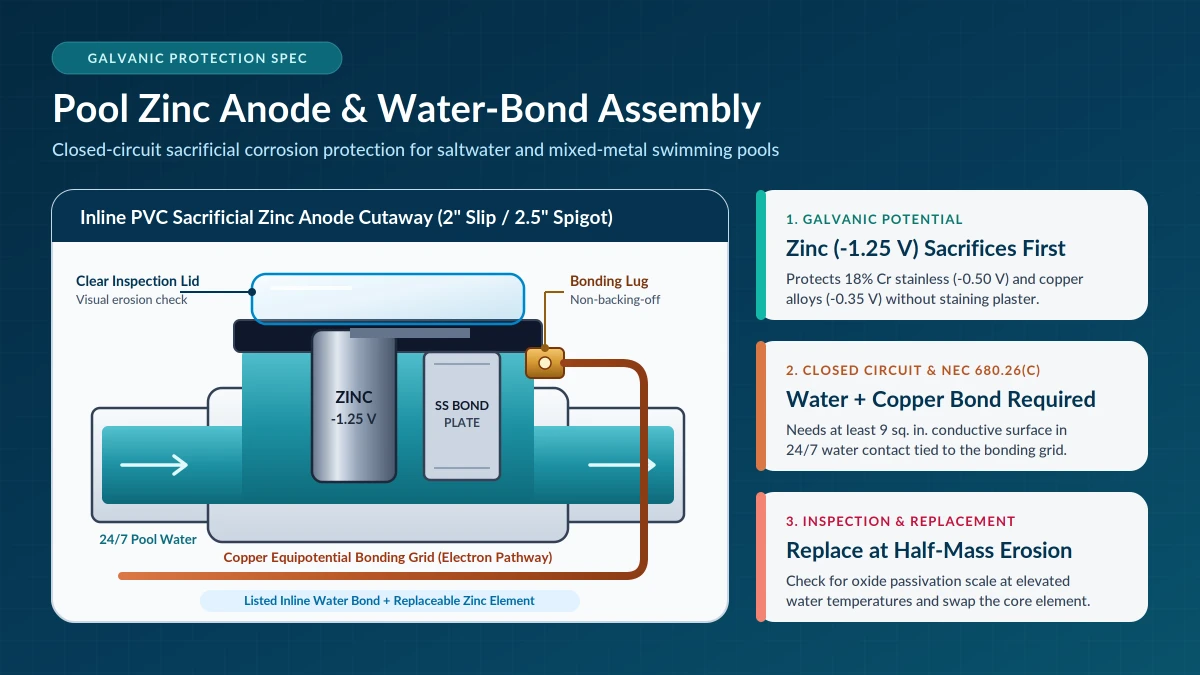
A pool zinc anode protects saltwater and mixed-metal swimming pools from galvanic corrosion by acting as a more electrochemically active sacrificial metal that corrodes preferentially ahead of stainless steel ladders, pool lights, light niches, and heat exchangers without discoloring plaster. Effective protection requires both continuous water immersion and a solid copper connection to the pool equipotential bonding grid.
Galvanic cathodic protection connects a vulnerable submerged metal to a more active alloy so corrosion transfers from expensive structural hardware onto the replaceable sacrificial element, as documented in the galvanic anode engineering reference. When specifying stainless steel fittings across a complete pool accessories package, coordinate anode placement alongside stainless steel pool ladders, stainless steel alloy selection, and wet-niche pool light bonding before locking the equipment schedule.
Why Use a Sacrificial Zinc Anode in Saltwater Pools?
Immersing dissimilar metals such as copper heat exchangers and stainless steel fittings in conductive saltwater creates a galvanic battery that erodes the less noble metal and stains pool plaster. Adding a bonded zinc anode introduces a more active metal at -1.25 V on the anodic index than copper and stainless steel so zinc dissolves first while its zinc ions do not discolor plaster.
As explained in the galvanic corrosion reference, dissimilar-metal corrosion occurs whenever two different metals share electrical contact inside an electrolyte. In swimming pools operated with salt chlorine generators, dissolved salt lowers electrolyte resistivity and accelerates ion migration between wetted hardware. Acqua Pools notes that combining different metals such as copper and stainless steel in a saltwater pool forms a battery that causes both metal erosion and plaster discoloration, whereas zinc gives up metal ions faster than pool lights, light niches, heaters, and handrail ladders without discoloring plaster.
Electrochemical compatibility can be compared using the anodic index relative to gold. In harsh outdoor, high-humidity, and salty environments, dissimilar metals in direct contact should stay within a 0.15 V anodic-index difference. Copper, low brass, and bronze sit at -0.35 V while 18%-chromium corrosion-resistant stainless steels sit at -0.50 V—already reaching that 0.15 V boundary before water chemistry shifts intervene. Wrought zinc and zinc-base alloys measure -1.25 V, creating a strong driving potential that shifts stainless ladders, light bezels, and copper-alloy exchangers into the protected cathodic role.
How Do Galvanic Corrosion and Electrolytic Corrosion Differ?
Galvanic corrosion is driven purely by the electrochemical potential difference between dissimilar metals coupled through an electrolyte and a metallic conductor. By contrast, electrolytic corrosion occurs when an external electrical current acts on submerged metal hardware. Both mechanisms follow the same electrochemical dissolution pathway, and improper water pH or elevated conductivity accelerates corrosion across mixed-metal circulating piping.
Where Does an Inline or Skimmer Pool Zinc Anode Install?
Install a sacrificial pool zinc anode inline within the circulation piping—or inside a listed water-bond skimmer assembly—at a point that stays submerged continuously even when the pump shuts off, and hard-wire its external lug directly into the copper equipotential bonding grid. Dropping a loose zinc weight into a plastic skimmer basket leaves an open circuit and fails to protect bonded hardware.
According to the galvanic anode technical guide, cathodic protection works only when two paths close the electrical circuit simultaneously: an electron pathway between the anode and the protected metals (via copper wire or direct metallic contact) and an ion pathway through the water electrolyte between both metals. A loose zinc block resting inside a non-conductive plastic skimmer basket touches pool water, but without a copper bonding conductor tying it to ladders, light niches, and heater casings, electrons cannot flow between the anode and protected fixtures.
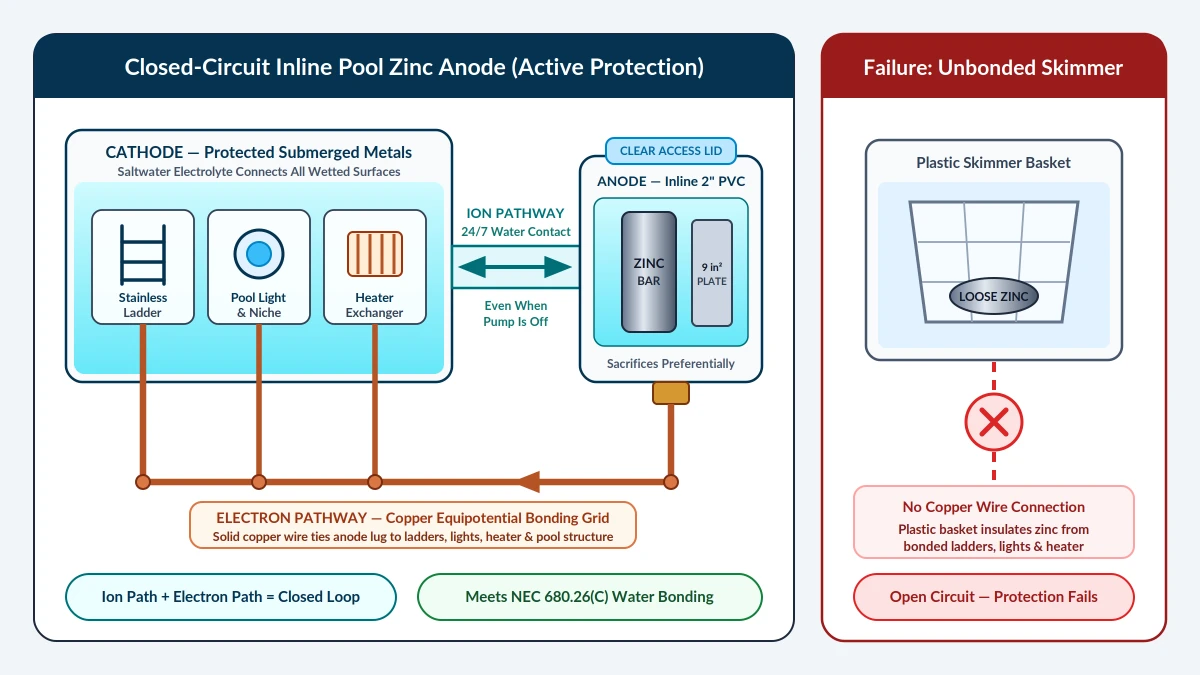
Galvanic protection requires a closed circuit combining continuous water contact (ion pathway) with a copper equipotential bond wire (electron pathway); an unbonded zinc puck in a plastic skimmer basket breaks the electron loop.
Never attempt to stop galvanic coupling by disconnecting or isolating metallic pool components from the safety bonding loop. As emphasized in galvanic corrosion prevention guidance, electrical isolation must never be attempted where an electrical earthing or equipotential bonding system relies on the connected metalwork.
Why Do Plastic Wet Niches and Nicheless LEDs Require Dedicated Water Bonding?
Since 2008, NEC Section 680.26(C) has required pool water itself to be electrically bonded—not only structural steel and metal deck hardware. CMP technical guidance summarizes three mandatory criteria under NEC Section 680.26(C): the water-bonding device must expose at least 9 sq. in. of conductive material, remain in contact with pool water 24/7 whether the circulation system is running or not, and use a connector lug that cannot back off from vibration.
Older concrete pools often achieved water bonding incidentally through a bonded metallic underwater light wet niche. When modern projects specify plastic wet niches or nicheless LED fixtures instead, CMP notes that removing the metal niche eliminates that water-bonding path and requires installing an alternative certified water-bonding device—either an inline combination zinc anode and water bond placed where piping stays flooded continuously, or a water-bond skimmer built with a stainless steel plate behind the basket and an embedded copper wire exiting the skimmer body to join the bonding grid.
What Components Come in an Inline Pool Zinc Anode Kit?
A listed inline pool zinc anode and water-bond kit includes a 2-inch slip or 2.5-inch spigot PVC housing, a removable clear inspection lid, an internal stainless steel water-bonding plate, a replaceable sacrificial zinc element, a vibration-resistant external bonding lug, and an optional 4 ft solid copper bonding wire.
On commercial and residential equipment pads, specifying a listed combination assembly simplifies both corrosion mitigation and electrical code compliance. For example, CMP Pool Defender compact inline assemblies (such as part 25810-400-050 with copper wire) combine a steel water-bonding plate with a sacrificial zinc bar inside a 2-inch slip / 2.5-inch spigot body, carry UL-1081, UL-1563, and CSA C22.2-218.1 compliance alongside NEC 680.26(C) water-bonding conformance, and allow core replacement through the clear top cap without cutting pipe.
| Kit Component | Engineering Specification and Units | Primary Failure Prevented |
|---|---|---|
| Inline PVC housing | Compact 2-inch slip / 2.5-inch spigot body mounted where water contacts the chamber 24/7 | Dry-out air pockets that break continuous NEC 680.26(C) water contact when the pump stops |
| Removable clear inspection lid | Transparent top cap providing direct visual inspection and top-entry service access | Unseen anode depletion or forced pipe cutting during routine element replacement |
| Replaceable sacrificial zinc element | Zinc-alloy bar (-1.25 V anodic index) supplied as a separately orderable refill element | Galvanic erosion of stainless ladders, light niches, and copper-alloy heat exchangers |
| Internal stainless water-bonding plate | Corrosion-resistant conductive plate providing at least 9 sq. in. of wetted surface | Loss of code-compliant water bonding in pools using plastic wet niches or nicheless LED lights |
| External bonding lug and copper wire | Non-backing-off lug paired with optional 4 ft solid copper bonding conductor | Open electron circuit caused by loose terminations or vibration loosening on the pump pad |
| Third-party compliance listings | UL-1081, UL-1563, CSA C22.2-218.1, and NEC 680.26(C) water-bonding device verification | Site inspection rejection on commercial and municipal pool electrical sign-offs |
What Are the Main Types of Sacrificial Anodes Used in Water Systems?
The three main sacrificial anode metals used in water systems are zinc, aluminum, and magnesium—supplied as blocks, rods, plates, or extruded ribbons. Saltwater swimming pools rely primarily on zinc because zinc avoids magnesium's rapid self-corrosion and hydrogen evolution while remaining electrochemically reliable where aluminum passivates below 1,446 parts per million of chloride.
Selecting the wrong anode metal for the electrolyte conductivity either starves the circuit of current or accelerates destructive side reactions, as detailed in the galvanic anode alloy guide and cathodic protection overview. Compare the three core sacrificial materials across their electrochemical properties before approving a pool specification.
| Anode Material | Anodic Index / Seawater Capacity | Target Electrolyte Regime | Key Operational Risks and Limits |
|---|---|---|---|
| Zinc | -1.25 V anodic index; 780 Ah/kg theoretical capacity in seawater | Saltwater pools and lower-resistivity brackish or marine water | Reliable low driving voltage prevents overprotection, but oxide passivation occurs at higher water temperatures and current drops in high-resistivity fresh water |
| Aluminum | 2000 Ah/kg theoretical capacity in seawater; lighter weight than zinc | Marine and higher-chloride saltwater installations | Less electrochemically reliable than zinc; passivates where chloride concentration falls below 1,446 parts per million |
| Magnesium | -1.75 V anodic index (most negative driving potential) | Higher-resistivity fresh water, water heaters, and buried onshore pipelines | Dissolves rapidly via self-corrosion in salt water and risks hydrogen embrittlement or coating disbonding from overprotection |
How Do Alloy Casting Methods and ICCP Differ From Passive Pool Anodes?
ASTM International publishes composition and manufacturing standards governing zinc, magnesium, and aluminum galvanic anodes. Production method also influences electrochemical consistency: gravity casting allows the alloy chemistry to remain tailored for 100% optimum corrosion protection, whereas automated high-pressure die-casting requires modifying the alloy composition for repeatable machine casting.
At utility scale—such as long buried pipelines or large steel marine hulls—engineers sometimes switch from passive sacrificial anodes to impressed current cathodic protection (ICCP), which connects inert anodes to an external DC transformer-rectifier. For swimming pool circulation loops, passive zinc anodes remain the standard choice because they require no external power supply, are straightforward to install, present a low risk of stray-current interference, and self-limit their driving voltage to prevent hydrogen embrittlement.
When Should You Replace an Eroded Pool Zinc Anode?
Replace a sacrificial pool zinc anode once half of its original mass has been lost to erosion. Waiting until the zinc bar dissolves completely leaves stainless steel ladders, underwater light rings, and heat-exchanger headers unprotected against accelerated galvanic pitting.
Acqua Pools states directly that a pool zinc anode should be replaced when half of it has been lost to erosion. Avoid estimating replacement timing from a fixed calendar guess alone, because actual consumption speed scales with two site-specific variables documented in galvanic anode design principles and galvanic corrosion engineering: the total surface area of bare metal exposed to pool water and water chemistry factors including pH and conductivity. Pools with multiple stainless steel handrails, submerged metal niches, brass valves, and aggressive sanitizer chemistry deplete zinc faster than lightly equipped basins.
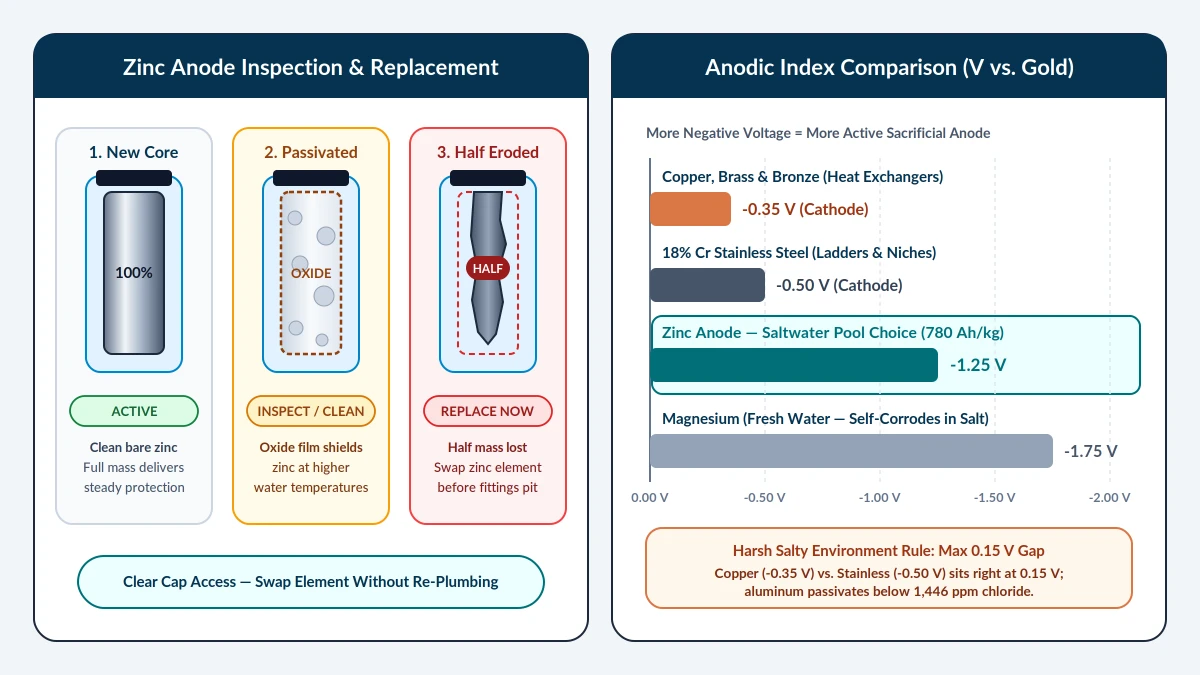
Inspect the zinc core for insulating oxide passivation and replace the refill element at half-mass loss, while verifying that zinc (-1.25 V) remains far more active than stainless steel (-0.50 V) and copper alloys (-0.35 V).
In industrial marine and pipeline cathodic protection, designers apply an anode utilization factor (UF) to specify how much anode mass can be consumed before geometry losses degrade output—using a UF value of 0.8 (80%) for short flush-mounted anodes and 0.9 for long slender stand-off anodes. In compact swimming pool inline housings, replacing the sacrificial core earlier at half erosion preserves healthy surface area and prevents loose corrosion fragments from entering downstream valves or heaters. Because compact inline housings use separately supplied replacement zinc elements, technicians swap only the internal core without disturbing the glued PVC body or the external bonding wire.
How Do You Inspect and Clean Scale Off a Pool Zinc Anode?
Inspect the zinc element periodically through the inline housing's clear access lid after shutting down circulation, verifying continuous water immersion, a tight bonding lug, and active bare zinc metal. If a chalky passivating oxide layer coats the bar—especially in heated pools or spas—clean the surface down to clean metal or replace the element if half its mass is already gone.
Unlike inert bonding plates, zinc requires active metallic exposure to keep delivering protective electrons. The galvanic anode engineering guide warns that zinc tends to passivate at higher temperatures, forming an oxide layer that shields the underlying metal from further oxidation; once passivation takes hold, protective current can cease to flow and the anode stops working even while looking mostly intact. Routine inspection and timely replacement are therefore mandatory maintenance steps to keep galvanic protection active.
Follow a consistent four-point maintenance check during routine pool plant servicing:
- Visual check through the clear lid: Confirm the housing chamber remains filled with water and inspect the zinc bar for heavy pitting, diameter loss approaching half of the original size, or thick white-grey surface oxide scale.
- Shutdown and isolation before opening: Turn off the circulation pump and isolate pad valves before unscrewing the clear inspection cap so water cannot drain back through the equipment pad.
- Surface reactivation or element swap: Remove passivating oxide buildup so bare zinc contacts the pool water directly, and install a matching replacement zinc element whenever erosion reaches half of the original mass.
- Bonding lug and water-contact verification: Confirm the external lug remains tight against vibration, the solid copper bonding conductor is intact and continuous to the grid, and air is purged so pool water contacts the anode and stainless bonding plate 24/7.
Project Submittal Checklist for Mixed-Metal Pool Packages
Include sacrificial corrosion protection and water-bonding hardware on the same equipment schedule as ladders, rails, lights, and heat exchangers so electrical and mechanical scopes never conflict on site. Confirm the following inputs before issuing a quotation request:
- Water chemistry and sanitizer scope: Record whether the basin uses a salt chlorine generator, target chloride level, water temperature range (heated pool or spa), and pH control method.
- Wetted metal inventory: List all submerged stainless steel ladders, handrails, anchor sockets, light niches, brass fittings, and copper-alloy or titanium heat exchangers.
- Lighting niche and NEC 680.26(C) water-bond path: Confirm whether lights use plastic wet niches or nicheless LEDs, and specify either a listed inline combination zinc anode and water bond (2-inch slip / 2.5-inch spigot) or a water-bond skimmer.
- Equipotential bonding continuity: Show the solid copper conductor route tying the anode's vibration-resistant lug directly to the pool equipotential bonding grid alongside ladder anchors and heater casings.
- Spare zinc refill elements: Include matching replacement zinc elements on the commissioning spares list so facility staff can service the clear-cap housing without re-plumbing.
Review alloy grade boundaries in our stainless steel pool fittings guide and luminaire bonding details in our pool light wet niche bonding guide. Submit your marked-up accessory schedule through Drawing and BOM Review, or request a project quote covering stainless hardware, inline zinc anodes, and replacement elements.
Frequently Asked Questions
Does a pool zinc anode work if you drop it in the skimmer basket?
No. A loose zinc block dropped into a plastic skimmer basket lacks an electron pathway to the pool's metallic ladders, light niches, and heater. Galvanic protection requires both a water ion pathway and a solid copper electrical connection tying the zinc anode into the pool equipotential bonding grid.
Will a sacrificial zinc anode stain or discolor pool plaster?
No. Acqua Pools notes that zinc erodes preferentially ahead of copper and stainless steel pool components and that dissolved zinc ions do not discolor pool plaster, whereas unchecked galvanic corrosion of other submerged metals causes plaster discoloration alongside hardware erosion.
Why is zinc preferred over magnesium or aluminum in saltwater pools?
Zinc (-1.25 V anodic index) provides reliable sacrificial protection in lower-resistivity salt water without magnesium's rapid self-corrosion or hydrogen-embrittlement risk, and without aluminum's tendency to passivate when chloride levels drop below 1,446 parts per million.
When should you replace a sacrificial zinc anode in a swimming pool?
Replace the zinc anode element once half of its original mass has been lost to erosion. Check the zinc bar periodically through the clear inline housing lid, and verify that elevated water temperatures have not formed an insulating oxide passivation layer that stops current flow.
Can an inline zinc anode satisfy NEC 680.26(C) pool water bonding requirements?
Yes, when you specify a listed combination inline zinc anode and water-bond assembly (compliant with UL-1081, UL-1563, CSA C22.2-218.1, and NEC 680.26(C)) that provides at least 9 sq. in. of conductive material, maintains 24/7 water contact even when the pump is off, and uses a vibration-resistant bonding lug tied to the copper grid.
Sources
- Galvanic anode — Closed-Circuit Pathways, Alloy Selection, Passivation, and Design Factors (Wikipedia)
- Galvanic corrosion — Electrochemical Mechanism, Anodic Index, and Bonding Boundaries (Wikipedia)
- Cathodic protection — Galvanic Series, ASTM Standards, and ICCP Comparison (Wikipedia)
- CMP — Pool Defender Anodes, Water Bond Devices, and Essential Guide to Pool Water Bonding Basics (NEC Section 680.26(C), UL-1081, UL-1563, CSA C22.2-218.1)
- Acqua Pools — Reason for the Use of a Zinc Anode in Chlorine Generated Salt Water Pools