
Pool Return Inlet Eyeball Sizing & Puddle Flanges
Contractor guide to pool return inlet eyeball sizing, orifice head loss, wall versus floor return inlet layout, and concrete wall conduit puddle flange sealing.
For a swimming pool filtration system, circulation flow is calculated as Q = V ÷ T (where Q is in m³/h, V is in m³, and T is in hours), with no Gulf-wide default.
A matching nominal connection size does not prove hydraulic capacity or physical compatibility.
Under the 2023 MAHC Glossary (Section 2.0), 'Inlet' means wall or floor fittings where treated water is returned to the pool.
Under MAHC Section 4.7.1.3.1.1, the recirculation system shall be designed for hydraulic apportionment ensuring effective distribution of treated water and a uniform disinfectant residual and pH.
PoolProject supplies pool ladders, handrails, anchors, tracks and rollers from its own factory for contractor projects and planned distributor orders, and dimensions are recorded in millimetres.
Water treatment, salt use, coastal exposure and cleaning access must be stated before approving stainless-steel grade; SS316 offers greater corrosion resistance than SS304, but it is not corrosion-proof.
| Circulation Assembly | Hydraulic and Civil Function | Submittal Verification Item |
|---|---|---|
| Directional eyeball orifice | Governs exit stream speed and local nozzle head loss | Record orifice opening schedule for near and far manifold branches |
| Wall and floor inlet placement | Sweeps treated water across basin corners, steps, and floor zones | Verify inlet spacing, submergence below waterline, and dye mixing |
| Concrete wall conduit body | Connects external circulation piping to the interior return faceplate | Confirm rear solvent socket or thread series prior to shell casting |
| Elastomeric puddle flange | Seals the cast-in conduit exterior against concrete curing shrinkage | Check pipe outside diameter, clamp band torque, and concrete cover |
Eyeball Orifice Hydraulics, Exit Velocity Bands, and Nozzle Head Loss
Selecting the nozzle opening inside a directional return fitting sets both the jet velocity entering the basin and the local pressure loss across the return branch.
In the HydrauCalc thick-edged orifice formulation, orifice cross-sectional area is Ao = pi * do^2 / 4, pipe velocity is V = Q / A, and orifice velocity is Vo = Q / Ao.
In the HydrauCalc thick-edged orifice formulation, total pressure loss coefficient based on mean pipe velocity is K = Ko * (A / Ao)^2, total fluid head loss is Delta H = K * V^2 / (2 * g), and hydraulic power loss is Wh = Delta P * Q.
In a thick-edged circular orifice, when the thickness of the orifice is greater than 1.4 times the diameter of the orifice, the head loss due to friction in the orifice becomes significant.
Nozzle Exit Speed, Aperture Gap Limits, and Pipe Velocity Ceilings
Public-health codes and aquatic engineering practice define target bands for nozzle exit velocity, aperture safety gaps, and circulation pipe velocities.
Under MAHC Annex Section 4.7.1.3.1, the velocity of flow through any inlet orifice (at 100–150% of the total recirculation flow rate chosen by the designer) should normally be in the range of 7–20 ft/s (2.1–6.1 m/s) to push water effectively to the center of the pool without wasting unnecessary energy.
PWTAG Code of Practice states that inlets should not stand proud of the wall or floor surfaces and the velocity of the water entering the pool should not generally exceed 1.5-2m/s, and perhaps be as low as 0.5m/s in shallow or sensitive areas (steps, teaching points etc) or where base inlets are involved.
PWTAG Code of Practice states that pool outlet and inlet apertures should not have gaps over 8mm so fingers and toes cannot get caught in them, citing BS EN 13451-1:2011+A1:2016; BS EN 13451 – 3 addresses supplementary requirements for single-outlet grilles.
Under MAHC Section 4.7.1.7.1.2.1, piping and piping system component materials shall be certified, listed, and labeled to NSF/ANSI 14, NSF/ANSI 50, and NSF/ANSI 61, as applicable.
Under MAHC Section 4.7.1.7.2.1A and 4.7.1.7.2.2A, water velocities shall not exceed 8 feet (2.4 m) per second on the discharge side of the recirculation pump and 6 feet per second (1.8 m/s) in suction piping unless alternative values have proper engineering justification.
MAHC Annex Section 4.7.1.7.2.1 states that pipe head loss is proportional to the square of pipe velocity (cutting velocity in half reduces head loss to 1/4 or 25% of the original value), and velocities in the range of 6 to 8 feet (1.8 m to 2.4 m) per second are recommended for discharge piping.
PWTAG Code of Practice states that as a guide conforming to good engineering practice, circulation pipe velocities should be suction 1.5m/sec and delivery 2-2.5m/sec.
Empirical Return Fitting Head Loss, Pump Efficiency, and Multi-Return Balancing
Empirical testing across adjustable return fittings and variable-orifice nozzles shows how orifice restriction alters pump head and branch distribution.
For Hayward SP1424 & SP1425 Series Return Inlets at Full Open, head loss is 0 PSI at 10, 20, 30, 40, and 50 gpm, 0.25 PSI at 60 gpm, 0.4 PSI at 70 gpm, and 0.7 PSI at 80 gpm.
For Hayward SP1424 & SP1425 Series Return Inlets at 1/2 Open, head loss is 0 PSI at 10 and 20 gpm, 0.25 PSI at 30 gpm, 0.5 PSI at 40 gpm, 0.7 PSI at 50 gpm, 1.0 PSI at 60 gpm, 1.5 PSI at 70 gpm, and 2.1 PSI at 80 gpm.
For Hayward SP1424 & SP1425 Series Return Inlets at 1/4 Open, head loss is 0 PSI at 10 gpm, 0.25 PSI at 20 gpm, 0.5 PSI at 30 gpm, 1.3 PSI at 40 gpm, 2.5 PSI at 50 gpm, and 3.5 PSI at 60 gpm; Hayward notes 1 1/2" pipe Max. flow 50gpm and 2" pipe Max. flow 85gpm.
Pool & Spa Marketing compares the three common pool return orifice sizes of 9.5, 19, and 25 mm (3/8, 3/4, and 1 in.): from 57 to 76 litres per minute (lpm) (15 to 20 gallons per minute [gpm]) there is little difference in energy usage, whereas with a standard 9.5-mm (3/8-in.) pool return on a variable-speed pump, any flow rate above 76 lpm (20 gpm) reduces efficiency.
For multi-return hydraulic balance, Aegean Pools states to install an eyeball with a smaller opening on the fitting closest to the pool filter and an eyeball with a larger opening on the return or returns farthest from the pump, pointing eyeballs to the side and down at a 45 degree angle and away from the skimmer.
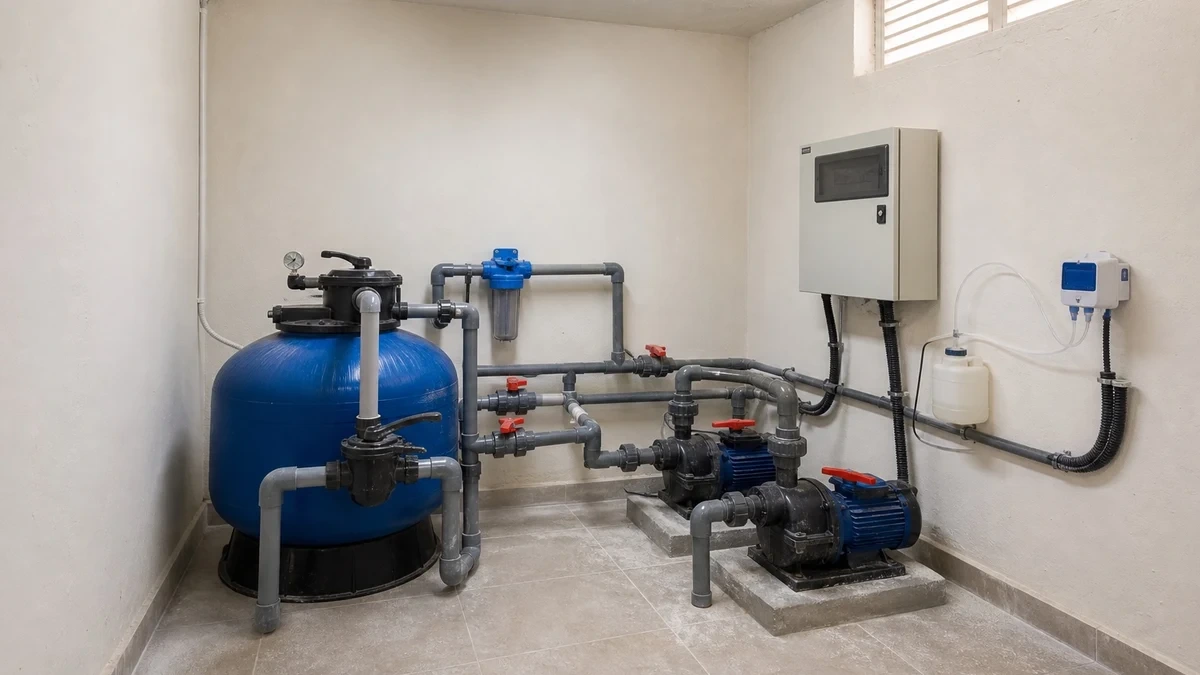
Filtration plant room showing the sand filter gauge, circulation pumps, and valved PVC return manifold branches.
Wall vs Floor Return Inlet Layout, Submergence Depth, and Dye Testing
Deciding between perimeter wall inlets, flush floor inlets, or combined return grids depends on basin width, surface skimming architecture, and jurisdictional pool codes.
Directly under MAHC Section 4.7.1.3.1.3.1, for pools greater than 50 feet wide (15.2 m), floor inlets shall be required.
Under MAHC Section 4.7.1.3.2.2 through 4.7.1.3.2.2.2, floor inlets shall be flush with the bottom of the pool, spaced no greater than 20 feet (6.1 m) apart, with a row within 15 feet (4.6 m) of each side wall.
Under MAHC Section 4.7.1.3.2.3, floor inlets used in combination with wall inlets shall be spaced no greater than 25 feet (7.6 m) from nearest side walls.
Under MAHC Section 4.7.1.3.3.2 and 4.7.1.3.3.3A, wall inlets shall be directionally adjustable to provide effective distribution of water and spaced no greater than 20 feet (6.1 m) apart.
Under MAHC Section 4.7.1.3.3.3.1 through 4.7.1.3.3.3.3, wall inlets shall be placed within 5 feet (1.5 m) of each corner of the pool, at least 5 feet (1.5 m) from a skimmer, and in each recessed or isolated area.
Specifically under MAHC Section 4.7.1.4.2.1, a perimeter overflow gutter system shall be designed to allow continuous removal of water from the pool's upper surface at a rate of at least 125 percent of the total design recirculation flow rate.
State Code Inlet Counts and Continuous Return Pipe Loops
State public-pool regulations establish baseline inlet counts by surface area or perimeter and cap the flow delivered through any single inlet fitting.
Under Indiana Swimming Pool Code 675 IAC 20-2-20 Sec. 20(b) and (c), the minimum number of inlets required shall be based on two (2) inlets per six hundred (600) square feet of pool surface area or fraction thereof, and the flow through any single inlet shall not exceed forty (40) gallons per minute.
Under Indiana Swimming Pool Code Sec. 20(d), (e), (g), and (h), inlets shall be located between twelve (12) inches below the waterline and the waterline, pools over thirty (30) feet wide shall have bottom inlets (unless equipped with a continuous gutter with integral return inlets), inlets shall be twelve (12) inches below the skimmer throat midpoint or eight (8) inches or more below the gutter lip, and inlets shall be placed at not more than fifteen (15) feet on center served by a continuous pipe loop.
Under Georgia Department of Public Health Rule 511-3-5-.10(1)(b) and (c), a swimming pool shall have a minimum of two return inlets regardless of pool size, and the total number of return inlets shall be based on one inlet per three hundred square feet of pool surface area or one inlet for every twenty feet of pool perimeter or fraction thereof, whichever is greater.
Pool & Spa News reports that builder Guy Wood often will place four returns in pools measuring 250 to 600 square feet and vessels of 600 to 800 square feet will generally have six returns.
Submergence Depth, Skimmer Short-Circuiting, Dye Tests, and Floor Line Draining
Mounting wall returns too close to the water surface or aiming eyeballs toward nearby skimmers causes newly filtered water to exit the basin before mixing with the deeper water column.
Pool & Spa News reports that traditional wall returns placed 12 to 18 inches below the water's surface can send already-clean water almost directly to the skimmer; in certain pools today it may be that only 60 to 70 percent of water going through the skimmer at each pass actually needs filtration.
Furthermore, MAHC Annex Section 4.7.1.3.3.1 states that for standard pools, locating wall inlets 24 inches (61.0 cm) below the design operating water level would reduce short-circuiting of water from the inlets to the surface removal system.
In a swim-school pool renovation test reported by Pool & Spa News, previously only about 40 percent of the water passing through the filter at each turnover needed treatment, whereas pointing existing top returns toward the floor raised that share to about 80 percent in one turnover according to a dye test, so instead of needing four turnovers a day they should be able to get away with maybe 1-1/2 or two.
Specifically under MAHC Section 4.7.1.3.3.5.1, if a dye test reveals inadequate mixing in the pool after 20 minutes, the recirculation system shall be adjusted or modified to assure adequate mixing.
Additionally, MAHC Annex Section 4.7.1.3.2 notes that floor inlets might require draining considerations when the pool is not in use because biofilm proliferation increases as free chlorine dissipates (citing Leoni et al. finding mycobacteria in 88.2% of pool water samples analyzed) and freezing water can damage pipes.
Return Fitting Hardware Selection: Orifice Knock-Outs, Snap-In Disks, and Flow Capacity
Equipment manufacturers supply directional return fittings in imperial threaded and slip-insider configurations as well as metric knock-out and solvent-weld assemblies matched to wall conduits.
Imperial Threaded Eyeballs, Snap-In Orifice Disks, and Slip Bodies
Imperial white-goods lines pair threaded or slip return bodies with pre-sized eyeball inserts or interchangeable snap-in orifice disks.
Hayward SP1419 Hydrostream Directional Flow Inlet Fittings (1-1/2-Inch MIP Thread) include SP1419A (Slotted Opening, $9.00), SP1419B (3/8" Opening, $9.00), and SP1419C (1/2" Opening, $9.00).
Hayward SP1419 Hydrostream Directional Flow Inlet Fittings (1-1/2-Inch MIP Thread) include SP1419D (3/4" Opening, $8.96), SP1419E (1" Opening, $8.96), and SP1419T (Hydrostream Seat Removal Tool, $10.31).
Pentair return fittings include 542402 (Long body, 1-1/2 in. threaded x 1-1/2 in. socket, white), 542404 (Standard body, 1-1/2 in. threaded x 1-1/2 in. threaded, white), 542405 (Standard body, 1-1/2 in. threaded x 1-1/2 in. socket, white), and Insider Fittings 542423 (white) and 542424 (black) with 2 in. slip body for schedule 40 pvc pipe.
Pentair 542087 (Item Number NP4208703, priced at $15.04 /EA) is the Ultimate eyeball 1-1/2 in. threaded fitting with snap-in disks for 1/2 in., 3/4 in., 1 in., and pressure test orifices in white.
Metric Knock-Out Rings, Wall Conduits, and Catalog Fitting Capacities
Metric and dual-series return assemblies use concentric knock-out eyeball rings or catalog wall and floor housings connected to pre-embedded wall conduits.
AstralPool Multiflow return inlets 00298 (Solvent 2" inlet ABS) and 00295 (Threaded 2" inch inlet ABS) have eyeball knock-outs at 14, 20, and 25 mm for a recommended max flow velocity of 4 m/sec, complying with UNE 13451-1.
AstralPool Multiflow return inlet flow rates by knock-out diameter are Ø 14 mm = >2.2 m3/h, Ø 20 mm = 4,5 m3/h, and Ø 25 mm = 7 m3/h, with 2" external thread, Ø 50 mm, white ABS body, grille slots < 8 mm, and compatible wall conduits 15658-15659.
Emaux Wall Conduit EM2841 (Code 91602501, 1.5"/50mm Solvent, G2A Screwthread) is for concrete pools with a rated flow rate of 150-240 L/min, and Conduit EM2842 (Code 91602502, 1.5"/50mm Solvent, G2A Screwthread) is for vinyl pools with a rated flow rate of 150-240 L/min.
Emaux adjustable-angle concrete pool return inlets EM4408 (1"/1.5" Class 12 or Class 15, or 32mm/50mm PN10 or PN16 Solvent) are rated at 50/150 L/min, while EM4409 (1.5"/2" Class 12, 2" Class 15, 50mm/63mm PN10, or 63mm PN16 Solvent) are rated at 150/240 L/min.
Emaux adjustable-angle concrete pool return inlet EM4413 is rated at 150 L/min across models EM4413(A) (Code 91601221, 1.5"/2" Class 12 Solvent), EM4413(A1) (Code 91601238, 2" Class 15 Solvent), EM4413(E) (Code 91601222, 50mm/63mm PN10 Solvent), and EM4413(E1) (Code 91601239, 63mm PN16 Solvent).
Emaux adjustable-angle concrete pool return inlets EM4410 (Codes 91601215 / 91601216) and EM4411 (Codes 91601217 / 91601218) use 1.5" or 50mm Solvent with G2A Screwthread, have a rated flow rate of 150 L/min, and specify recommended wall conduits EM2841/EM2842.
Emaux Wall Return EM2824 has rated flow rates of 92 L/min for EM2824(A1) (1.25" Solvent Imperial), 150 L/min for EM2824(A2) (1.5" Solvent Imperial) and EM2824(E1) (50mm Solvent Metric), and 240 L/min for EM2824(A3) (2" Solvent Imperial) and EM2824(E2) (63mm Solvent Metric).
Emaux Floor Inlet EM2861 (2" Class 12 or Class 15, or 63mm PN10 or PN16 Solvent for Concrete Pool) and Floor Inlet EM2862 (1.5" or GB50 Solvent, G2A Screwthread for Concrete Pool) are rated at 200 L/min.
Emaux Floor Inlet EM2817 (182 mm diameter; available in 1.5" and 2.0" Solvent for Vinyl Pools and in Class 9, Class 12, and Class 15 Solvent plus 50mm and 63mm PN10 or PN16 for Concrete Pools) is rated at 328 L/min.
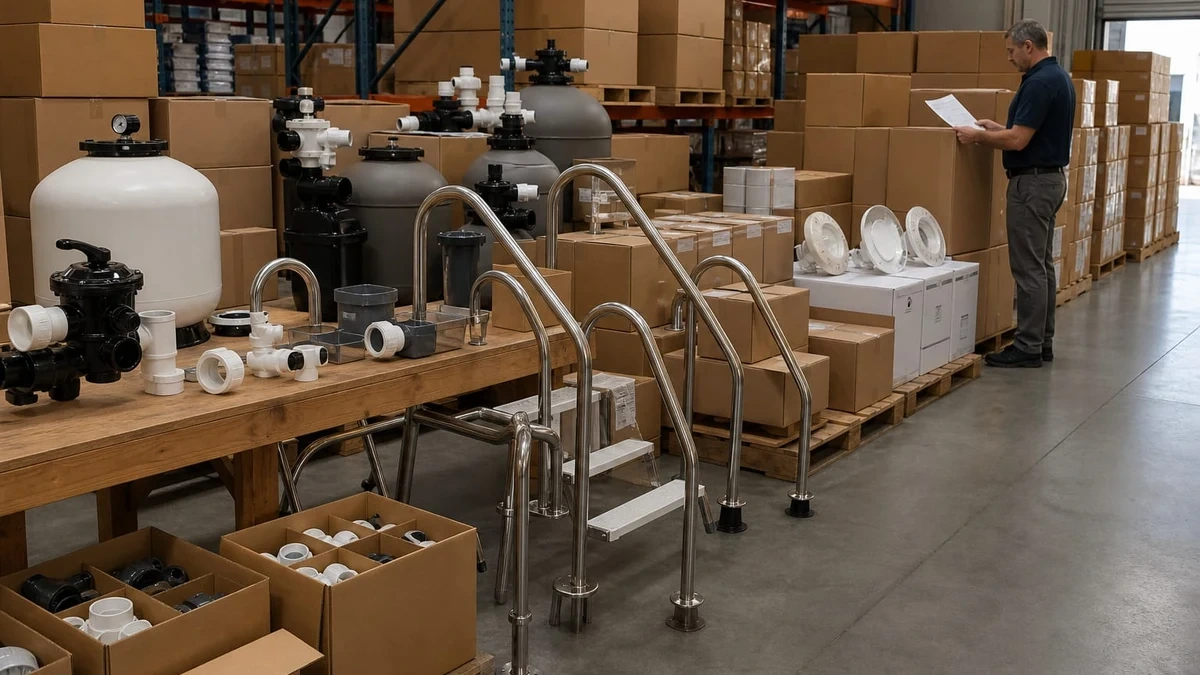
Warehouse staging of sand filters, stainless steel ladders and handrails, and boxed PVC fittings beside supply shelving.
Concrete Pool Wall Conduits and Elastomeric Puddle Flange Sealing
Fernco Australia states that concrete will not bond to a cast-in pipe and usually shrinks during curing, leaving an ingress path along the outside of the pipe; the Fernco Puddle Flange compresses during casting and relaxes when the concrete shrinks during curing to maintain a pressure-tight seal.
Fernco Australia states that its Puddle Flanges connect to standard pipe materials from 22mm outside diameter upward, are pressure-tight to 8bar in independent testing, and are manufactured in compliance with ISO 9001:2015 from EPDM conforming to EN 681 and grade 316 stainless steel as standard (with 304 grade stainless steel and Nitrile available on request).
In the Fernco UK / LEAP Puddle Flanges Product Guide, moulded puddle flanges include PF036-044 (36 - 44MM), PF045-056 (45 - 56MM), and PF057-071 (57 - 71MM) up to PF304-341 (304 - 341MM), while fabricated puddle flanges range from PF300 (300 - 399MM) to PF1200 (1200 - 1299MM).
In the Fernco UK / LEAP Puddle Flanges Product Guide, fitted puddle flanges have an outside diameter 100/110mm larger than the pipe, require 50mm of waterproof concrete cover against every surface around the puddle flange, and do not provide axial restraint so the pipe has to be fully supported to withstand the concrete pouring process.
In the Fernco UK / LEAP Puddle Flanges Product Guide, material is EPDM Rubber and 1.4401 (316) Stainless Steel, Moulded Puddle Flanges are watertight to 10bar and Fabricated Puddle Flanges are watertight to 5bar, EPDM temperature range is -50°c to 80°c constant (100°c intermittent) and Nitrile is -20°C to 45°C Maximum, and tightening torque is 6Nm / 13Nm.
In the Fernco UK / LEAP Puddle Flanges Product Guide, independent testing institute MFPA Leipzig GmbH confirmed a seal up to 10 bar depending on diameter, and Fernco's quality and environmental systems are certified to BS EN ISO 9001:2015 and ISO 14001: 2015.
In the Fernco US Puddle Flange Technical Data sheet, Molded Flanges (5/8" to 18 1/2") are watertight to 43.5 psi (external water head) and Fabricated Flanges (11 7/8" to 51") are watertight to 7.25 psi (external water head), both made of EPDM Rubber with 304 Stainless Steel clamps, rated -58°F to 302°F, and tightened to 60 in-lb installation torque.
In the Fernco US Puddle Flange Technical Data sheet, Molded Puddle Flanges include FRK9404 (1.50 in. internal diameter, fitting 1.50 to 1.77 in. pipe size), FRK9405 (1.89 in. internal diameter, fitting 1.90 to 2.13 in. pipe size), and FRK9406 (2.36 in. internal diameter, fitting 2.30 to 2.72 in. pipe size), with outside diameter approximately 4" larger than the pipe and requiring 2" waterproof concrete cover against every surface.
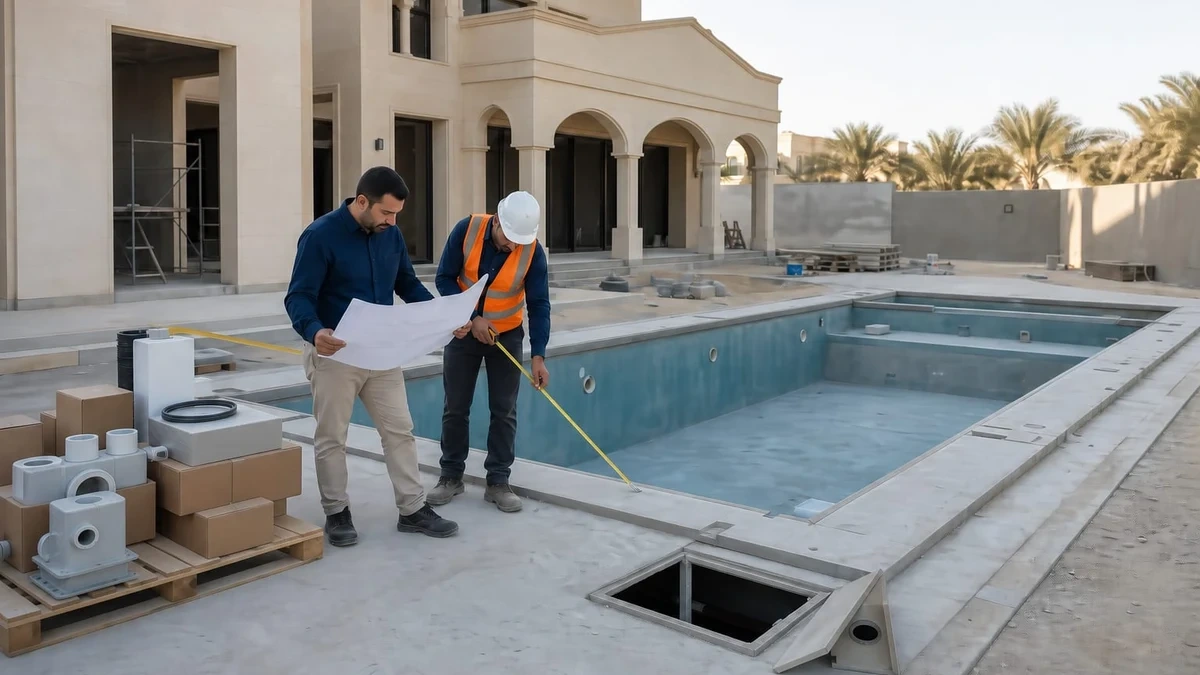
Finished concrete pool interior with wall return fittings visible while engineers measure along the basin edge.
Submittal Checklist for Return Inlets, Wall Conduits, and Shell Penetrations
When preparing MEP circulation drawings and concrete shell penetration schedules for contractor procurement, record these project inputs on the submittal sheet:
- Branch flow and nozzle orifice schedule: Specify the design flow for each return branch and state whether each fitting uses a fixed eyeball opening, snap-in disk, or multi-diameter knock-out ring.
- Wall and floor inlet placement: Identify whether the basin uses wall returns, flush floor returns, or a combined layout, and record horizontal spacing, corner offsets, and submergence below the waterline.
- Wall conduit and rear pipe interface: Match the return faceplate thread or solvent socket to the cast-in wall conduit sleeve and state whether the rear piping uses imperial schedule pipe or metric pressure pipe.
- Puddle flange bore and concrete encasement: Select the elastomeric puddle flange model for the exact pipe outside diameter, record clamp band stainless grade and tightening torque, and brace the conduit stub prior to concrete placement.
- Consolidated project hardware: Coordinate return fittings and wall sleeves with pool ladders, handrails, and metal accessories, complete pool equipment packages, or request a project quotation from our engineering supply team.
Sources
- PoolProject — Swimming Pool Filtration System: Pump & Sand Filter BOM Matching
- PoolProject — Pool Ladders, Handrails & Metal Accessories
- HydrauCalc — Thick-Edged Orifice Circular Cross-Section Pipe Flow Guide
- Centers for Disease Control and Prevention — Model Aquatic Health Code and Annex
- Pool Water Treatment Advisory Group — Swimming Pool Water Code of Practice
- Indiana Administrative Code — Public Swimming Pool Return Inlets Regulation
- Georgia Department of Public Health — Public Swimming Pools, Spas, and Recreational Water Parks Rules
- Pool & Spa News — Circulation from the Inside Technical Report
- Pool & Spa Marketing — Maximizing Pump Efficiency with Variable Orifice Pool Returns
- Aegean Pools Retail — Pool Returns and Circulation Technical Guide
- Hayward — Return Inlets Head Loss Technical Data Leaflet
- Horizon Commercial Pools — Hayward Hydrostream Directional Flow Inlet Fittings Catalog
- Pentair — Pool Return Fittings Specification Table
- RecSupply — Pentair Ultimate Eyeball Return Fitting Product Data
- Astralux Pools — AstralPool Multiflow Return Inlet Specifications
- Emaux Water Technology — Pool Fittings Technical Brochure
- Fernco Australia — Elastomeric Puddle Flanges Technical Overview
- Fernco UK and LEAP — Puddle Flanges Product Guide
- Fernco US — Puddle Flange Technical Data Sheet