
Pool UV System: How It Works, Sizing & Chlorine Pairing
Size a pool UV system by validated flow, ≤94% UVT, and target mJ/cm² dose—and pair it with downstream free chlorine because UV leaves no basin residual.
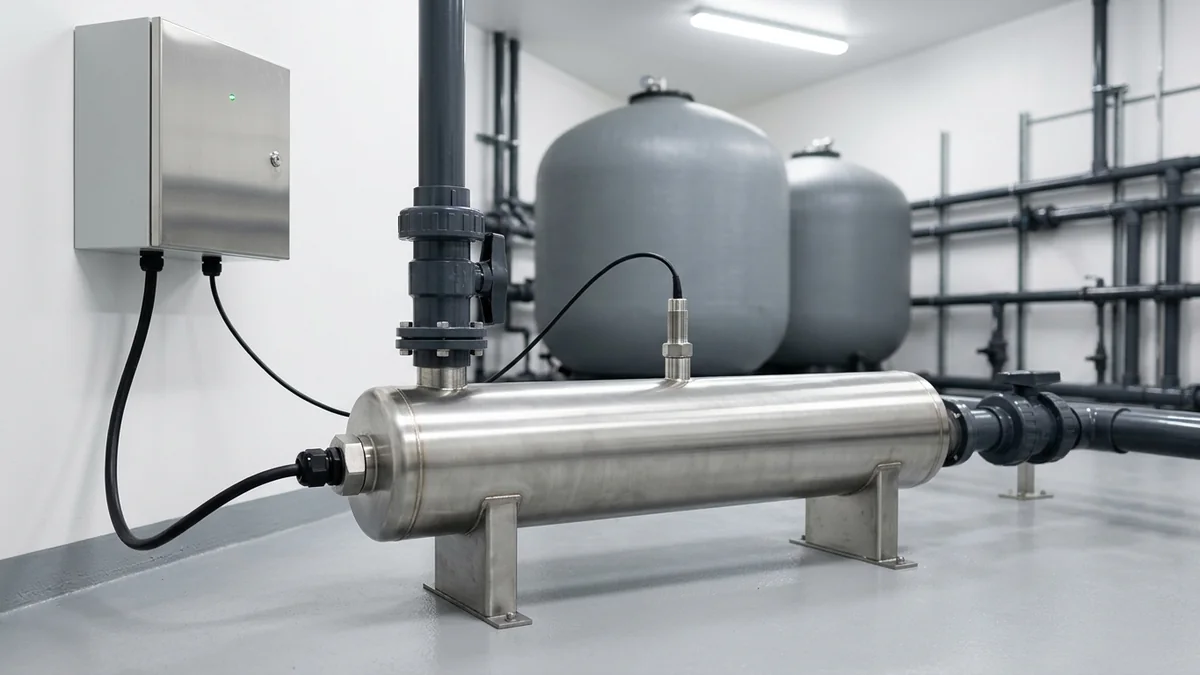
A pool UV system treats filtered return water in a single pass through an inline reactor chamber, delivering germicidal ultraviolet dose (reported in mJ/cm² or J/m²) as a function of sensor-measured UV intensity, water flow rate, and UV transmittance (UVT). Because ultraviolet light imparts no persistent disinfecting residual to water leaving the vessel, a measurable free-chlorine (or equivalent approved halogen) residual must remain active throughout the pool basin. Where an authority having jurisdiction adopts the Model Aquatic Health Code (2024), secondary UV equipment sits after filtration and before addition of the primary disinfectant (except on interactive water play venues) and carries third-party validation to the EPA Ultraviolet Disinfection Guidance Manual, EPA 815-R-06-007.
On commercial, hospitality, and villa pool submittals—including GCC projects where international benchmarks are specified alongside municipal health rules—the EPA manual provides the third-party reactor validation protocol, while aquatic codes such as the MAHC (2024) or California Code of Regulations, Section 65529 establish Cryptosporidium log-reduction targets, piping order, and basin free-chlorine minimums. When coordinating a complete pool equipment package, match the UV selection and return-line sequence below with swimming pool filtration pump and sand filter BOM matching and salt chlorinator cell flow switch and velocity.
How Do UV Pool Systems Work in the Return Line?
Inside a filtered return line, a pool UV reactor exposes passing water to germicidal ultraviolet light within the 200 to 300 nm wavelength band. Low-pressure (LP) and low-pressure high-output (LPHO) amalgam lamps emit essentially monochromatic UV-C light around 254 nm (253.7 nm), near the peak of the microbial nucleic-acid action spectrum. Medium-pressure (MP) UV lamps generate higher-intensity polychromatic output across a broader UV and visible spectrum, enabling compact multi-lamp vessels and combined-chlorine photolysis at higher electrical demand.
Each quartz UV lamp envelope sits inside a protective quartz sleeve whose exterior contacts the flowing pool water, separated by an air gap of roughly 1 cm between lamp and sleeve. Both the water column and the quartz sleeve absorb a fraction of emitted UV energy, so delivered microbial dose inside the vessel depends on water UV transmittance, sleeve cleanliness, hydraulic velocity profile, and lamp output.
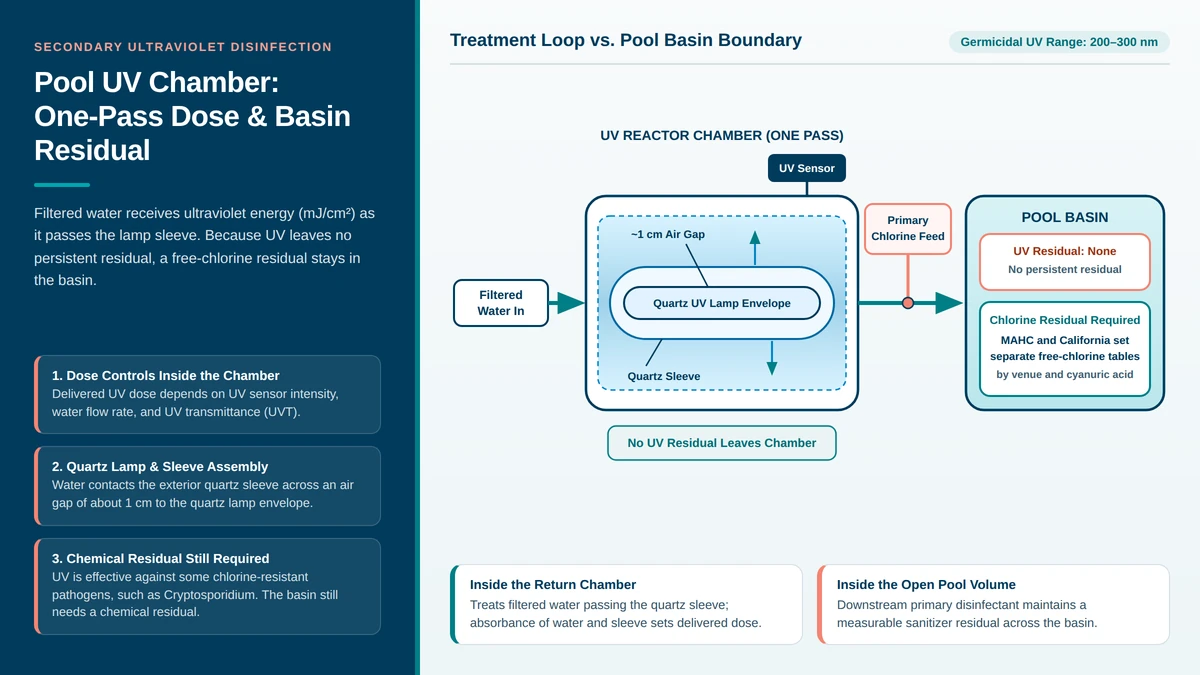
Filtered return water receives germicidal UV dose (mJ/cm²) inside the chamber as a function of sensor intensity, flow rate, and UV transmittance; because no UV residual exits the vessel, free chlorine maintains protection in the open pool volume.
Across operating hours, equipment validation applies a fouling and aging factor to cover gradual lamp output depreciation and mineral scale buildup on the quartz sleeve. Sleeve fouling accelerates with higher hardness, alkalinity, pH, ORP, lamp surface temperature, and dissolved calcium or iron. Reactors control mineral film either through periodic off-line weak-acid cleaning via a service port or through automatic mechanical wipers—for example, one wiper sweep every 15 to 60 minutes controlled sleeve fouling in EPA-documented pilot runs with total hardness below 140 mg/L and iron below 0.1 mg/L. Feeding chemical oxidants downstream of the UV chamber (or completing iron and manganese oxidation upstream of the media filters rather than directly ahead of the quartz sleeve) further limits sleeve precipitation.
Do UV Light Sanitizers Work Without a Chlorine Residual?
No. Ultraviolet disinfection cannot replace a primary basin sanitizer because UV acts strictly inside the illuminated chamber and leaves zero residual in the pool to control bather-to-bather contamination or wall biofilm. Its role is secondary treatment: inactivating chlorine-resistant protozoa—most notably Cryptosporidium—and breaking down chloramines in recirculated return water. Under the Model Aquatic Health Code (2024) where adopted, secondary treatment must achieve at least a 3-log (99.9%) reduction in infective Cryptosporidium oocysts per pass on interactive water play venues and at least a 2-log (99%) reduction per pass on other aquatic venues.
Downstream of the UV reactor, an approved primary disinfectant must maintain a measurable concentration across the basin at all times. Where the Model Aquatic Health Code (2024) applies, only primary disinfectants listed in MAHC Section 5.7.3 are permitted (with chlorine supplied by EPA-registered aquatic sanitizers in U.S. jurisdictions), holding minimum DPD free-chlorine floors of 1.0 ppm (mg/L) without cyanuric acid (CYA), 2.0 ppm with CYA, and 3.0 ppm in spas.
California Section 65529 enforces a parallel requirement: public pools must be disinfected continuously while open or in use, and any supplemental treatment must still be paired with a readily measurable chemical residual. California sets free chlorine between 1.0 ppm minimum and 10.0 ppm maximum on public pools without CYA, at least 2.0 ppm on public pools with CYA, and at least 3.0 ppm on public spas, wading pools, and spray grounds without CYA. On private villas, hotel pools, and residential compounds outside U.S. jurisdictions, engineers follow the same physical principle—treating UV as a return-line dose barrier alongside automated ORP/free-chlorine dosing rather than a chlorine-free system.
| Document and Venue Scope | Free-Chlorine Residual Requirement |
|---|---|
| MAHC (2024, where adopted) — aquatic venues without CYA | Minimum 1.0 ppm (mg/L) DPD free chlorine using approved primary aquatic disinfectants |
| MAHC (2024, where adopted) — aquatic venues with CYA | Minimum 2.0 ppm (mg/L) DPD free chlorine |
| MAHC (2024, where adopted) — spas | Minimum 3.0 ppm (mg/L) DPD free chlorine |
| California Section 65529 — public pools without CYA | Continuous chemical disinfection from 1.0 ppm minimum to 10.0 ppm maximum free chlorine |
| California Section 65529 — public pools with CYA | Minimum 2.0 ppm free-chlorine residual |
| California Section 65529 — public spas, wading pools, and spray grounds without CYA | Minimum 3.0 ppm free-chlorine residual |
Where Does a Pool UV System Sit vs Chlorine, Salt, and Ozone?
Where the Model Aquatic Health Code (2024) is adopted, UV equipment is installed in the post-filtration return loop after filtration and before primary disinfectant injection, treating up to 100% of filtration flow before water returns to the basin. Injecting liquid chlorine or placing a salt-chlorinator cell downstream of the UV vessel prevents high local free-chlorine concentrations from undergoing UV photolysis inside the chamber. Interactive water play venues are the key piping exception: secondary UV sits downstream of the dedicated feature pump so 100% of spray-feature water is irradiated immediately before reaching bathers.
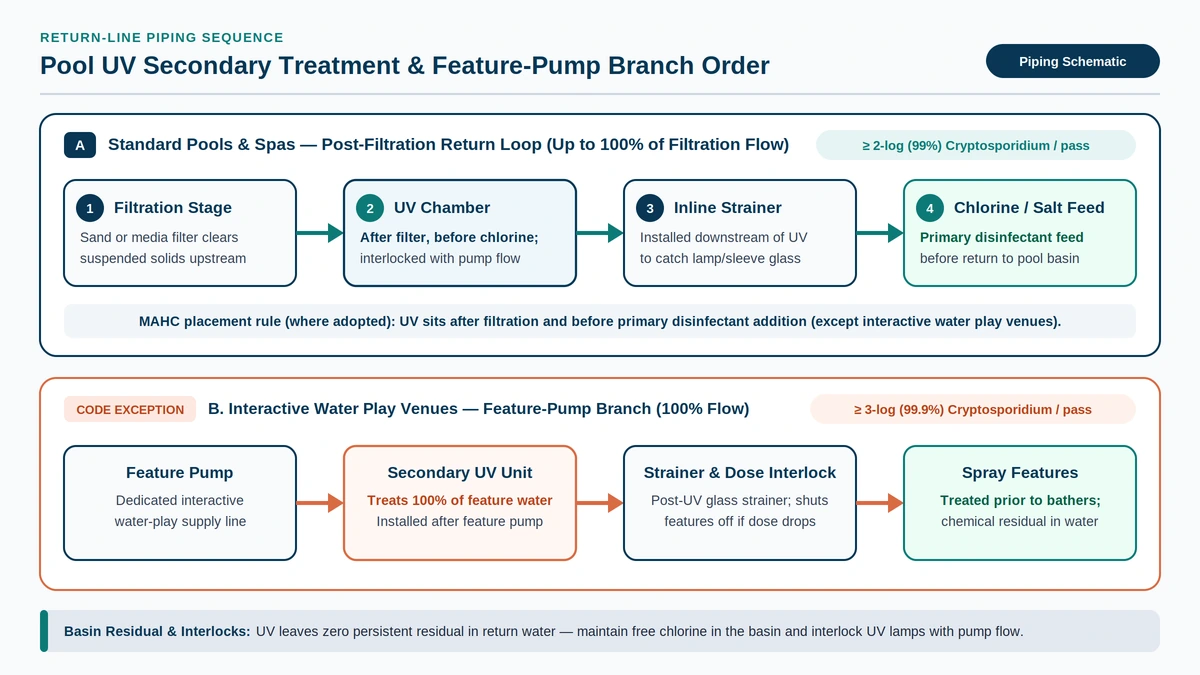
Return-line piping sequence under the Model Aquatic Health Code (2024, where adopted): UV sits after filtration, followed by an inline glass-capture strainer and downstream primary chlorine feed, whereas interactive water play venues place secondary UV after the feature pump to treat 100% of spray flow.
Keep UV and ozone secondary treatment specifications distinct on mechanical drawings:
- UV reactors sit post-filtration and pre-chlorine, require a downstream inline strainer to trap quartz or lamp fragments, and are verified by validated UV dose (mJ/cm²) across flow and UVT.
- Ozone systems under MAHC (2024) inject into the return line after both filtration and heating equipment (prior to primary disinfectant feed) and are verified by concentration-time (CT), requiring 4.9 mg·min/L (ppm·min) for 2-log (99%) Cryptosporidium reduction at 25 °C (77 °F).
When pairing a UV chamber with a heat pump, chiller, or downstream electrolytic cell, keep the UV reactor within its rated water-temperature window and place the chlorine feed or salt cell last before the basin return headers. For straight-pipe runs, bypass manifolds, and velocity limits on downstream salt cells, see our salt chlorinator cell flow switch and velocity guide.
Why Do EPA, MAHC, and California UV Dose Numbers Differ?
Datasheets and pool codes cite several ultraviolet dose figures (12, 40, 60, and 143 mJ/cm²) because each benchmark applies to a specific organism, validation surrogate, or operational duty:
- EPA UVDGM pathogen inactivation table (12 mJ/cm² and 143 mJ/cm²): In the EPA drinking-water guidance manual's post-filter dose table, Cryptosporidium requirements span 1.6 to 22 mJ/cm² across 0.5-log to 4.0-log targets (with 12 mJ/cm² at 3.0-log), while adenovirus-driven 3.0-log virus credit reaches 143 mJ/cm². Those intrinsic table figures exclude site piping hydraulics and UV sensor uncertainty, which full-scale reactor validation must account for.
- MAHC (2024) ÖNORM and DVGW reactor credit (40 mJ/cm²): Where the MAHC (2024) applies, UV reactors certified under ÖNORM or DVGW for a Bacillus subtilis reduction-equivalent dose (RED) of 40 mJ/cm² receive 3-log Cryptosporidium and 3-log Giardia credit as long as pool water UVT stays within the reactor's validated range.
- California spray-ground continuous floor (40 mJ/cm²): Under California Section 65529(c), spray grounds and water features equipped with UV must operate continuously at at least 40 mJ/cm² alongside required chemical residual, and operators must close the spray ground and features if dosage drops below 40 mJ/cm².
- MAHC Annex (2024) combined-chlorine photolysis (60 mJ/cm²): For indoor commercial, hotel, or therapy pools targeting chloramine breakdown, the Model Aquatic Health Code Annex (2024) notes that combined-chlorine reduction typically uses a calculated dose of 60 mJ/cm² across the combined UV-C and UV-B spectrum.
| Dose Figure | Source Document | Specific Scope and Condition |
|---|---|---|
| 12 mJ/cm² (3-log Cryptosporidium) & 143 mJ/cm² (virus entry) | EPA UVDGM (Nov 2006) | Post-filter drinking-water dose table; excludes installation hydraulics and reactor sensor uncertainty |
| 40 mJ/cm² Bacillus subtilis RED | MAHC Code (2024, where adopted) | ÖNORM and DVGW certified UV reactors granted 3-log Cryptosporidium and 3-log Giardia credit within validated UVT |
| 40 mJ/cm² continuous minimum | California Section 65529(c) | Spray grounds and water features while in use alongside chemical residual; mandatory feature closure below 40 mJ/cm² |
| 60 mJ/cm² calculated dose | MAHC Annex (2024) | Calculated across total UV-C and UV-B spectrum for combined-chlorine (chloramine) reduction |
How Do You Size Flow and UV Transmissivity Without Hand Calculations?
Because water passes through an inline UV chamber in a fraction of a second and hydraulic short-circuiting varies with vessel geometry, the MAHC Annex (2024) emphasizes that UV units cannot be sized reliably from hand calculations alone. Instead, buyers and MEP engineers select a reactor from third-party biodosimetry validation curves covering flow rate, sensor-monitored UV intensity, lamp status, water UV absorbance, and end-of-lamp-life fouling/aging factors:
- Set the design flow rate through the UV branch (m³/h or GPM): Select a model whose validated maximum flow is greater than or equal to actual operating flow through the UV line—never size by pipe connection diameter alone. Operating above the validated flow cap invalidates dose delivery (for instance, a reactor validated up to 500 GPM [113.6 m³/h] is off-specification at any flow above 500 GPM). On private villas and hotel pools routing full circulation through the UV vessel, match 100% of filtration pump duty at total dynamic head. On large commercial basins where adopted code allows separate secondary-treatment flow—such as the MAHC Annex worked example for a 100,000-gallon (378.5 m³) venue closed 12 continuous hours per 24 hours, where required secondary flow is at least 609 GPM (138.3 m³/h) versus 833 GPM (189.2 m³/h) for a 2-hour filtration turnover—designers may size the UV loop anywhere from 609 GPM up to full 833 GPM filtration flow.
- Lock a conservative design UV transmissivity (≤ 94% T10): Demand the reactor's validated flow rating at a design UVT no higher than 94% T10 (measured in a 1 cm cell). Per the MAHC Annex, operating pools typically run at 94–95% T10 and interactive water play venues at 92–94% T10; datasheet ratings quoted at 98–99% clean-water UVT overstate capacity once bather organics, sunscreen, or blown dust enter outdoor basins.
- Select the target dose for the venue duty: Specify 40 mJ/cm² third-party validated dose (or 2-log / 3-log Cryptosporidium validation per EPA UVDGM, ÖNORM, or DVGW) for protozoan secondary protection and spray pads, or 60 mJ/cm² broad-spectrum calculated dose where indoor chloramine control is primary.
- Adapt certification and plant-room specs for GCC and international tenders: In GCC villa, hospitality, and compound projects (UAE, Saudi Arabia, Qatar, Oman, Bahrain, Kuwait) where U.S. state codes are not statutory, MEP consultants typically anchor submittals to ANSI/NSF 50, EPA 815-R-06-007, ÖNORM M 5873, or DVGW W 294 validation certificates alongside local municipality water-quality rules. At the same time, confirm 316L stainless-steel, titanium, or UV-stabilized HDPE/UPVC reactor construction for salt-chlorinated or high-TDS coastal plant rooms, verify 50 Hz or 60 Hz ballast supply (see pool equipment voltage and frequency in the GCC), and reserve axial service clearance equal to at least one full quartz-sleeve length.
For upstream pump duty-point selection and sand-filter loading verification before locking the UV flow rate, use our swimming pool filtration pump and sand filter BOM matching guide.
What Plumbing and Electrical Checks Belong on a Pool UV Checklist?
Where the Model Aquatic Health Code (2024) is adopted, secondary treatment is mandatory on new or substantially altered increased-risk aquatic venues—including wading pools, interactive water play venues with no standing water, other venues designed primarily for children under five, and therapy pools—and optional on standard pools. Under MAHC rules, secondary UV units carry ANSI/NSF 50 certification (or AHJ engineering approval), an EPA establishment number on U.S. projects, and third-party validation to EPA 815-R-06-007.
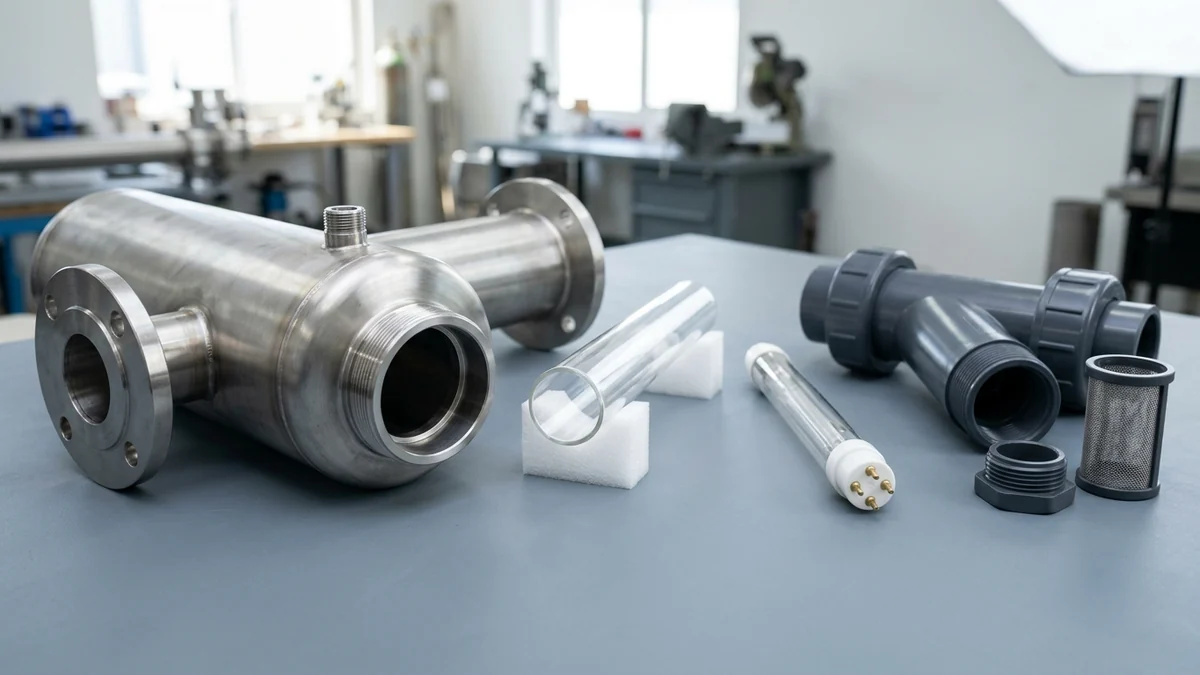
A protective quartz sleeve isolates the four-pin UV lamp from water contact across an air gap of roughly 1 cm, while a downstream inline strainer captures broken quartz or lamp glass before water reaches the basin.
Before releasing a pool equipment package for procurement, verify every nameplate, mechanical, and electrical interface on the submittal schedule below.
| Checklist Item | Required Verification Detail |
|---|---|
| Validated maximum flow rate | Confirm nameplate validated maximum flow (m³/h or GPM) covers actual operating flow at end-of-lamp-life; operating above validated flow is off-specification |
| Design UV transmissivity (UVT) | Record labeled minimum UVT and size at a design assumption no higher than 94% T10 (92–94% T10 typical on interactive water play) |
| Minimum intensity, dose, and alarm setpoints | Verify nameplate minimum UV intensity and dose (e.g., 40 mJ/cm² RED or 60 mJ/cm² chloramine duty) with calibrated UV sensor alarm outputs |
| Certification and validation protocol | Check ANSI/NSF 50 listing, EPA 815-R-06-007 validation, or ÖNORM / DVGW certification per project jurisdiction (plus EPA establishment marking where U.S. MAHC applies) |
| Post-UV inline strainer & bypass valves | Install an inline strainer immediately downstream of the UV chamber to trap broken quartz or lamp glass, plus isolation/bypass valves and axial lamp-pull clearance |
| Flow, temperature, and feature interlocks | Interlock UV power so lamps shut off when recirculation stops, and wire low-dose alarms to shut off interactive water features if dose drops below threshold |
| Wetted metallurgy, voltage/Hz, and chlorine pairing | Match 316L SS / titanium / HDPE body rating to pool salinity, match ballast 50/60 Hz supply, and inject primary chlorine downstream to hold required basin residual |
Sources
- U.S. Environmental Protection Agency — Ultraviolet Disinfection Guidance Manual, November 2006, EPA 815-R-06-007 (PDF)
- Centers for Disease Control and Prevention — Model Aquatic Health Code (2024), 5th Edition: Code Language (PDF)
- Centers for Disease Control and Prevention — Model Aquatic Health Code (2024), 5th Edition: Annex (PDF)
- California Code of Regulations, Section 65529 — Public Pool Disinfection (Cornell Law School Legal Information Institute)