
Pool Heat Pump vs Gas Heater: Recovery & Power Check
Compare electric pool heat pumps and gas-fired heaters by recovery speed, mild-weather COP, reversible cooling, cover use, and site utility checks.
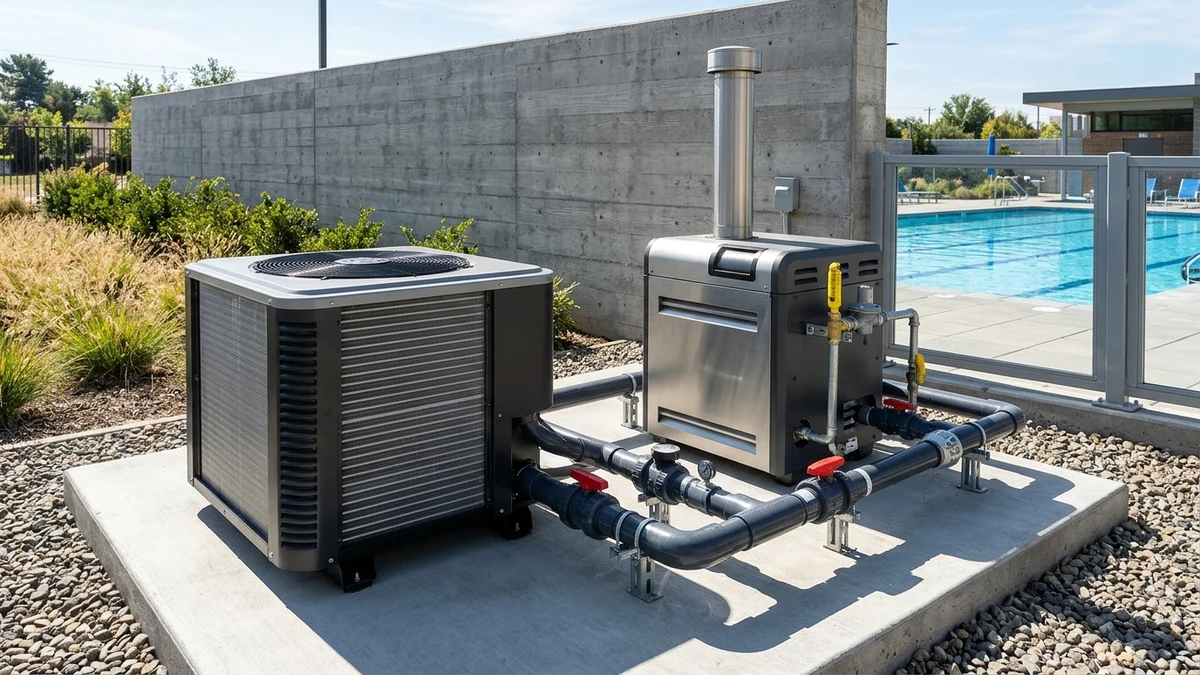
Specify an electric air-source pool heat pump for continuous temperature holding in mild-to-warm climates, or a reversible heat-cool unit when summer cooling is also required. Choose a natural gas or propane pool heater when projects demand rapid on-demand heat-up, intermittent weekend or spa recovery, or cold-ambient operation where air-source efficiency drops.
Under U.S. Department of Energy appliance definitions, a pool heater is an appliance designed for heating nonpotable water contained at atmospheric pressure, including swimming pools, spas, and hot tubs, while federal rules separate electric pool heaters, gas-fired pool heaters, oil-fired pool heaters, and electric spa heaters. When specifying a complete pool equipment package, confirm thermal duty, pool cover heat retention, equipment voltage and frequency, and external heater bypass plumbing before approving the bill of materials.
What Are the Pros and Cons of a Pool Heat Pump vs Gas Heater?
An electric air-source pool heat pump transfers ambient thermal energy at a mild-weather COP of 2 to 5 and can reverse for cooling, but loses capacity in cold air. A gas-fired pool heater burns fuel directly at a minimum 82% federal thermal efficiency independent of air temperature, but requires gas piping or propane storage and exhaust venting.
As documented in the heat pump engineering reference, an air-source heat pump absorbs thermal energy from outdoor ambient air using a fan across a finned exterior coil and releases that heat at a higher temperature into pool water rather than generating heat by combustion. Federal definitions in 10 CFR 430.2 likewise describe heat pump water-heating products as transferring thermal energy from a lower to a higher temperature level using fans, pumps, and controls. Under 10 CFR 430.32(k)(1), gas-fired pool heaters manufactured on and after April 16, 2013 and before May 30, 2028 must achieve at least 82% thermal efficiency, while 10 CFR 430.32(k)(2) transitions both gas-fired and electric pool heaters to minimum integrated thermal efficiency standards beginning May 30, 2028.
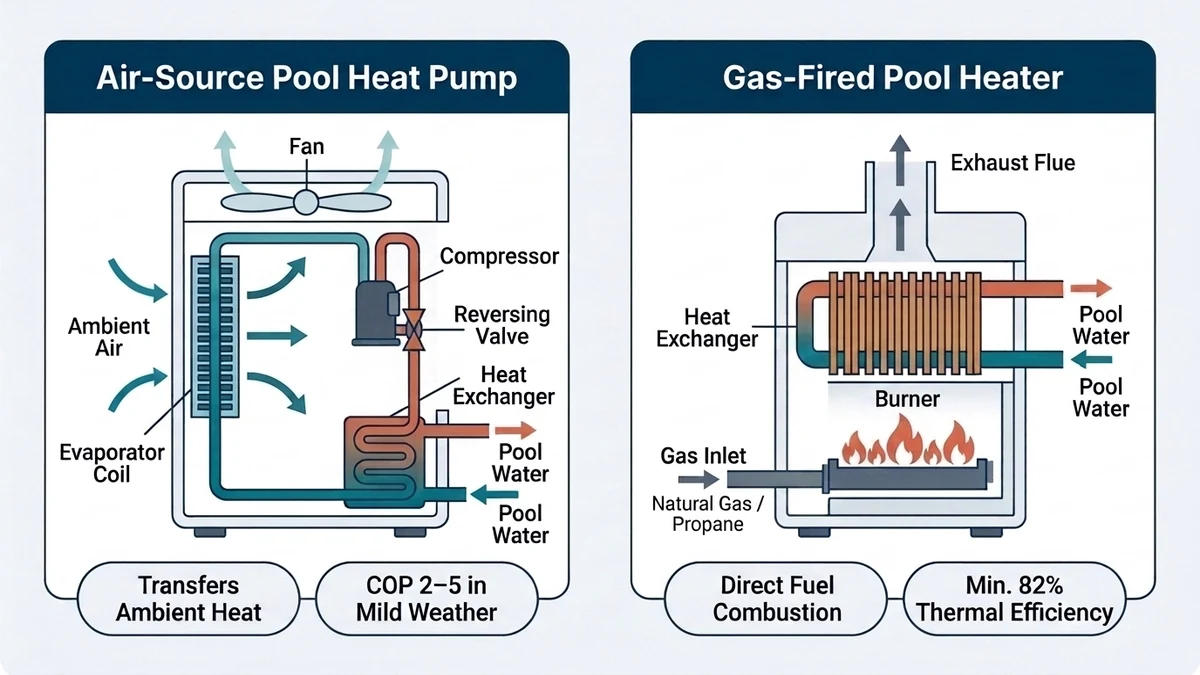
Air-source pool heat pumps move ambient thermal energy via vapor-compression refrigeration (COP 2 to 5 in mild weather), whereas gas-fired pool heaters burn natural gas or propane directly at a minimum 82% federal thermal efficiency.
Raypak notes that pool heating extends the usable swimming season beyond peak summer months. Compare the core engineering trade-offs between both technologies in the decision matrix below.
| Selection Factor | Electric Air-Source Pool Heat Pump | Gas-Fired Pool Heater (Natural Gas / Propane) |
|---|---|---|
| Heat generation mechanism | Vapor-compression refrigeration transferring ambient air heat via fan and finned coil | Direct fuel combustion transferring burner heat across an internal heat exchanger |
| Efficiency metric and baseline | Mild-weather COP of 2 to 5 (typically 4 kWh thermal output per 1 kWh electrical input); federal integrated thermal efficiency applies May 30, 2028 | Minimum 82% thermal efficiency under 10 CFR 430.32(k)(1) through May 29, 2028; integrated thermal efficiency applies May 30, 2028 |
| Federal rating basis | Certified active electrical power PE in Btu/h under 10 CFR 430.32(k)(2) | Certified input capacity Q IN in Btu/h under 10 CFR 430.32(k)(2) |
| Cold ambient sensitivity | Older designs lose performance in low temperatures; newer variable-speed compressors retain higher efficiency in cold air | Combustion heat output operates independent of outdoor ambient air temperature |
| Cooling capability | Reversible models with a reversing valve provide both heating and summer cooling | Heating duty only; requires a separate chiller if summer water cooling is needed |
| Primary utility requirements | Verified site voltage (V), frequency (50 Hz or 60 Hz), phase, and unobstructed outdoor airflow | Natural gas line or LPG propane tank matched to certified Btu/h input plus exhaust venting |
| Shared hydraulic flow window | Commonly rated for 40 to 100 GPM system flow with external bypass valve and outlet check valve | Commonly rated for 40 to 100 GPM system flow with external bypass valve and outlet check valve |
How Do Equipment and Operating Cost Mechanics Compare?
Operating efficiency favors an electric air-source heat pump during continuous mild-weather holding because a typical unit delivers 4 kWh of thermal energy per 1 kWh of electrical input (COP of 4, within a 2 to 5 range). A gas-fired heater converts fuel at a minimum 82% thermal efficiency, suiting low-runtime projects needing rapid on-demand recovery.
Rather than relying on static retail estimates that shift with local electricity tariffs and fuel contracts, evaluate lifecycle economics through energy-conversion mechanics and runtime hours. Because an air-source heat pump multiplies electrical input by moving ambient heat, sustained daily holding in warm or mild climates spreads equipment capital over thousands of high-COP operating hours. Conversely, when a pool or spa runs only sporadically for brief events, low total runtime limits the cumulative energy advantage of a heat pump while magnifying the value of fast gas-fired recovery.
How Do Gas vs Electric Spa Heaters Differ Under Federal Categories?
When comparing a gas vs electric spa heater, federal appliance definitions in 10 CFR 430.2 classify an electric spa heater as a distinct category separate from general electric pool heaters, while gas-fired pool heaters cover nonpotable water heating across swimming pools, spas, and hot tubs using gas as their primary energy source. For dedicated spas that stay cool between sessions and require rapid heating on demand, gas-fired heaters deliver combustion output regardless of evening air temperature, whereas electric spa heaters suit compact vessels with verified electrical service and no gas supply.
Which Is Better for Maintaining Pool Temperature vs Rapid Heat-Up?
An electric air-source heat pump is better for maintaining steady pool temperature across mild-to-warm seasons because continuous operation keeps compressor efficiency high and avoids large temperature swings. A gas-fired pool heater is better for rapid heat-up from cold water, tight recovery windows, or intermittent weekend and event operation where an undersized heat pump cannot close the temperature gap in time.
Never select heater capacity from pool water volume alone, because a pool-volume figure leaves surface heat load and available recovery hours unresolved. Before choosing between heat pump holding duty and gas-fired rapid pull-up, record the starting and target water temperatures in degrees Celsius, the required recovery hours, and whether the operating schedule is continuous or intermittent. In colder ambient conditions, older air-source heat pumps lose performance and favor warm climates, although newer variable-speed compressor designs retain higher efficiency in cold air.
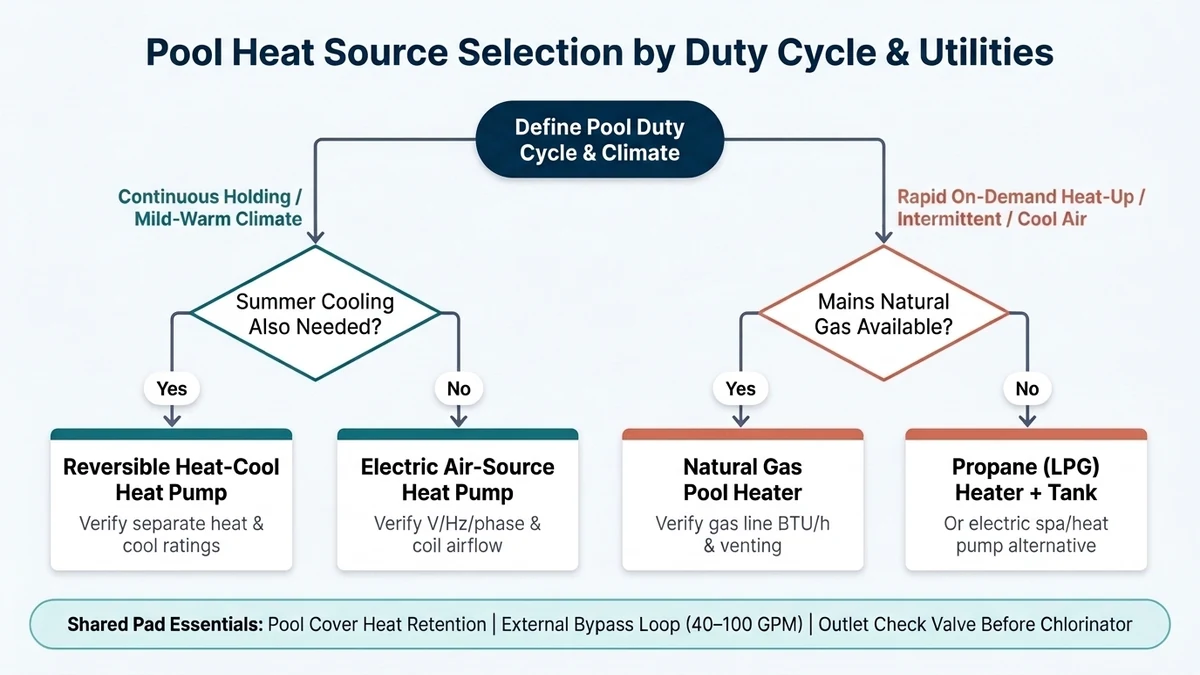
Heat-source selection starts with operating duty cycle and ambient climate, then branches by summer cooling scope or natural gas availability before confirming shared cover and hydraulic bypass essentials.
When Should You Specify a Reversible Pool Heater and Chiller Combo?
A reversible pool heater and chiller combo belongs in the equipment package when a single project requires both winter heating and summer water cooling. Because a reversible heat pump uses a reversing valve and dual-duty heat exchangers that swap condenser and evaporator roles between modes, reversibility does not mean equal heating and cooling output. On every quote-ready specification, list heating output, cooling output, and electrical input separately at each mode's design conditions; for tropical cooling-duty submittals, review our pool chiller and heat pump BOM specification guide.
Is It More Efficient to Leave a Pool Heater On or Heat on Demand?
Leaving a pool heater on steady thermostat control is generally more efficient for electric heat pumps paired with a pool cover during regular use, because steady holding avoids deep recovery loads. Heating on demand is more practical for gas-fired heaters serving sporadic weekend or event schedules, provided recovery hours and active circulation pump flow are verified in advance.
Pool thermal sizing separates stored water heat, governed by water volume in cubic meters, from surface heat loss, governed by surface area in square meters alongside cover status, wind, and humidity. Pool cover type and covered hours directly govern open-surface versus covered heat balance for any heat source. Covering the basin overnight and between swim periods cuts surface heat loss so an electric heat pump holds target temperature steadily at high COP, while an uncovered pool left idling wastes thermal energy regardless of fuel type. Coordinate cover hours with your heating schedule using our pool cover energy and heating guide.
How Does a Heat Pump Compare With a Natural Gas or Propane Pool Heater on Site Utilities?
An electric pool heat pump requires verified site electrical service—voltage, 50 Hz or 60 Hz frequency, phase, and active electrical power PE—plus unobstructed airflow across its finned outdoor coil. A natural gas or propane heater requires fuel capacity matched to certified Btu/h input Q IN, exhaust venting clearances, and on-site tank storage without mains gas.
Both heat sources share strict hydraulic requirements on the equipment pad. Pool heaters are commonly rated for 40 to 100 GPM system flow, though internal heat exchangers route only a controlled portion of that volume, and both gas heaters and heat pumps operate efficiently only when BTU heat transfer matches water flow volume and velocity across the heat exchanger. Active circulation pump flow is mandatory whenever either unit runs, protected by flow-fault monitoring for low-flow or excess-flow faults.
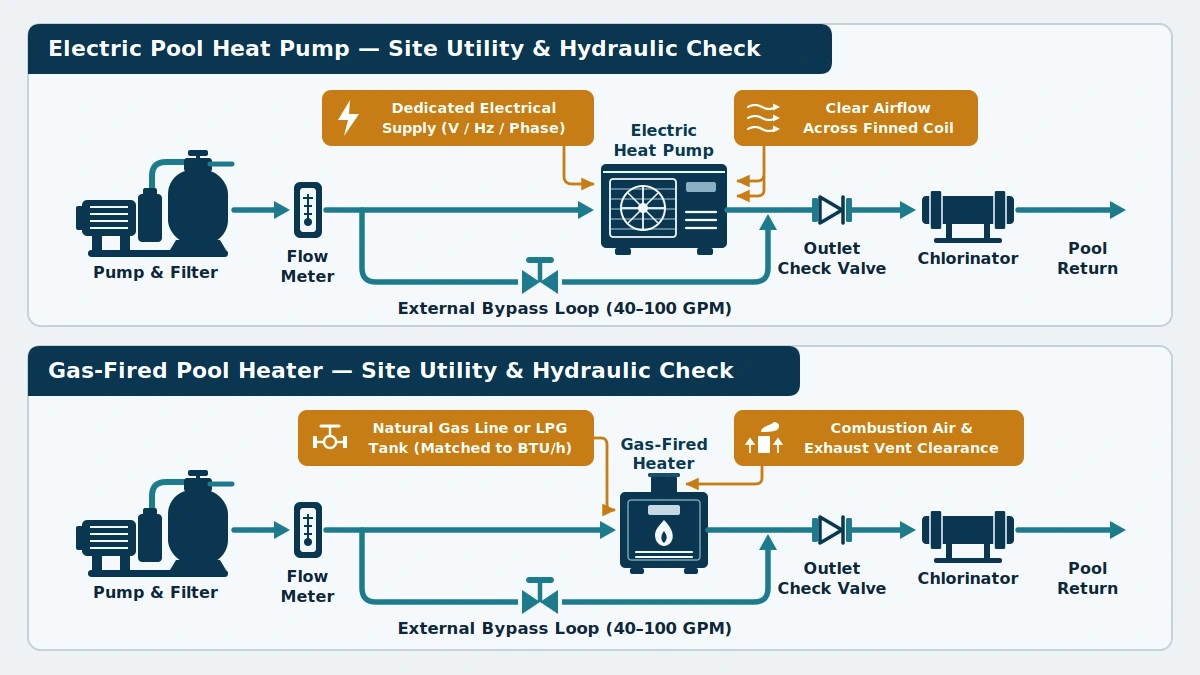
Site utility checks diverge between dedicated V/Hz/phase power with coil airflow for heat pumps and fuel sizing with venting for gas heaters, while both require a post-filter external bypass loop and outlet check valve upstream of any chlorinator.
When Does a Propane Pool Heater Make Sense Without Mains Gas?
On remote villas, standalone spas, or commercial decks without piped natural gas that still require rapid on-demand recovery or cool-ambient firing, a gas-fired pool heater configured for propane delivers the same ambient-independent combustion duty as natural gas—provided the site plan accommodates on-site LPG tank storage and scheduled fuel delivery. Where fuel storage is impractical or continuous seasonal holding is the real duty, an electric air-source pool heat pump with verified electrical service or a dedicated electric spa heater is the cleaner engineering choice.
What Hydraulic Bypass and Utility Checks Belong on the Equipment BOM?
Before approving a heating line on a pool equipment package, confirm electrical supply, fuel supply, and hydraulic bypass details on one shared schedule. Because 50 Hz and 60 Hz versions of the same equipment family can carry different model references and performance data, put voltage, frequency, and phase on every powered BOM line and verify the nameplate before shipment using our pool equipment voltage and frequency guide. On the hydraulic side, install an external heater bypass valve downstream of the filter and flow meter and upstream of any automatic chlorinator, with an outlet check valve blocking concentrated sanitizer backflow, as detailed in our pool heater bypass valve plumbing and flow guide.
| Verification Item | Required Engineering Input and Units | Primary Failure Prevented |
|---|---|---|
| Basin thermal geometry | Water volume in m3 and water surface area in m2 separated on one load sheet | Undersizing caused by estimating heat load from water volume alone |
| Temperature and recovery schedule | Starting and target water temperature in °C, recovery hours, and continuous vs intermittent schedule | Specifying a slow heat pump when rapid weekend or event pull-up is required |
| Cover and exposure basis | Pool cover type, daily covered hours, shade, wind, and humidity basis | Ignoring open-surface evaporation losses that overwhelm holding capacity |
| Electrical service check | Site voltage (V), frequency (50 Hz or 60 Hz), phase, and active electrical power PE (Btu/h) | Shipping an incompatible electrical version or overloading the mechanical panel |
| Fuel and venting check | Mains natural gas line or LPG tank capacity matched to certified input Q IN (Btu/h) plus vent clearances | Gas starvation during firing or unsafe combustion exhaust routing |
| Dual-mode combo ratings | Separate heating output, cooling output, and electrical input at each mode's design conditions | Assuming a reversible heat-cool unit delivers equal heating and cooling capacity |
| Hydraulic flow and bypass loop | Available flow and head (typical 40 to 100 GPM heater range), post-filter external bypass valve, and outlet check valve before chlorinator | Heat-exchanger copper stripping, condensation corrosion, flow faults, and sanitizer backflow |
To standardize submittals across pumps, filters, heat sources, and bypass valves, record these fields in our equipment BOM template before requesting final supplier quotes.
Frequently Asked Questions
What is the main difference between a pool heat pump and a gas pool heater?
An air-source pool heat pump uses a vapor-compression refrigeration cycle and outdoor fan coil to transfer ambient heat from outdoor air into pool water, achieving a mild-weather COP of 2 to 5. A gas-fired pool heater burns natural gas or propane directly at a minimum 82% federal thermal efficiency, heating water independent of outdoor air temperature.
Can an electric pool heat pump both heat and cool a swimming pool?
Yes, if you specify a reversible heat-cool model equipped with a reversing valve and dual-duty heat exchangers that swap condenser and evaporator roles. Because reversibility does not mean equal heating and cooling output, require separate heating and cooling ratings alongside electrical input at each mode's design conditions.
Why can you not size a pool heater from pool water volume alone?
Pool thermal sizing separates stored water heat (volume in m3) from surface heat loss (surface area in m2, cover status, wind, and humidity). Relying on water volume alone leaves surface heat exchange, starting and target water temperatures, and required recovery hours unresolved.
Does the circulation pump need to run whenever a pool heat pump or gas heater operates?
Yes. Active circulation pump flow is required whenever a pool heater operates so filtered water passes through the heat exchanger and returns to the pool jets, while flow-fault monitoring protects the unit against low-flow or excess-flow conditions.
What federal efficiency changes take effect for pool heaters on May 30, 2028?
Under 10 CFR 430.32(k)(1), gas-fired pool heaters manufactured from April 16, 2013 through May 29, 2028 must meet at least 82% thermal efficiency. Starting May 30, 2028, 10 CFR 430.32(k)(2) transitions both gas-fired and electric pool heaters to minimum integrated thermal efficiency standards rated by certified input capacity Q IN (Btu/h) for gas units and active electrical power PE (Btu/h) for electric units.
Sources
- 10 CFR 430.2 — Definitions for Pool Heaters, Electric Pool Heaters, Gas-Fired Pool Heaters, and Electric Spa Heaters (eCFR / U.S. DOE)
- 10 CFR 430.32(k) — Energy Conservation Standards for Pool Heaters (eCFR / U.S. DOE)
- Heat Pump — Vapor-Compression Cycle, COP, and Reversing Valves (Wikipedia)
- Swimming Pool — General Reference (Wikipedia)
- Raypak — Heat Pump vs. Gas Heater Technical Guidance