
Pool Heater Bypass Valve: Plumbing Layout & Flow Tuning
An external pool heater bypass valve diverts excess pump flow around the heat exchanger, stabilizes temperature rise, and isolates heater piping for service.
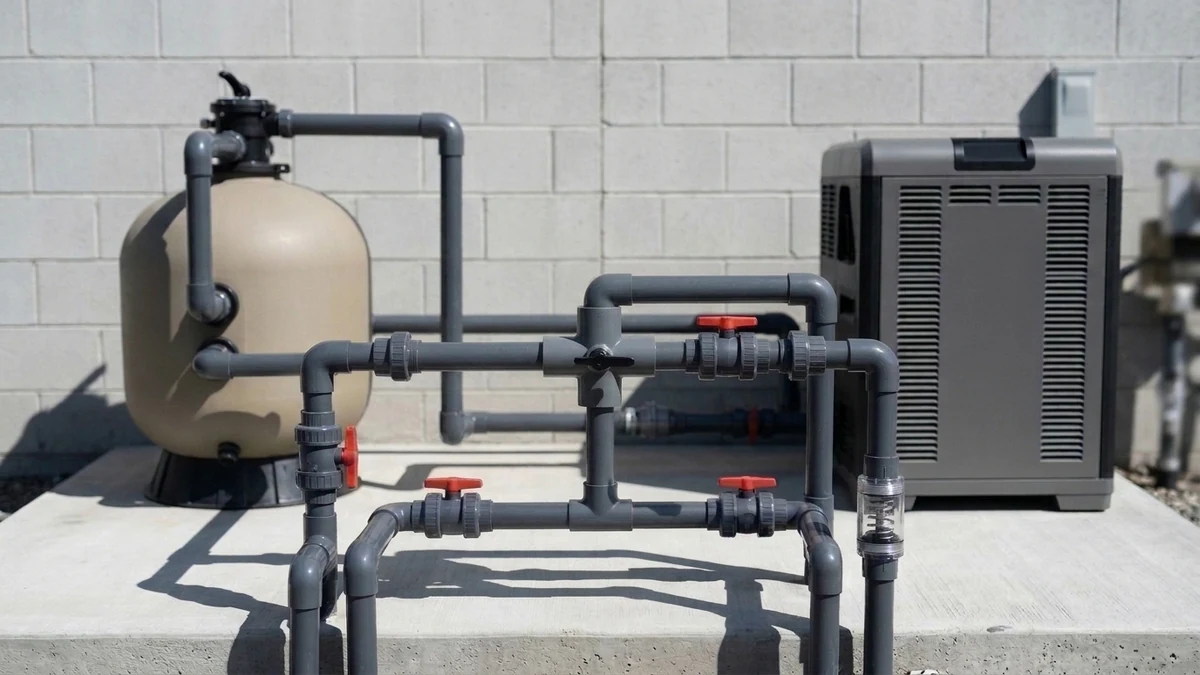
A pool heater bypass valve is an external piping loop installed across the heater inlet and outlet that lets technicians adjust how much pump water bypasses the heat exchanger entirely. Routing excess flow around the heater matches heat transfer to water velocity, prevents copper velocity erosion and condensation-related corrosion, and isolates the heater for periodic maintenance.
Under Kentucky public pool regulation, a water heater piping system shall be equipped with a bypass, and a valve shall be provided at the bypass and on the influent and effluent heater piping. When coordinating a complete pool equipment package, specify the external bypass assembly alongside swimming pool filtration pump and sand filter BOM matching and pool chiller and heat pump BOM specification.
What Does a Heater Bypass Valve Do in a Pool System?
In a pool circulation system, an external heater bypass valve—typically a loop with a ball valve—lets field technicians divert excess filtration pump flow around the heater while maintaining balanced water volume and velocity through the heat exchanger, increasing inlet-to-outlet temperature rise and preventing internal copper stripping and condensation corrosion.
Raypak technical guidance notes that as variable-speed pumps and high-efficiency heaters have become standard in pool system design, external bypass valve installation and tuning remains relevant as heater failures and efficiency issues continue to surface. Variable-speed pumps can deliver flow rates beyond traditional system design expectations even at mid-range speeds such as 2700 RPM (80 to 100 GPM). Although manufacturers rate heaters to handle flows between 40 and 100 GPM, most heat exchangers only route a portion of that volume internally.
Pool and spa heaters operate efficiently when heat transfer in BTUs matches the volume and velocity of water passing through the heat exchanger. A lower flow rate allows each pound of water to absorb heat for a greater temperature rise between the inlet and outlet, whereas higher flow dilutes BTU impact and produces a smaller temperature rise. When unbypassed flow exceeds heat-exchanger limits—compounded by hydraulic restrictions and surges from inside pipe fittings, 3-way valves, chemical feeders, 90-degree elbows, and 45-degree fittings—velocity erosion strips copper from internal heat-exchanger surfaces, while tuned external bypass flow prevents condensation-related corrosion.
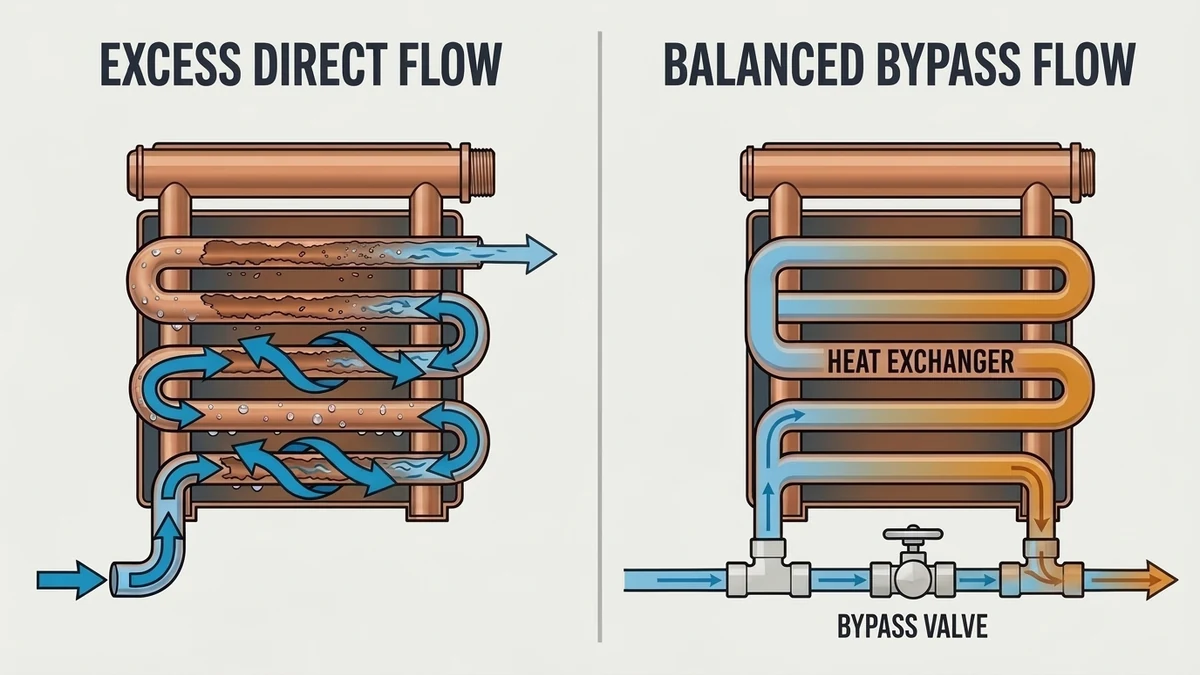
Routing excess pump volume through an external bypass valve prevents high-velocity copper stripping and condensation-related corrosion while stabilizing temperature rise across the heat exchanger.
Does the Pool Pump Have to Be On for the Heater to Work?
Yes, the circulation pump has to run whenever a pool heater operates because water moves from poolside skimmers and main drains into the pre-pump strainer, passes through the filter and heater, and returns to the pool jets, while heater flow-fault monitoring records low-flow or excess-flow faults for system safety.
Tameson technical notes divide pool plumbing into three connected stages: suction lines pull water from skimmers and drains into the pre-pump intake, filtration and heating equipment clean and condition that water, and return piping delivers heated water back to the pool jets. Without active pump circulation pushing filtered water through the heat exchanger, heated water cannot circulate back to the basin.
Public aquatic codes reinforce continuous flow verification across the recirculation loop. Under Kentucky public pool regulation, a flow meter is defined as a device that measures the flow of water through piping, and New York public pool treatment regulations state that all flow meters shall be maintained in accordance with state treatment provisions. Raypak also notes that electronic flow-fault monitoring protects the heater and logs diagnostic fault records in the Service menu.
Where Is the Pool Heater Bypass Valve Located on the Equipment Pad?
On the equipment pad, the pool heater bypass valve sits on the post-filter return line bridging the heater inlet and outlet, downstream of the filter and flow meter and upstream of any automatic chlorinator, with a check valve on the heater outlet blocking concentrated sanitizer backflow when circulation stops.
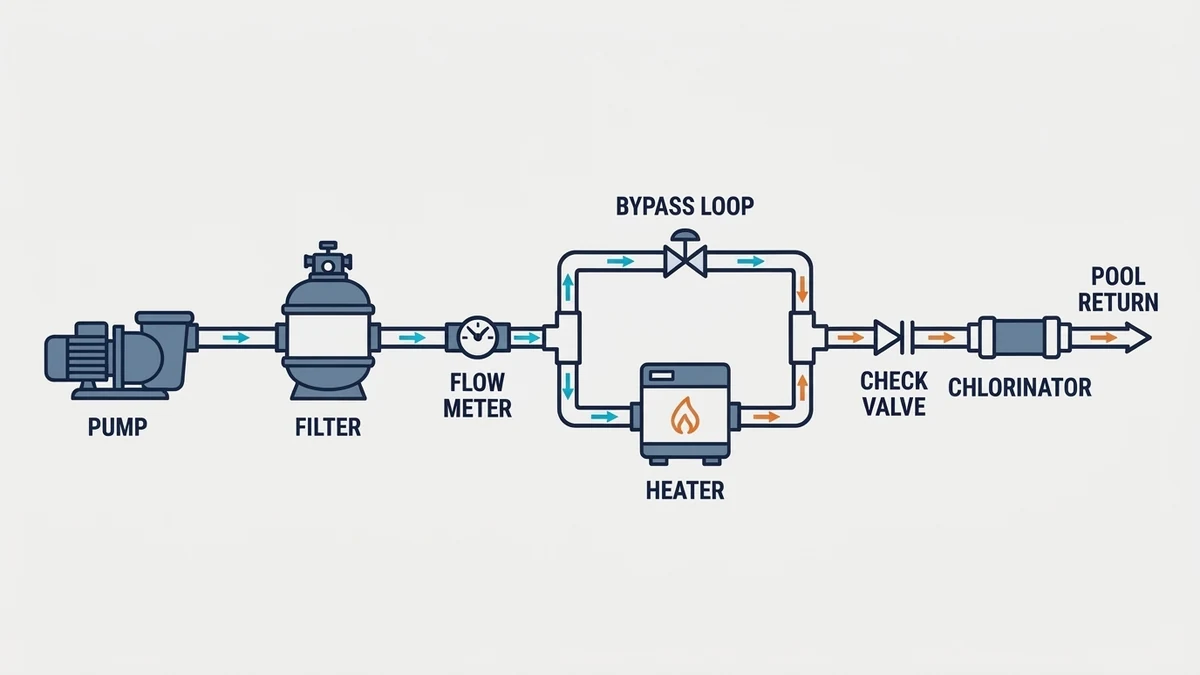
Equipment-pad circulation sequence: filtered water passes the flow meter into the external bypass loop and heater, then crosses a downstream check valve before the chlorinator feeds treated water to the pool return.
Under Kentucky public pool definitions, a disinfectant means an approved chemical compound such as chlorine or bromine, and accessible means having access to a fixture, connection, appliance, or equipment even if removing an access panel or door is required. Keeping the external bypass valves accessible on the equipment pad allows technicians to adjust flow settings and inspect O-rings and seals during routine maintenance.
Tameson notes that an automatic chlorinator is placed as the last component before water returns to the pool so concentrated chlorine dilutes into the return stream rather than corroding upstream equipment. Installing a spring or flapper check valve between the heater outlet and the chlorinator closes the line automatically when the pump stops, preventing concentrated chemical backflow into the heat exchanger. Tameson also notes installing suction check valves 18 inches ahead of the pump intake where backflow control is needed and inspecting check-valve springs, flappers, and O-rings across a 5 to 7 year service life. For downstream salt-cell placement and straight-pipe runs, see our salt chlorinator cell flow switch and velocity guide.
How Is a Pool Heater Bypass Valve Plumbing Diagram Arranged?
A pool heater bypass plumbing diagram follows one of two layouts: a three-valve isolation loop placing a valve on the bypass bridge alongside shutoff valves on the heater piping, or a three-way diverter valve on the heater inlet paired with a unidirectional check valve on the heater outlet.
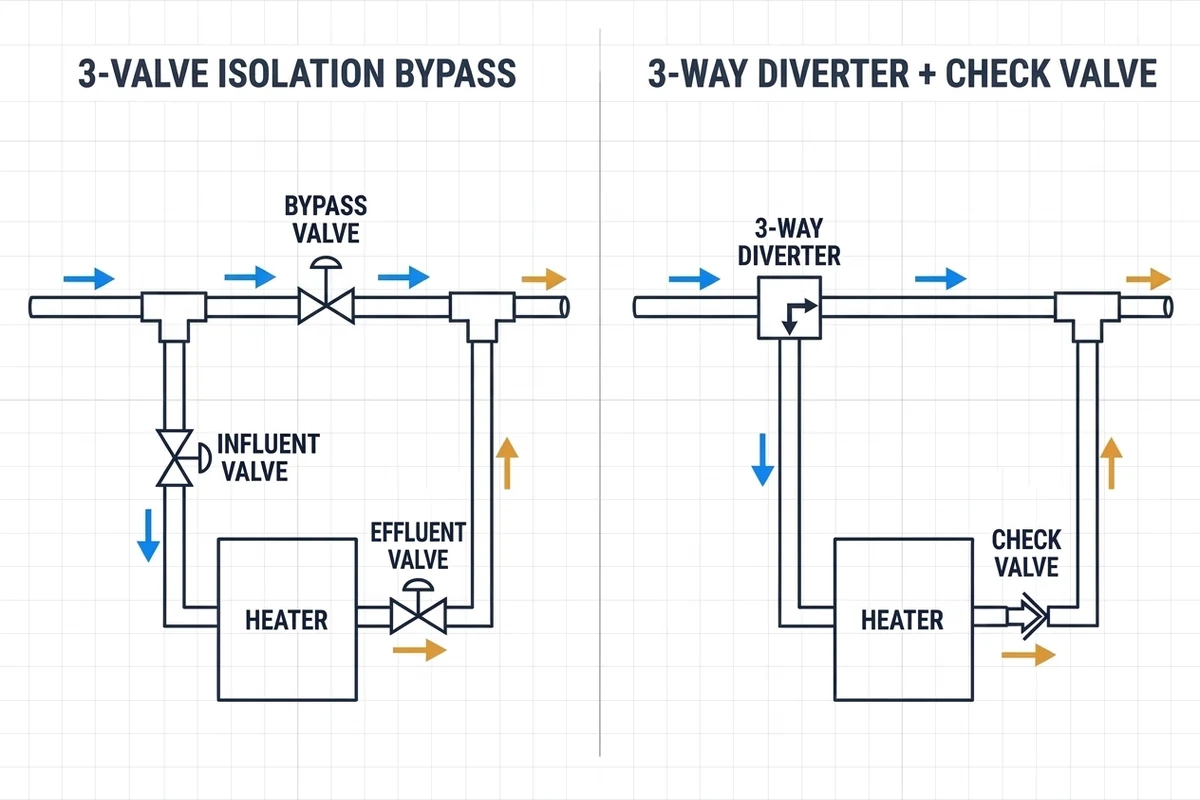
Two external heater bypass layouts: a three-valve isolation loop places shutoff valves on the bypass branch and heater lines, while a three-way diverter at the inlet paired with an outlet check valve modulates split flow and prevents reverse backflow.
Raypak describes both external bypass assemblies for balancing heat-exchanger flow and isolating the heater during periodic maintenance. Compare the hardware count, flow-splitting action, and service isolation behavior of both layouts below.
| Design Criterion | 3-Valve Isolation & Bypass Loop | 3-Way Diverter + Outlet Check Valve |
|---|---|---|
| Valve hardware array | 1 bypass branch ball valve plus shutoff valves on the influent and effluent heater piping | 1 three-way pool diverter valve at heater inlet plus 1 spring or flapper check valve at heater outlet |
| Flow-balancing mechanism | Quarter-turn ball valve throttles how much water bypasses the heater loop | Rotating three-way diverter splits incoming filtered flow between heater inlet and bypass bridge |
| Outlet backflow protection | Manual heater shutoff valve closes outlet line; separate post-heater check valve added ahead of chlorinators | Unidirectional check valve automatically blocks reverse water and sanitizer backflow into the heater |
| Actuation options | Manual quarter-turn levers (24-volt electric or pneumatic actuation available on compatible ball valves) | Manual diverter handle with closed-port indicator or 24-volt electric actuator drive |
| Long-term isolation rule | Drain the heater whenever valves remain closed long term so chemical damage does not void warranty | Isolates heater via inlet diverter and outlet check valve; drain heater if closed long term |
How Do Pipe Diameter and Valve Materials Affect Head Loss?
Matching valve port diameter and body metallurgy to the return header prevents circulation bottlenecks and chemical degradation. Pool & Spa News reports that traditional 2.5-inch valves can restrict flow on 3-inch headers, whereas true 3-inch CPVC two-way, three-way diverter, and check valves handle flow rates up to 230 gallons per minute (GPM) with minimal head loss and extended ports that reduce extra couplings and glue joints.
During installation, Pool & Spa News recommends avoiding reducers and sharp bends near the valves, leaving clearance around handles for adjustments, inspecting flow-direction labels before gluing, keeping spare O-rings and seals on hand, and keeping excess sealant off moving parts. Regarding wetted materials, Tameson notes that PVC handles sodium hypochlorite service at temperatures up to 60 °C (140 °F), polypropylene serves higher temperature and pressure demands, 316 stainless steel resists low-chloride water yet is unsuitable for high concentrations of hydrochloric acid or bleach, and EPDM or FKM seals resist treated pool water, UV, and ozone.
What Valve Position Sets Proper Flow Through the Heater?
During heating operation, keep the heater piping shutoff valves open and partially close the bypass ball valve—or adjust the three-way diverter handle—until excess pump discharge routes around the heater while maintaining steady heat-exchanger flow, verified by an inline flow meter and inlet-to-outlet temperature rise.
On manual ball valves, Tameson notes that a lever aligned parallel with the pipe indicates an open path, whereas turning the handle perpendicular to the pipe closes the port. On three-way diverter valves, closed-port markings show which branch is restricted or closed, and 24-volt electric actuators allow push-button or automated switching between heating and full-bypass modes.
Field technicians verify the bypass setting by checking the inline flow meter alongside the heater Service menu and inlet-to-outlet temperature rise: closing the bypass valve directs a larger share of pump flow through the heater (lowering temperature rise), while opening the bypass diverts excess variable-speed pump volume around the heat exchanger (raising temperature rise within manufacturer limits). Raypak cautions that if you close the heater isolation valve long term, the heater should be drained because chemical damage from trapped water voids warranty coverage.
What Belongs on a Pool Heater External Bypass BOM Checklist?
A quote-ready pool heater external bypass bill of materials records each valve and fitting tag, service role, pump duty flow and head, heater water-flow limits, nominal pipe diameter, body and seal material grades, connection ends, actuator supply, and quantity arrangement while keeping requested specifications and offered models in separate columns.
When preparing a complete pool equipment package, compare pumps, filters, heating units, controls, and bypass accessories on a single revision of the schedule. Keep unknown site values marked TBC with a named person responsible for closing them before purchase, and express equipment counts as installed units = duty units + standby units (for example, 2 = 1 + 1). Where two circulation pumps run together, have the supplier verify their combined operating point on the shared system curve rather than adding two catalogue flow labels.
| BOM Schedule Field | Required Engineering Entry |
|---|---|
| Item tag and service role | Assign distinct tags for the bypass valve, heater shutoff valves or 3-way diverter, and post-heater check valve |
| Pump duty and heater flow window | Record circulation pump flow and head alongside heater water-flow limits (e.g., 40–100 GPM rated heaters paired with 80–100 GPM VSPs at 2700 RPM) |
| Nominal port size and flow rating | Match 2-inch or true 3-inch port bore (up to 230 GPM on true 3-inch CPVC valves) to header pipe dimensions without restrictive 2.5-inch bottlenecks |
| Body and seal material grades | Specify CPVC, PVC (up to 60 °C / 140 °F), or polypropylene body with EPDM or FKM seals compatible with chlorine or bromine feed |
| Actuator and control interface | State manual quarter-turn / diverter handle or 24-volt electric actuator interface plus flow-meter verification location |
| Quantity, TBC closure, and model columns | Record installed units = duty units + standby units (e.g., 2 = 1 + 1), keep requested vs offered models separate, and assign an owner to every TBC entry |
Keep whole-unit heating and cooling load calculations on one shared input sheet recording pool water volume in m³ and surface area in m² from project drawings, since a pool-volume figure alone leaves heat load and operating hours unresolved. Review thermal capacity sizing in pool chiller and heat pump BOM specification, check line-item formatting in pool equipment BOM required fields, and download our equipment BOM template; final thermal design and site approval stay with the project engineer.
Frequently Asked Questions
Why does a variable-speed pool pump still need an external heater bypass valve?
Even at mid-range speeds such as 2700 RPM, variable-speed pumps can deliver 80 to 100 GPM, and although heaters carry 40 to 100 GPM ratings, most heat exchangers route only part of that flow internally. An external bypass diverts excess water to prevent copper velocity erosion and condensation-related corrosion.
Can you use a 3-way diverter and check valve instead of three ball valves?
Yes. Raypak notes that pairing a 3-way diverter valve on the heater inlet with a check valve on the heater outlet controls water flow through the heater, prevents reverse backflow via the check valve, and allows full isolation of the heater for periodic maintenance.
How do you tell if a pool bypass ball valve is open or closed?
On standard quarter-turn pool ball valves, a handle aligned parallel with the pipe indicates that the valve is open, while a handle turned perpendicular to the pipe indicates that the valve is closed. Three-way pool diverter valves use closed-port indicators on the handle to mark the shut port.
What happens if you leave heater isolation valves closed without draining the heater?
Raypak warns that if you close the isolation valve long term without draining the heater, chemical damage from trapped pool water voids the heater warranty. Drain the heat exchanger whenever isolating the unit for extended shutdowns.
Why is a check valve installed between the pool heater and the chlorinator?
Automatic chlorinators sit last on the return line before the pool jets and release concentrated chlorine. A spring or flapper check valve installed between the heater outlet and the chlorinator shuts automatically when the pump stops so concentrated sanitizer cannot backflow and corrode the heat exchanger.
Sources
- Kentucky Administrative Regulations — Public Swimming and Bathing Facilities (Cornell Law School Legal Information Institute)
- New York Codes, Rules and Regulations — Swimming Pool Treatment and Flow Measurement (Cornell Law School Legal Information Institute)
- Raypak — The Long Lost Art of Bypass Valves: Rebalancing Flow for Optimal Heat Transfer
- Pool & Spa News — Why Pool Professionals Should Upgrade to a True 3-Inch Valve
- Tameson Technical Information Center — Learn What Your Pool Valves Do