
Skimmer vs Overflow: Automatic Cover Quote Differences
Compare skimmer and overflow pool-cover quotes by track, water path, roller access and civil scope. See which edge drawings to send suppliers.
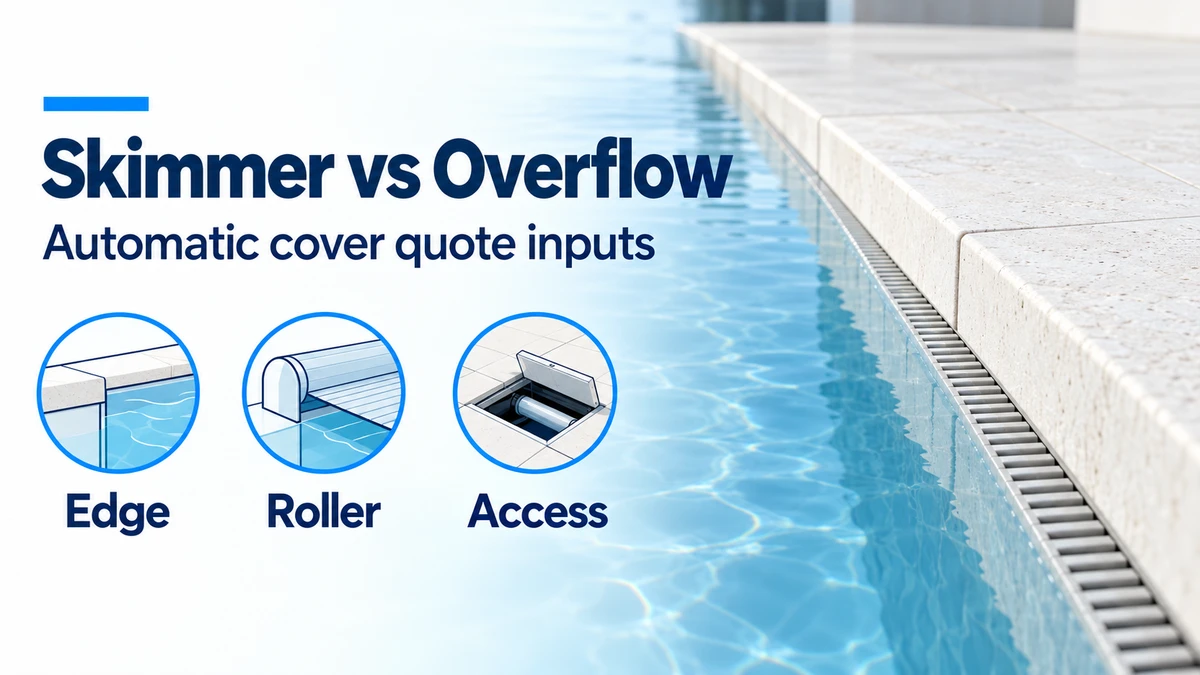
A cover quote based only on pool length and width can leave you paying for edge alterations later. Skimmer and overflow pools change where the cover can be fixed, how it passes the water edge and how the roller can be serviced.
The quote should follow the edge section, not the pool label. Two pools with the same waterline dimensions may need different track, enclosure or water-level arrangements. Start by identifying the cover family, then compare the proposed detail against the finished edge. This guide gives contractors a scope comparison and a drawing package for an indicative supplier review; it does not select an installation detail from a pool photograph.
What changes at a skimmer or overflow edge?
The difference is the surface-water route and the space left around it. A skimmer draws surface water through a wall opening below the coping. An overflow pool passes water over an edge into a collection channel; an infinity edge needs its own section rather than a generic perimeter-overflow detail.
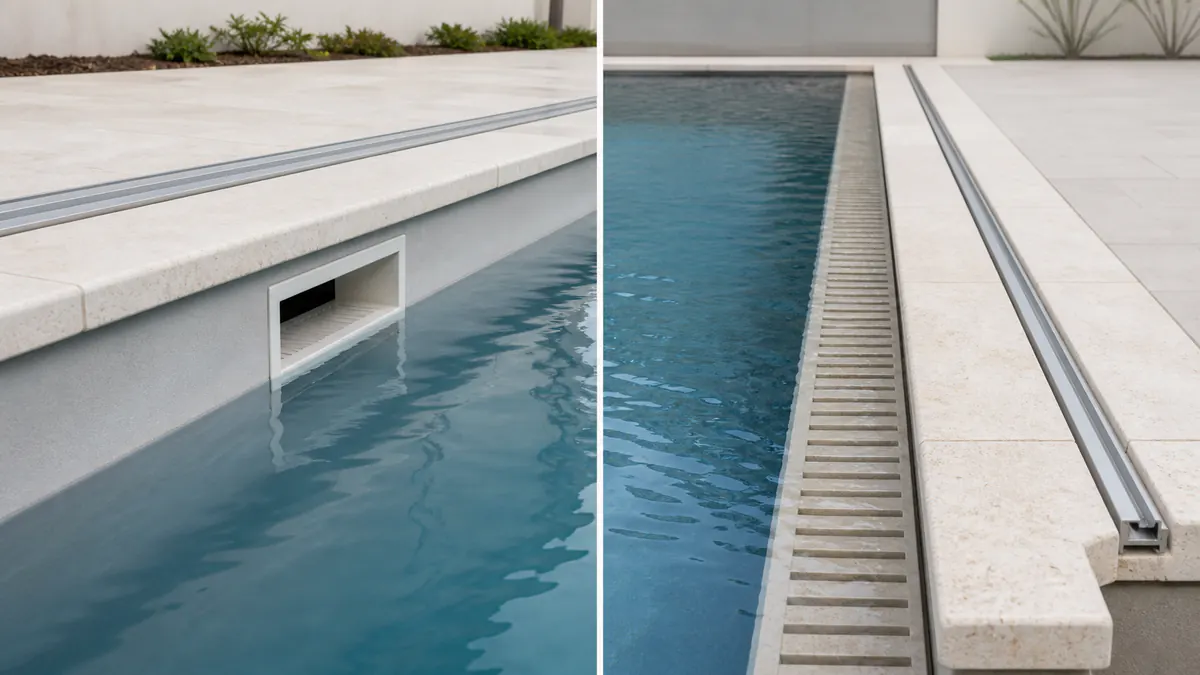
Skimmer opening at left; overflow collection channel at right. Mark the fixing surface and water route separately on the project section.
| Input or item | Value or source | Why it matters |
|---|---|---|
| Cover family | Supplier proposal: guided fabric or floating slats | Determines which edge, guide and roller details need review |
| Waterline and finished edge | Dimensioned plan and section | Separates the swimming area from coping, channel and fixing space |
| Roller end and access | Marked plan plus enclosure section | Defines equipment, lid and service interfaces |
| New build or retrofit | Drawing revision and current site photos | Shows whether changes can precede finishes or require reinstatement |
A dry skimmer edge can provide a candidate fixing location, but coping overhang, substrate, ladders, steps and skimmer-lid access still need checking. An overflow edge adds a water path and removable grating to that same review. Neither label establishes a fixed surcharge.
| Edge | Detail to price | Dominant Failure Mode & Prevention |
|---|---|---|
| Skimmer | Fixing position, coping underside or deck track, skimmer-lid clearance | Track crosses a lid or unsuitable fixing surface. Overlay the track and access openings on the finished-edge drawing before ordering. |
| Perimeter overflow | Track or slat interface, channel, grating removal and roller enclosure | Cover hardware conflicts with the water route or traps the grating. Review the open and closed cover positions on the same section. |
| Infinity / vanishing edge | Actual spill-edge profile and offered system-specific arrangement | A standard edge detail is assumed to fit the spill edge. Obtain the supplier's matching section and have the project team confirm the water path. |
The source notes explain the scope of the manufacturer planning examples behind these checks.
Does every automatic cover need side tracks?
Identify the mechanism before discussing track position. Guided fabric systems and floating slat systems need different reviews; “automatic” describes how the cover moves, not one universal edge detail.
For a guided fabric proposal, ask whether the supplier has selected under-coping, surface-mounted or another track arrangement, and how its guides align with the roller. For a floating slat proposal, ask for the slat travel envelope, roller position and permitted water-level arrangement, including the overflow interface. Do not transfer a fabric undertrack drawing to a slat quotation.
The edge type also does not select the slat material. Span, sun, water treatment and the offered profile still matter. Use the PVC and polycarbonate slat guide once the proposed cover family is clear.
Does the proposed fixing detail fit beside the channel?
Compare usable space with the supplier's required envelope on the same finished-edge section. Measure between the actual limiting surfaces; the width of a coping stone alone does not establish fixing space.
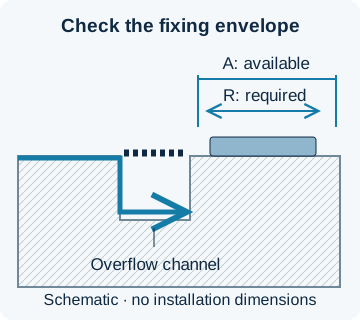
A is usable space at the proposed fixing location. R is the envelope required by that supplier detail, including its specified clearances. Compare matching directions and datums.
Fit margin = available envelope A − required envelope R.
For an illustrative drawing check, assume A = 140 mm and R = 165 mm: 140 − 165 = −25 mm. That proposed detail does not fit the available envelope. Revise the position or configuration before comparing its price. These are assumed inputs, not product dimensions or an installation allowance.
If A is smaller than R, set that detail aside until it is revised. If A equals or exceeds R, continue checking the fixing substrate, cover travel, water path and service access. A positive subtraction alone does not approve the installation. Ask the supplier to state which clearances R includes rather than adding an invented universal margin.
How do roller position and access change the quote?
Price the roller together with its enclosure and service route. A recessed roller, a deck-mounted enclosure and a submerged slat roller are different arrangements; edge type alone does not choose between them.
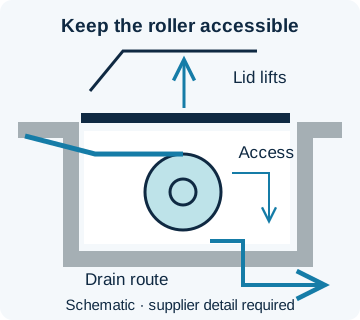
For a recessed dry enclosure, show how the lid opens, how the mechanism is reached and where drainage goes. A submerged roller requires its own supplier detail.
Show the motor side, full enclosure footprint and removal opening on the drawing. Ask whether adjacent grating can still be lifted and whether servicing would disturb finished stone. Have the appointed project team resolve the structure, waterproofing and drainage; the diagram is a coordination section, not a construction detail.
On a new pool, coordinate these interfaces before finishes. On an operating pool, identify the existing construction and reinstatement scope before selecting concealment. The retrofit cover guide provides a workflow when no CAD drawing is available. The automatic cover pricing guide explains the broader equipment and civil cost split.
How can two cover quotes be compared fairly?
Compare the same cover family, drawing revision and scope boundary. An equipment-only quotation can look cheaper while excluding channel alterations, lid supports, drainage or access work.
Use this cost boundary: comparison total over horizon H = equipment + site/interface work + commissioning + planned service/access costs over H. Choose the same horizon H for both offers and obtain each amount from the relevant supplier or contractor. Keep unpriced work visible as an open item; do not enter zero for it or count an item twice.
Record who prices the track and fixing components, roller and lid, channel/grating changes, drainage and waterproofing reinstatement, controls coordination and commissioning. For ongoing costs, ask how the mechanism is accessed, which maintenance items the offered system requires and whether removal disturbs finishes. This creates a comparable ownership-cost scope without assuming a fabric replacement interval or inventing local labour and energy costs.
What should you send for an edge-based quotation?
Send a dimensioned waterline plan and one edge section first. Add the cover travel direction and identify skimmer, perimeter overflow or infinity edge explicitly.
| Item | Why we need it | Example format |
|---|---|---|
| Waterline plan, steps and obstructions | Locate travel direction, roller end and interruptions | Dimensioned PDF or marked site sketch |
| Finished edge section | Compare water, deck, coping, channel and fixing envelopes | Section with levels and material build-up |
| Roller and service preference | Identify motor side, lid opening and access questions | Marked plan plus section |
| New or existing condition | Separate supply from alterations and reinstatement | Drawing revision; wide photo and close edge photos |
The 12-point automatic cover drawing checklist and measurement guide help your site team collect these details in one pass.
Request a project quotation with the plan, edge section and roller preference, or add them to the configured WhatsApp conversation. We use the first review to mark missing interfaces and coordinate an indicative configuration with the China-side supplier. The appointed contractor and engineer own the final site dimensions, structural modification, drainage, waterproofing, electrical design, installation and local approval.
For the supply scope, continue to automatic pool cover supply. Keep the edge drawing with the quotation so later revisions can be checked against the same basis.
Sources, method and update
Updated 20 October 2026; first published 1 August 2026. This comparison organizes manufacturer planning examples into contractor quotation checks. The guided-cover installation overview (2015, revision 0024, track options, excavation, coping and cost-consideration sections) describes particular systems. The submerged slat-cover leaflet (2024, use and limitations section) identifies water-level and overflow conditions for its own configuration. Both were retrieved on 20 October 2026. Their product-specific dimensions and compliance statements are not universal edge requirements. Confirm the current drawing and instructions for the offered system before ordering.